 Add to Chrome
 Add to Firefox
 Add to Edge
Sidelink Positioning: Standardization Advancements, Challenges and Opportunities
Dec 31, 2025
With the integration of cellular networks in vertical industries that demand precise location information, such as vehicle-to-everything (V2X), public safety, and Industrial Internet of Things (IIoT), positioning has become an imperative component for future wireless networks. By exploiting a wider spectrum, multiple antennas and flexible architectures, cellular positioning achieves ever-increasing positioning accuracy. Still, it faces fundamental performance degradation when the distance between user equipment (UE) and the base station (BS) is large or in non-line-of-sight (NLoS) scenarios. To this end, the 3rd generation partnership project (3GPP) Rel-18 proposes to standardize sidelink (SL) positioning, which provides unique opportunities to extend the positioning coverage via direct positioning signaling between UEs. Despite the standardization advancements, the capability of SL positioning is controversial, especially how much spectrum is required to achieve the positioning accuracy defined in 3GPP. To this end, this article summarizes the latest standardization advancements of 3GPP on SL positioning comprehensively, covering a) network architecture; b) positioning types; and c) performance requirements. The capability of SL positioning using various positioning methods under different imperfect factors is evaluated and discussed in-depth. Finally, according to the evolution of SL in 3GPP Rel-19, we discuss the possible research directions and challenges of SL positioning.

AI-driven Wireless Positioning: Fundamentals, Standards, State-of-the-art, and Challenges
Jan 24, 2025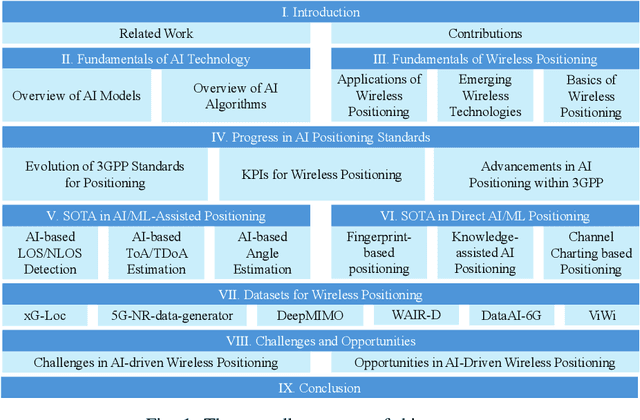

Wireless positioning technologies hold significant value for applications in autonomous driving, extended reality (XR), unmanned aerial vehicles (UAVs), and more. With the advancement of artificial intelligence (AI), leveraging AI to enhance positioning accuracy and robustness has emerged as a field full of potential. Driven by the requirements and functionalities defined in the 3rd Generation Partnership Project (3GPP) standards, AI/machine learning (ML)-based positioning is becoming a key technology to overcome the limitations of traditional methods. This paper begins with an introduction to the fundamentals of AI and wireless positioning, covering AI models, algorithms, positioning applications, emerging wireless technologies, and the basics of positioning techniques. Subsequently, focusing on standardization progress, we provide a comprehensive review of the evolution of 3GPP positioning standards, with an emphasis on the integration of AI/ML technologies in recent and upcoming releases. Based on the AI/ML-assisted positioning and direct AI/ML positioning schemes outlined in the standards, we conduct an in-depth investigation of related research. we focus on state-of-the-art (SOTA) research in AI-based line-of-sight (LOS)/non-line-of-sight (NLOS) detection, time of arrival (TOA)/time difference of arrival (TDOA) estimation, and angle estimation techniques. For Direct AI/ML Positioning, we explore SOTA advancements in fingerprint-based positioning, knowledge-assisted AI positioning, and channel charting-based positioning. Furthermore, we introduce publicly available datasets for wireless positioning and conclude by summarizing the challenges and opportunities of AI-driven wireless positioning.