 Add to Chrome
 Add to Firefox
 Add to Edge
FAIL: Flow Matching Adversarial Imitation Learning for Image Generation
Feb 12, 2026
Post-training of flow matching models-aligning the output distribution with a high-quality target-is mathematically equivalent to imitation learning. While Supervised Fine-Tuning mimics expert demonstrations effectively, it cannot correct policy drift in unseen states. Preference optimization methods address this but require costly preference pairs or reward modeling. We propose Flow Matching Adversarial Imitation Learning (FAIL), which minimizes policy-expert divergence through adversarial training without explicit rewards or pairwise comparisons. We derive two algorithms: FAIL-PD exploits differentiable ODE solvers for low-variance pathwise gradients, while FAIL-PG provides a black-box alternative for discrete or computationally constrained settings. Fine-tuning FLUX with only 13,000 demonstrations from Nano Banana pro, FAIL achieves competitive performance on prompt following and aesthetic benchmarks. Furthermore, the framework generalizes effectively to discrete image and video generation, and functions as a robust regularizer to mitigate reward hacking in reward-based optimization. Code and data are available at https://github.com/HansPolo113/FAIL.

X-Omni: Reinforcement Learning Makes Discrete Autoregressive Image Generative Models Great Again
Jul 29, 2025Numerous efforts have been made to extend the ``next token prediction'' paradigm to visual contents, aiming to create a unified approach for both image generation and understanding. Nevertheless, attempts to generate images through autoregressive modeling with discrete tokens have been plagued by issues such as low visual fidelity, distorted outputs, and failure to adhere to complex instructions when rendering intricate details. These shortcomings are likely attributed to cumulative errors during autoregressive inference or information loss incurred during the discretization process. Probably due to this challenge, recent research has increasingly shifted toward jointly training image generation with diffusion objectives and language generation with autoregressive objectives, moving away from unified modeling approaches. In this work, we demonstrate that reinforcement learning can effectively mitigate artifacts and largely enhance the generation quality of a discrete autoregressive modeling method, thereby enabling seamless integration of image and language generation. Our framework comprises a semantic image tokenizer, a unified autoregressive model for both language and images, and an offline diffusion decoder for image generation, termed X-Omni. X-Omni achieves state-of-the-art performance in image generation tasks using a 7B language model, producing images with high aesthetic quality while exhibiting strong capabilities in following instructions and rendering long texts.
PSALM: Pixelwise SegmentAtion with Large Multi-Modal Model
Mar 21, 2024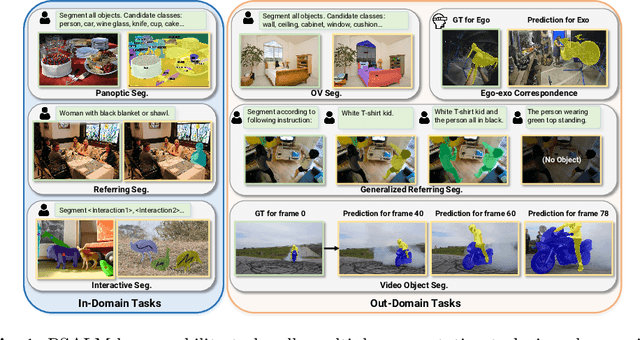
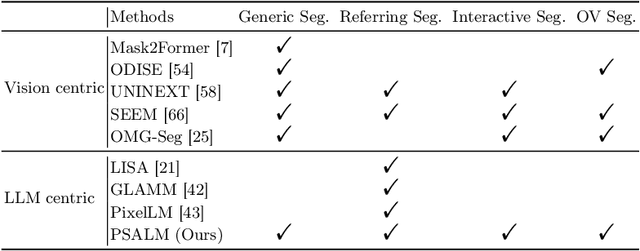
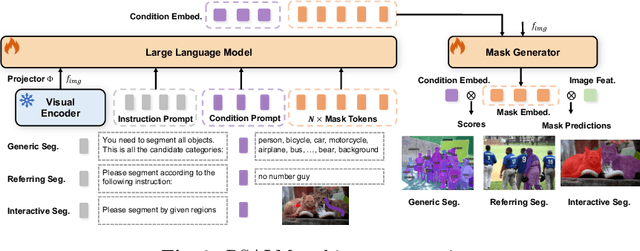
PSALM is a powerful extension of the Large Multi-modal Model (LMM) to address the segmentation task challenges. To overcome the limitation of the LMM being limited to textual output, PSALM incorporates a mask decoder and a well-designed input schema to handle a variety of segmentation tasks. This schema includes images, task instructions, conditional prompts, and mask tokens, which enable the model to generate and classify segmentation masks effectively. The flexible design of PSALM supports joint training across multiple datasets and tasks, leading to improved performance and task generalization. PSALM achieves superior results on several benchmarks, such as RefCOCO/RefCOCO+/RefCOCOg, COCO Panoptic Segmentation, and COCO-Interactive, and further exhibits zero-shot capabilities on unseen tasks, such as open-vocabulary segmentation, generalized referring expression segmentation and video object segmentation, making a significant step towards a GPT moment in computer vision. Through extensive experiments, PSALM demonstrates its potential to transform the domain of image segmentation, leveraging the robust visual understanding capabilities of LMMs as seen in natural language processing. Code and models are available at https://github.com/zamling/PSALM.