 Add to Chrome
 Add to Firefox
 Add to Edge
FedRD: Reducing Divergences for Generalized Federated Learning via Heterogeneity-aware Parameter Guidance
Jan 28, 2026
Heterogeneous federated learning (HFL) aims to ensure effective and privacy-preserving collaboration among different entities. As newly joined clients require significant adjustments and additional training to align with the existing system, the problem of generalizing federated learning models to unseen clients under heterogeneous data has become progressively crucial. Consequently, we highlight two unsolved challenging issues in federated domain generalization: Optimization Divergence and Performance Divergence. To tackle the above challenges, we propose FedRD, a novel heterogeneity-aware federated learning algorithm that collaboratively utilizes parameter-guided global generalization aggregation and local debiased classification to reduce divergences, aiming to obtain an optimal global model for participating and unseen clients. Extensive experiments on public multi-domain datasets demonstrate that our approach exhibits a substantial performance advantage over competing baselines in addressing this specific problem.

FedCCA: Client-Centric Adaptation against Data Heterogeneity in Federated Learning on IoT Devices
Jan 25, 2026With the rapid development of the Internet of Things (IoT), AI model training on private data such as human sensing data is highly desired. Federated learning (FL) has emerged as a privacy-preserving distributed training framework for this purpuse. However, the data heterogeneity issue among IoT devices can significantly degrade the model performance and convergence speed in FL. Existing approaches limit in fixed client selection and aggregation on cloud server, making the privacy-preserving extraction of client-specific information during local training challenging. To this end, we propose Client-Centric Adaptation federated learning (FedCCA), an algorithm that optimally utilizes client-specific knowledge to learn a unique model for each client through selective adaptation, aiming to alleviate the influence of data heterogeneity. Specifically, FedCCA employs dynamic client selection and adaptive aggregation based on the additional client-specific encoder. To enhance multi-source knowledge transfer, we adopt an attention-based global aggregation strategy. We conducted extensive experiments on diverse datasets to assess the efficacy of FedCCA. The experimental results demonstrate that our approach exhibits a substantial performance advantage over competing baselines in addressing this specific problem.
First realization of macroscopic Fourier ptychography for hundred-meter distance sub-diffraction imaging
Oct 23, 2023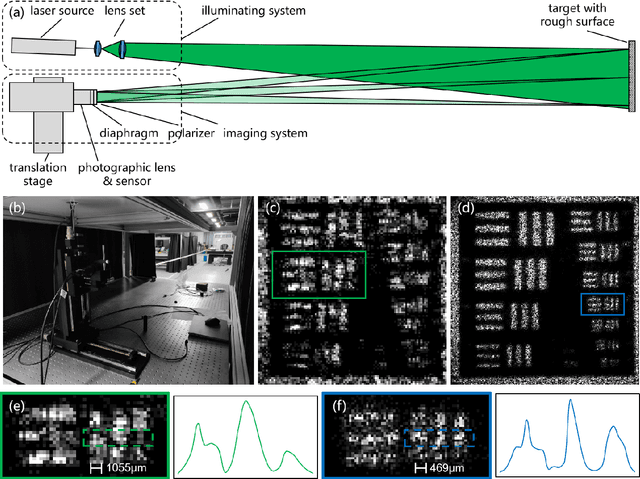
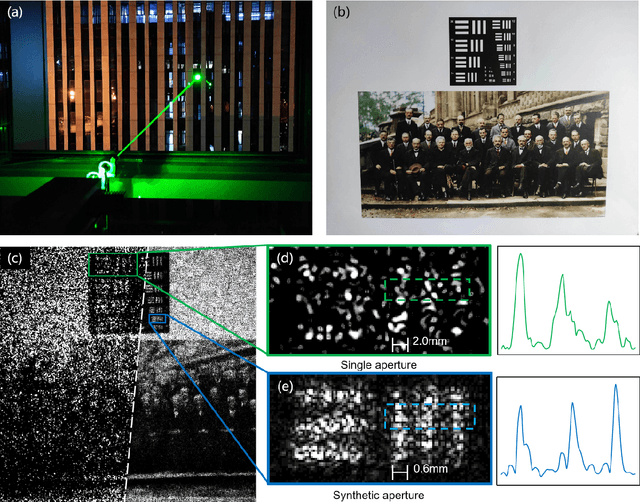
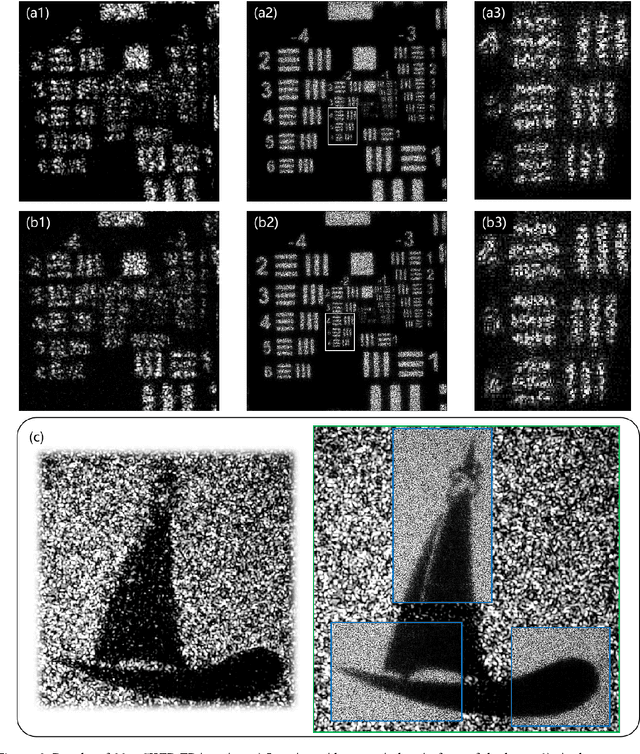
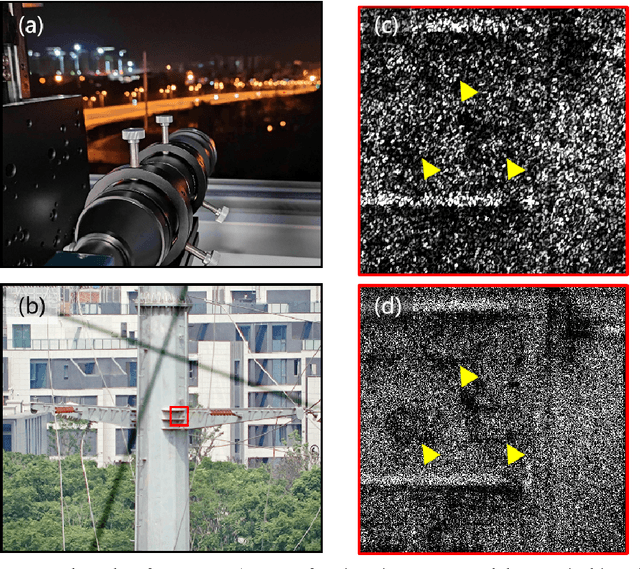
Fourier ptychography (FP) imaging, drawing on the idea of synthetic aperture, has been demonstrated as a potential approach for remote sub-diffraction-limited imaging. Nevertheless, the farthest imaging distance is still limited around 10 m even though there has been a significant improvement in macroscopic FP. The most severely issue in increasing the imaging distance is FoV limitation caused by far-field condition for diffraction. Here, we propose to modify the Fourier far-field condition for rough reflective objects, aiming to overcome the small FoV limitation by using a divergent beam to illuminate objects. A joint optimization of pupil function and target image is utilized to attain the aberration-free image while estimating the pupil function simultaneously. Benefiting from the optimized reconstruction algorithm which effectively expands the camera's effective aperture, we experimentally implement several FP systems suited for imaging distance of 12 m, 90 m, and 170 m with the maximum synthetic aperture of 200 mm. The maximum imaging distance and synthetic aperture are thus improved by more than one order of magnitude of the state-of-the-art works with a fourfold improvement in the resolution. Our findings demonstrate significant potential for advancing the field of macroscopic FP, propelling it into a new stage of development.