 Add to Chrome
 Add to Firefox
 Add to Edge
Improving the Safety and Trustworthiness of Medical AI via Multi-Agent Evaluation Loops
Jan 19, 2026
Large Language Models (LLMs) are increasingly applied in healthcare, yet ensuring their ethical integrity and safety compliance remains a major barrier to clinical deployment. This work introduces a multi-agent refinement framework designed to enhance the safety and reliability of medical LLMs through structured, iterative alignment. Our system combines two generative models - DeepSeek R1 and Med-PaLM - with two evaluation agents, LLaMA 3.1 and Phi-4, which assess responses using the American Medical Association's (AMA) Principles of Medical Ethics and a five-tier Safety Risk Assessment (SRA-5) protocol. We evaluate performance across 900 clinically diverse queries spanning nine ethical domains, measuring convergence efficiency, ethical violation reduction, and domain-specific risk behavior. Results demonstrate that DeepSeek R1 achieves faster convergence (mean 2.34 vs. 2.67 iterations), while Med-PaLM shows superior handling of privacy-sensitive scenarios. The iterative multi-agent loop achieved an 89% reduction in ethical violations and a 92% risk downgrade rate, underscoring the effectiveness of our approach. This study presents a scalable, regulator-aligned, and cost-efficient paradigm for governing medical AI safety.

AgEval: A Benchmark for Zero-Shot and Few-Shot Plant Stress Phenotyping with Multimodal LLMs
Jul 29, 2024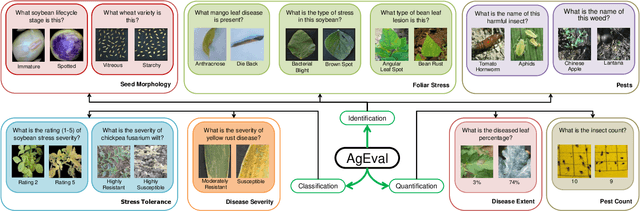
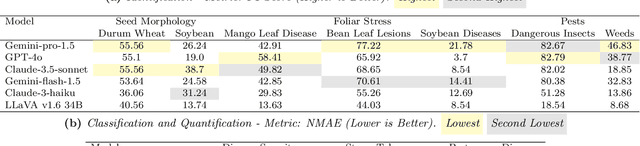
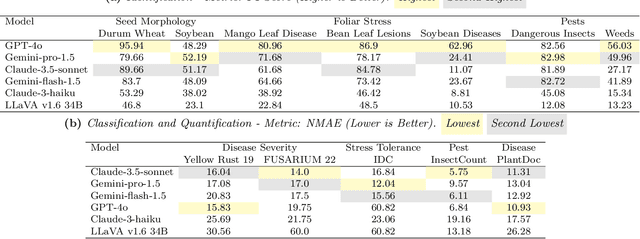
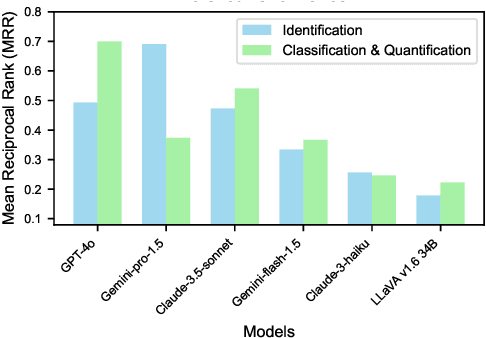
Plant stress phenotyping traditionally relies on expert assessments and specialized models, limiting scalability in agriculture. Recent advances in multimodal large language models (LLMs) offer potential solutions to this challenge. We present AgEval, a benchmark comprising 12 diverse plant stress phenotyping tasks, to evaluate these models' capabilities. Our study assesses zero-shot and few-shot in-context learning performance of state-of-the-art models, including Claude, GPT, Gemini, and LLaVA. Results show significant performance improvements with few-shot learning, with F1 scores increasing from 46.24% to 73.37% in 8-shot identification for the best-performing model. Few-shot examples from other classes in the dataset have negligible or negative impacts, although having the exact category example helps to increase performance by 15.38%. We also quantify the consistency of model performance across different classes within each task, finding that the coefficient of variance (CV) ranges from 26.02% to 58.03% across models, implying that subject matter expertise is needed - of 'difficult' classes - to achieve reliability in performance. AgEval establishes baseline metrics for multimodal LLMs in agricultural applications, offering insights into their promise for enhancing plant stress phenotyping at scale. Benchmark and code can be accessed at: https://anonymous.4open.science/r/AgEval/