 Add to Chrome
 Add to Firefox
 Add to Edge
Predicting Neuromodulation Outcome for Parkinson's Disease with Generative Virtual Brain Model
Mar 31, 2026
Parkinson's disease (PD) affects over ten million people worldwide. Although temporal interference (TI) and deep brain stimulation (DBS) are promising therapies, inter-individual variability limits empirical treatment selection, increasing non-negligible surgical risk and cost. Previous explorations either resort to limited statistical biomarkers that are insufficient to characterize variability, or employ AI-driven methods which is prone to overfitting and opacity. We bridge this gap with a pretraining-finetuning framework to predict outcomes directly from resting-state fMRI. Critically, a generative virtual brain foundation model, pretrained on a collective dataset (2707 subjects, 5621 sessions) to capture universal disorder patterns, was finetuned on PD cohorts receiving TI (n=51) or DBS (n=55) to yield individualized virtual brains with high fidelity to empirical functional connectivity (r=0.935). By constructing counterfactual estimations between pathological and healthy neural states within these personalized models, we predicted clinical responses (TI: AUPR=0.853; DBS: AUPR=0.915), substantially outperforming baselines. External and prospective validations (n=14, n=11) highlight the feasibility of clinical translation. Moreover, our framework provides state-dependent regional patterns linked to response, offering hypothesis-generating mechanistic insights.

Towards General Text-guided Image Synthesis for Customized Multimodal Brain MRI Generation
Sep 25, 2024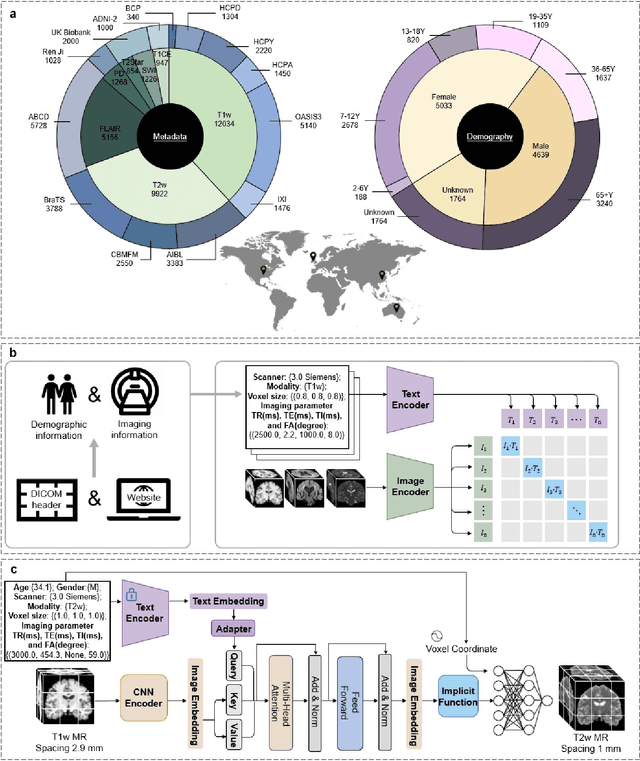
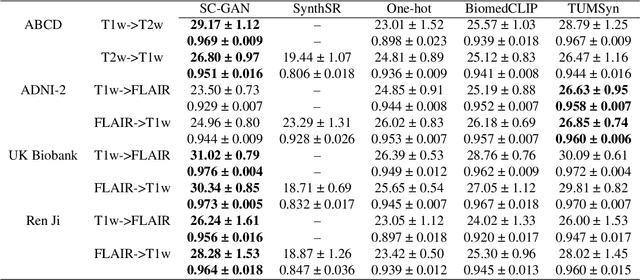
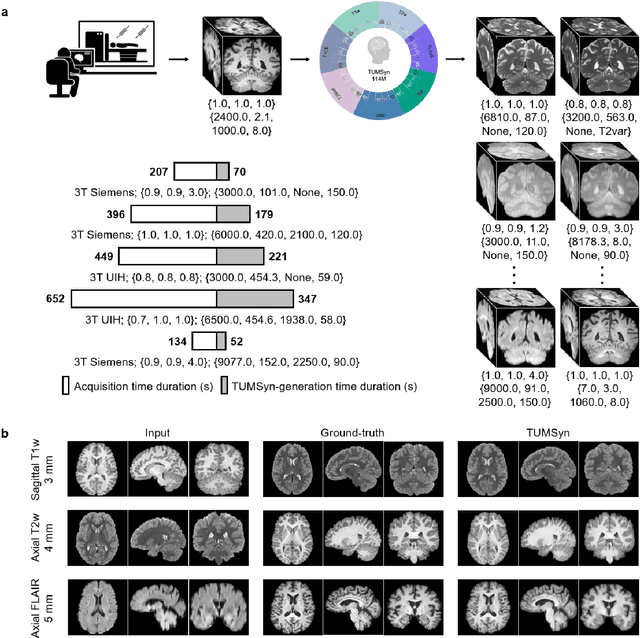
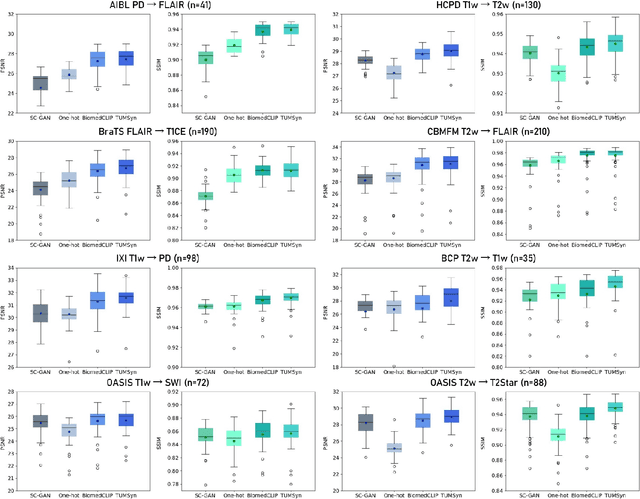
Multimodal brain magnetic resonance (MR) imaging is indispensable in neuroscience and neurology. However, due to the accessibility of MRI scanners and their lengthy acquisition time, multimodal MR images are not commonly available. Current MR image synthesis approaches are typically trained on independent datasets for specific tasks, leading to suboptimal performance when applied to novel datasets and tasks. Here, we present TUMSyn, a Text-guided Universal MR image Synthesis generalist model, which can flexibly generate brain MR images with demanded imaging metadata from routinely acquired scans guided by text prompts. To ensure TUMSyn's image synthesis precision, versatility, and generalizability, we first construct a brain MR database comprising 31,407 3D images with 7 MRI modalities from 13 centers. We then pre-train an MRI-specific text encoder using contrastive learning to effectively control MR image synthesis based on text prompts. Extensive experiments on diverse datasets and physician assessments indicate that TUMSyn can generate clinically meaningful MR images with specified imaging metadata in supervised and zero-shot scenarios. Therefore, TUMSyn can be utilized along with acquired MR scan(s) to facilitate large-scale MRI-based screening and diagnosis of brain diseases.