 Add to Chrome
 Add to Firefox
 Add to Edge
PreGME: Prescribed Performance Control of Aerial Manipulators based on Variable-Gain ESO
Dec 28, 2025
An aerial manipulator, comprising a multirotor base and a robotic arm, is subject to significant dynamic coupling between these two components. Therefore, achieving precise and robust motion control is a challenging yet important objective. Here, we propose a novel prescribed performance motion control framework based on variable-gain extended state observers (ESOs), referred to as PreGME. The method includes variable-gain ESOs for real-time estimation of dynamic coupling and a prescribed performance flight control that incorporates error trajectory constraints. Compared with existing methods, the proposed approach exhibits the following two characteristics. First, the adopted variable-gain ESOs can accurately estimate rapidly varying dynamic coupling. This enables the proposed method to handle manipulation tasks that require aggressive motion of the robotic arm. Second, by prescribing the performance, a preset error trajectory is generated to guide the system evolution along this trajectory. This strategy allows the proposed method to ensure the tracking error remains within the prescribed performance envelope, thereby achieving high-precision control. Experiments on a real platform, including aerial staff twirling, aerial mixology, and aerial cart-pulling experiments, are conducted to validate the effectiveness of the proposed method. Experimental results demonstrate that even under the dynamic coupling caused by rapid robotic arm motion (end-effector velocity: 1.02 m/s, acceleration: 5.10 m/s$^2$), the proposed method achieves high tracking performance.

EvDetMAV: Generalized MAV Detection from Moving Event Cameras
Jun 24, 2025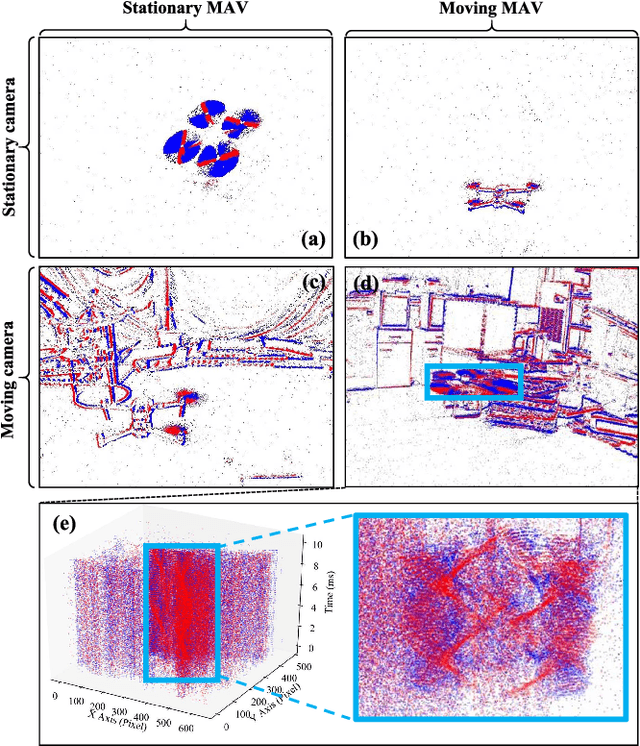

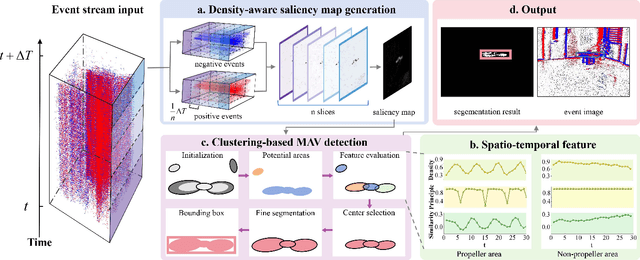
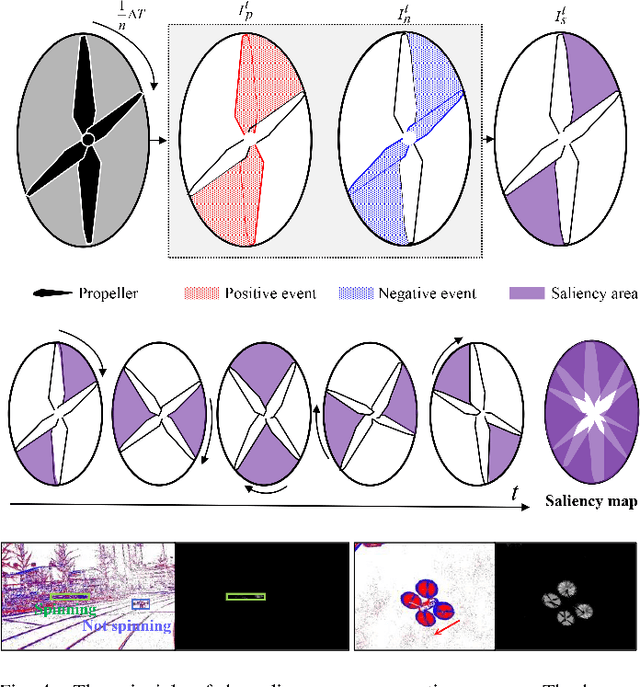
Existing micro aerial vehicle (MAV) detection methods mainly rely on the target's appearance features in RGB images, whose diversity makes it difficult to achieve generalized MAV detection. We notice that different types of MAVs share the same distinctive features in event streams due to their high-speed rotating propellers, which are hard to see in RGB images. This paper studies how to detect different types of MAVs from an event camera by fully exploiting the features of propellers in the original event stream. The proposed method consists of three modules to extract the salient and spatio-temporal features of the propellers while filtering out noise from background objects and camera motion. Since there are no existing event-based MAV datasets, we introduce a novel MAV dataset for the community. This is the first event-based MAV dataset comprising multiple scenarios and different types of MAVs. Without training, our method significantly outperforms state-of-the-art methods and can deal with challenging scenarios, achieving a precision rate of 83.0\% (+30.3\%) and a recall rate of 81.5\% (+36.4\%) on the proposed testing dataset. The dataset and code are available at: https://github.com/WindyLab/EvDetMAV.
Cooperative Bearing-Only Target Pursuit via Multiagent Reinforcement Learning: Design and Experiment
Mar 11, 2025This paper addresses the multi-robot pursuit problem for an unknown target, encompassing both target state estimation and pursuit control. First, in state estimation, we focus on using only bearing information, as it is readily available from vision sensors and effective for small, distant targets. Challenges such as instability due to the nonlinearity of bearing measurements and singularities in the two-angle representation are addressed through a proposed uniform bearing-only information filter. This filter integrates multiple 3D bearing measurements, provides a concise formulation, and enhances stability and resilience to target loss caused by limited field of view (FoV). Second, in target pursuit control within complex environments, where challenges such as heterogeneity and limited FoV arise, conventional methods like differential games or Voronoi partitioning often prove inadequate. To address these limitations, we propose a novel multiagent reinforcement learning (MARL) framework, enabling multiple heterogeneous vehicles to search, localize, and follow a target while effectively handling those challenges. Third, to bridge the sim-to-real gap, we propose two key techniques: incorporating adjustable low-level control gains in training to replicate the dynamics of real-world autonomous ground vehicles (AGVs), and proposing spectral-normalized RL algorithms to enhance policy smoothness and robustness. Finally, we demonstrate the successful zero-shot transfer of the MARL controllers to AGVs, validating the effectiveness and practical feasibility of our approach. The accompanying video is available at https://youtu.be/HO7FJyZiJ3E.
TACO: General Acrobatic Flight Control via Target-and-Command-Oriented Reinforcement Learning
Mar 06, 2025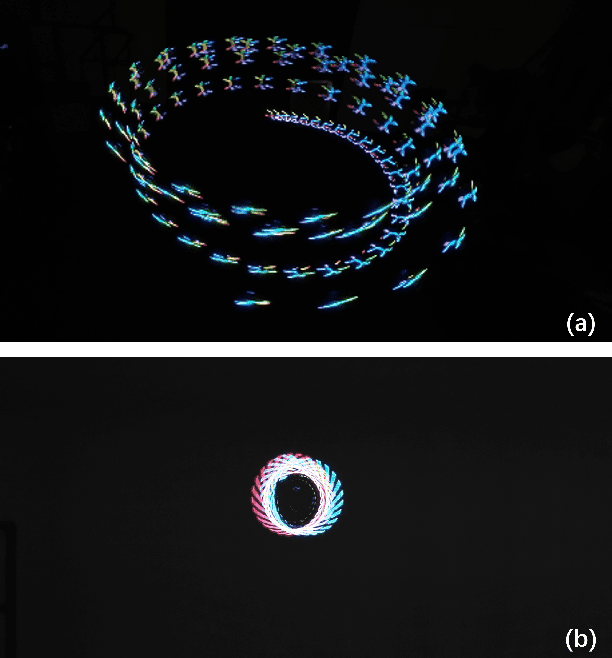
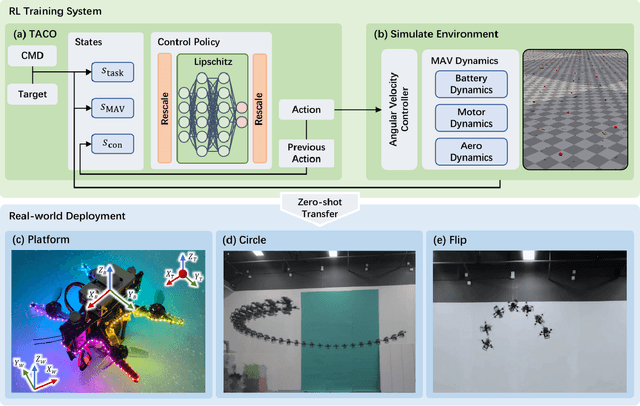
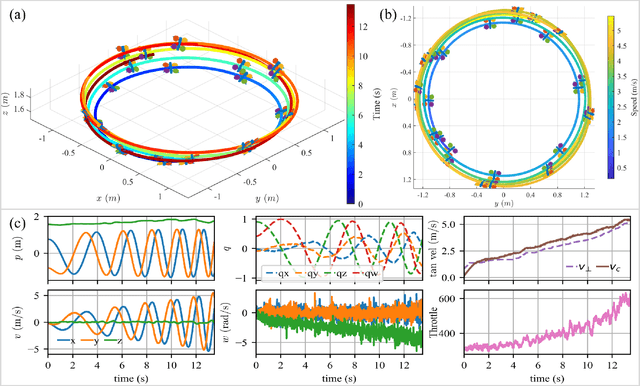
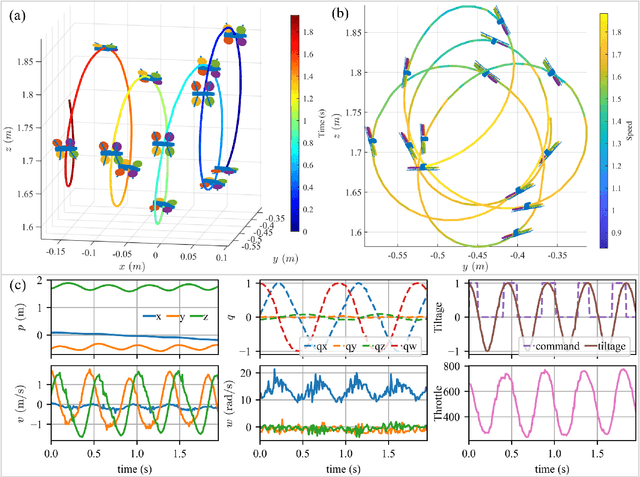
Although acrobatic flight control has been studied extensively, one key limitation of the existing methods is that they are usually restricted to specific maneuver tasks and cannot change flight pattern parameters online. In this work, we propose a target-and-command-oriented reinforcement learning (TACO) framework, which can handle different maneuver tasks in a unified way and allows online parameter changes. Additionally, we propose a spectral normalization method with input-output rescaling to enhance the policy's temporal and spatial smoothness, independence, and symmetry, thereby overcoming the sim-to-real gap. We validate the TACO approach through extensive simulation and real-world experiments, demonstrating its capability to achieve high-speed circular flights and continuous multi-flips.