 Add to Chrome
 Add to Firefox
 Add to Edge
WebArbiter: A Principle-Guided Reasoning Process Reward Model for Web Agents
Jan 29, 2026
Web agents hold great potential for automating complex computer tasks, yet their interactions involve long-horizon, sequential decision-making with irreversible actions. In such settings, outcome-based supervision is sparse and delayed, often rewarding incorrect trajectories and failing to support inference-time scaling. This motivates the use of Process Reward Models (WebPRMs) for web navigation, but existing approaches remain limited: scalar WebPRMs collapse progress into coarse, weakly grounded signals, while checklist-based WebPRMs rely on brittle template matching that fails under layout or semantic changes and often mislabels superficially correct actions as successful, providing little insight or interpretability. To address these challenges, we introduce WebArbiter, a reasoning-first, principle-inducing WebPRM that formulates reward modeling as text generation, producing structured justifications that conclude with a preference verdict and identify the action most conducive to task completion under the current context. Training follows a two-stage pipeline: reasoning distillation equips the model with coherent principle-guided reasoning, and reinforcement learning corrects teacher biases by directly aligning verdicts with correctness, enabling stronger generalization. To support systematic evaluation, we release WebPRMBench, a comprehensive benchmark spanning four diverse web environments with rich tasks and high-quality preference annotations. On WebPRMBench, WebArbiter-7B outperforms the strongest baseline, GPT-5, by 9.1 points. In reward-guided trajectory search on WebArena-Lite, it surpasses the best prior WebPRM by up to 7.2 points, underscoring its robustness and practical value in real-world complex web tasks.

SwarmAgentic: Towards Fully Automated Agentic System Generation via Swarm Intelligence
Jun 18, 2025The rapid progress of Large Language Models has advanced agentic systems in decision-making, coordination, and task execution. Yet, existing agentic system generation frameworks lack full autonomy, missing from-scratch agent generation, self-optimizing agent functionality, and collaboration, limiting adaptability and scalability. We propose SwarmAgentic, a framework for fully automated agentic system generation that constructs agentic systems from scratch and jointly optimizes agent functionality and collaboration as interdependent components through language-driven exploration. To enable efficient search over system-level structures, SwarmAgentic maintains a population of candidate systems and evolves them via feedback-guided updates, drawing inspiration from Particle Swarm Optimization (PSO). We evaluate our method on six real-world, open-ended, and exploratory tasks involving high-level planning, system-level coordination, and creative reasoning. Given only a task description and an objective function, SwarmAgentic outperforms all baselines, achieving a +261.8% relative improvement over ADAS on the TravelPlanner benchmark, highlighting the effectiveness of full automation in structurally unconstrained tasks. This framework marks a significant step toward scalable and autonomous agentic system design, bridging swarm intelligence with fully automated system multi-agent generation. Our code is publicly released at https://yaoz720.github.io/SwarmAgentic/.
MaskFi: Unsupervised Learning of WiFi and Vision Representations for Multimodal Human Activity Recognition
Feb 29, 2024
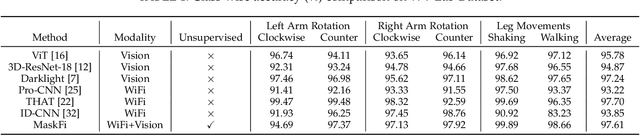
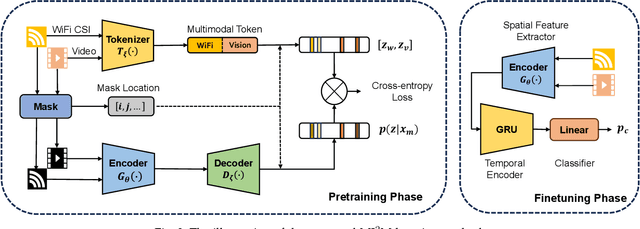
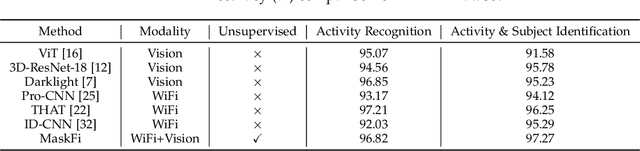
Human activity recognition (HAR) has been playing an increasingly important role in various domains such as healthcare, security monitoring, and metaverse gaming. Though numerous HAR methods based on computer vision have been developed to show prominent performance, they still suffer from poor robustness in adverse visual conditions in particular low illumination, which motivates WiFi-based HAR to serve as a good complementary modality. Existing solutions using WiFi and vision modalities rely on massive labeled data that are very cumbersome to collect. In this paper, we propose a novel unsupervised multimodal HAR solution, MaskFi, that leverages only unlabeled video and WiFi activity data for model training. We propose a new algorithm, masked WiFi-vision modeling (MI2M), that enables the model to learn cross-modal and single-modal features by predicting the masked sections in representation learning. Benefiting from our unsupervised learning procedure, the network requires only a small amount of annotated data for finetuning and can adapt to the new environment with better performance. We conduct extensive experiments on two WiFi-vision datasets collected in-house, and our method achieves human activity recognition and human identification in terms of both robustness and accuracy.