 Add to Chrome
 Add to Firefox
 Add to Edge
LingLanMiDian: Systematic Evaluation of LLMs on TCM Knowledge and Clinical Reasoning
Feb 02, 2026
Large language models (LLMs) are advancing rapidly in medical NLP, yet Traditional Chinese Medicine (TCM) with its distinctive ontology, terminology, and reasoning patterns requires domain-faithful evaluation. Existing TCM benchmarks are fragmented in coverage and scale and rely on non-unified or generation-heavy scoring that hinders fair comparison. We present the LingLanMiDian (LingLan) benchmark, a large-scale, expert-curated, multi-task suite that unifies evaluation across knowledge recall, multi-hop reasoning, information extraction, and real-world clinical decision-making. LingLan introduces a consistent metric design, a synonym-tolerant protocol for clinical labels, a per-dataset 400-item Hard subset, and a reframing of diagnosis and treatment recommendation into single-choice decision recognition. We conduct comprehensive, zero-shot evaluations on 14 leading open-source and proprietary LLMs, providing a unified perspective on their strengths and limitations in TCM commonsense knowledge understanding, reasoning, and clinical decision support; critically, the evaluation on Hard subset reveals a substantial gap between current models and human experts in TCM-specialized reasoning. By bridging fundamental knowledge and applied reasoning through standardized evaluation, LingLan establishes a unified, quantitative, and extensible foundation for advancing TCM LLMs and domain-specific medical AI research. All evaluation data and code are available at https://github.com/TCMAI-BJTU/LingLan and http://tcmnlp.com.

TCM-FTP: Fine-Tuning Large Language Models for Herbal Prescription Prediction
Jul 15, 2024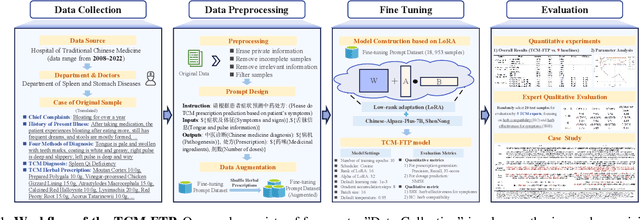
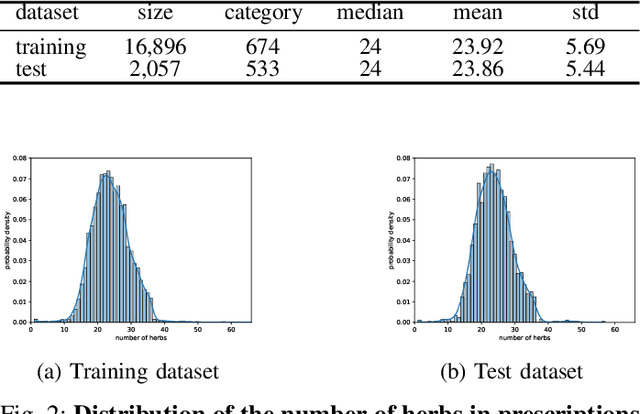

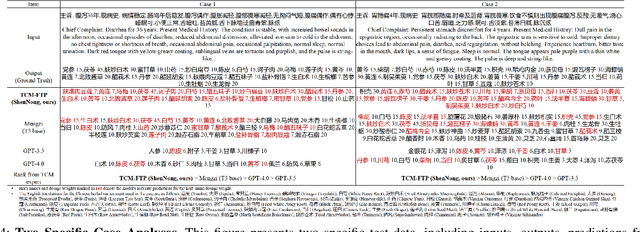
Traditional Chinese medicine (TCM) relies on specific combinations of herbs in prescriptions to treat symptoms and signs, a practice that spans thousands of years. Predicting TCM prescriptions presents a fascinating technical challenge with practical implications. However, this task faces limitations due to the scarcity of high-quality clinical datasets and the intricate relationship between symptoms and herbs. To address these issues, we introduce DigestDS, a new dataset containing practical medical records from experienced experts in digestive system diseases. We also propose a method, TCM-FTP (TCM Fine-Tuning Pre-trained), to leverage pre-trained large language models (LLMs) through supervised fine-tuning on DigestDS. Additionally, we enhance computational efficiency using a low-rank adaptation technique. TCM-FTP also incorporates data augmentation by permuting herbs within prescriptions, capitalizing on their order-agnostic properties. Impressively, TCM-FTP achieves an F1-score of 0.8031, surpassing previous methods significantly. Furthermore, it demonstrates remarkable accuracy in dosage prediction, achieving a normalized mean square error of 0.0604. In contrast, LLMs without fine-tuning perform poorly. Although LLMs have shown capabilities on a wide range of tasks, this work illustrates the importance of fine-tuning for TCM prescription prediction, and we have proposed an effective way to do that.