 Add to Chrome
 Add to Firefox
 Add to Edge
PEARL: Prototype-Enhanced Alignment for Label-Efficient Representation Learning with Deployment-Driven Insights from Digital Governance Communication Systems
Jan 24, 2026
In many deployed systems, new text inputs are handled by retrieving similar past cases, for example when routing and responding to citizen messages in digital governance platforms. When these systems fail, the problem is often not the language model itself, but that the nearest neighbors in the embedding space correspond to the wrong cases. Modern machine learning systems increasingly rely on fixed, high-dimensional embeddings produced by large pretrained models and sentence encoders. In real-world deployments, labels are scarce, domains shift over time, and retraining the base encoder is expensive or infeasible. As a result, downstream performance depends heavily on embedding geometry. Yet raw embeddings are often poorly aligned with the local neighborhood structure required by nearest-neighbor retrieval, similarity search, and lightweight classifiers that operate directly on embeddings. We propose PEARL (Prototype-Enhanced Aligned Representation Learning), a label-efficient approach that uses limited supervision to softly align embeddings toward class prototypes. The method reshapes local neighborhood geometry while preserving dimensionality and avoiding aggressive projection or collapse. Its aim is to bridge the gap between purely unsupervised post-processing, which offers limited and inconsistent gains, and fully supervised projections that require substantial labeled data. We evaluate PEARL under controlled label regimes ranging from extreme label scarcity to higher-label settings. In the label-scarce condition, PEARL substantially improves local neighborhood quality, yielding 25.7% gains over raw embeddings and more than 21.1% gains relative to strong unsupervised post-processing, precisely in the regime where similarity-based systems are most brittle.

Structural Equation-VAE: Disentangled Latent Representations for Tabular Data
Aug 08, 2025Learning interpretable latent representations from tabular data remains a challenge in deep generative modeling. We introduce SE-VAE (Structural Equation-Variational Autoencoder), a novel architecture that embeds measurement structure directly into the design of a variational autoencoder. Inspired by structural equation modeling, SE-VAE aligns latent subspaces with known indicator groupings and introduces a global nuisance latent to isolate construct-specific confounding variation. This modular architecture enables disentanglement through design rather than through statistical regularizers alone. We evaluate SE-VAE on a suite of simulated tabular datasets and benchmark its performance against a series of leading baselines using standard disentanglement metrics. SE-VAE consistently outperforms alternatives in factor recovery, interpretability, and robustness to nuisance variation. Ablation results reveal that architectural structure, rather than regularization strength, is the key driver of performance. SE-VAE offers a principled framework for white-box generative modeling in scientific and social domains where latent constructs are theory-driven and measurement validity is essential.
Soundwave: Less is More for Speech-Text Alignment in LLMs
Feb 18, 2025Existing end-to-end speech large language models (LLMs) usually rely on large-scale annotated data for training, while data-efficient training has not been discussed in depth. We focus on two fundamental problems between speech and text: the representation space gap and sequence length inconsistency. We propose Soundwave, which utilizes an efficient training strategy and a novel architecture to address these issues. Results show that Soundwave outperforms the advanced Qwen2-Audio in speech translation and AIR-Bench speech tasks, using only one-fiftieth of the training data. Further analysis shows that Soundwave still retains its intelligence during conversation. The project is available at https://github.com/FreedomIntelligence/Soundwave.
Achieving Semantic Consistency Using BERT: Application of Pre-training Semantic Representations Model in Social Sciences Research
Dec 03, 2024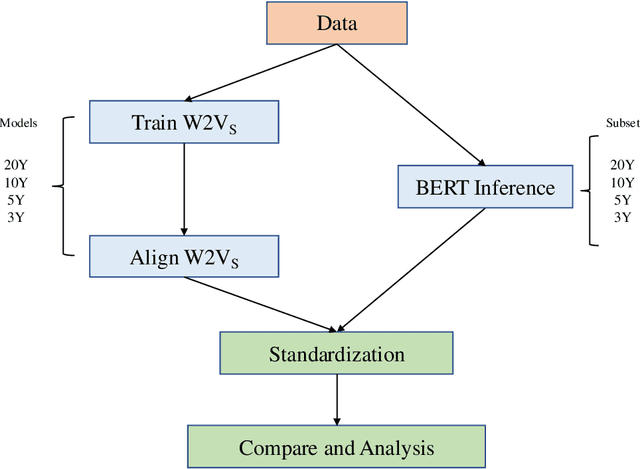
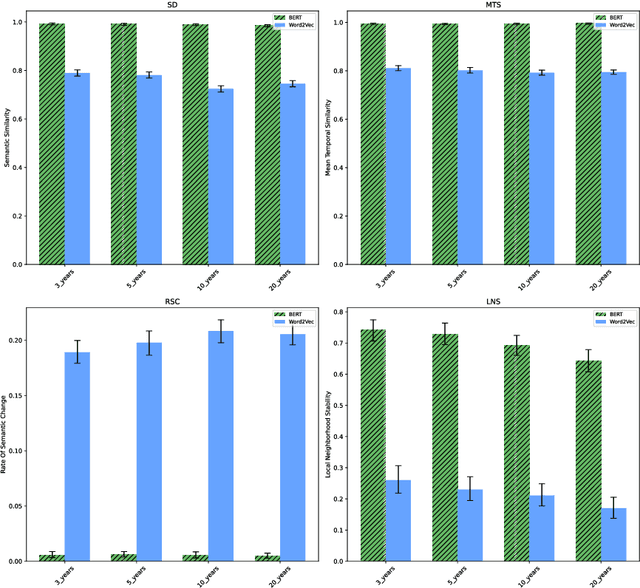
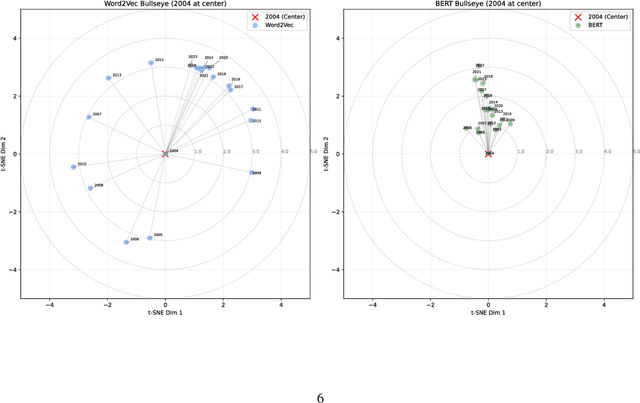
Achieving consistent word interpretations across different time spans is crucial in social sciences research and text analysis tasks, as stable semantic representations form the foundation for research and task correctness, enhancing understanding of socio-political and cultural analysis. Traditional models like Word2Vec have provided significant insights into long-term semantic changes but often struggle to capture stable meanings in short-term contexts, which may be attributed to fluctuations in embeddings caused by unbalanced training data. Recent advancements, particularly BERT (Bidirectional Encoder Representations from Transformers), its pre-trained nature and transformer encoder architecture offer contextual embeddings that improve semantic consistency, making it a promising tool for short-term analysis. This study empirically compares the performance of Word2Vec and BERT in maintaining stable word meanings over time in text analysis tasks relevant to social sciences research. Using articles from the People's Daily spanning 20 years (2004-2023), we evaluated the semantic stability of each model across different timeframes. The results indicate that BERT consistently outperforms Word2Vec in maintaining semantic stability, offering greater stability in contextual embeddings. However, the study also acknowledges BERT's limitations in capturing gradual semantic shifts over longer periods due to its inherent stability. The findings suggest that while BERT is advantageous for short-term semantic analysis in social sciences, researchers should consider complementary approaches for long-term studies to fully capture semantic drift. This research underscores the importance of selecting appropriate word embedding models based on the specific temporal context of social science analyses.