 Add to Chrome
 Add to Firefox
 Add to Edge
Dichotomous Diffusion Policy Optimization
Dec 31, 2025
Diffusion-based policies have gained growing popularity in solving a wide range of decision-making tasks due to their superior expressiveness and controllable generation during inference. However, effectively training large diffusion policies using reinforcement learning (RL) remains challenging. Existing methods either suffer from unstable training due to directly maximizing value objectives, or face computational issues due to relying on crude Gaussian likelihood approximation, which requires a large amount of sufficiently small denoising steps. In this work, we propose DIPOLE (Dichotomous diffusion Policy improvement), a novel RL algorithm designed for stable and controllable diffusion policy optimization. We begin by revisiting the KL-regularized objective in RL, which offers a desirable weighted regression objective for diffusion policy extraction, but often struggles to balance greediness and stability. We then formulate a greedified policy regularization scheme, which naturally enables decomposing the optimal policy into a pair of stably learned dichotomous policies: one aims at reward maximization, and the other focuses on reward minimization. Under such a design, optimized actions can be generated by linearly combining the scores of dichotomous policies during inference, thereby enabling flexible control over the level of greediness.Evaluations in offline and offline-to-online RL settings on ExORL and OGBench demonstrate the effectiveness of our approach. We also use DIPOLE to train a large vision-language-action (VLA) model for end-to-end autonomous driving (AD) and evaluate it on the large-scale real-world AD benchmark NAVSIM, highlighting its potential for complex real-world applications.

Infinite Mobility: Scalable High-Fidelity Synthesis of Articulated Objects via Procedural Generation
Mar 17, 2025Large-scale articulated objects with high quality are desperately needed for multiple tasks related to embodied AI. Most existing methods for creating articulated objects are either data-driven or simulation based, which are limited by the scale and quality of the training data or the fidelity and heavy labour of the simulation. In this paper, we propose Infinite Mobility, a novel method for synthesizing high-fidelity articulated objects through procedural generation. User study and quantitative evaluation demonstrate that our method can produce results that excel current state-of-the-art methods and are comparable to human-annotated datasets in both physics property and mesh quality. Furthermore, we show that our synthetic data can be used as training data for generative models, enabling next-step scaling up. Code is available at https://github.com/Intern-Nexus/Infinite-Mobility
Diffusion-Based Planning for Autonomous Driving with Flexible Guidance
Jan 26, 2025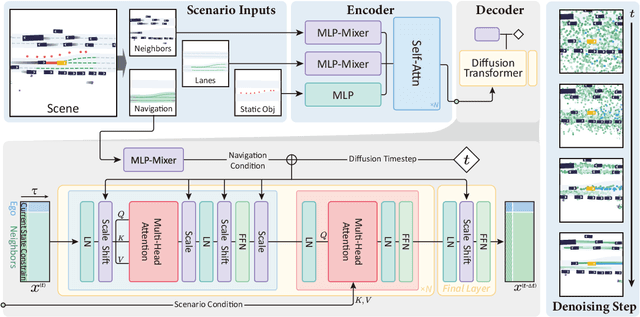
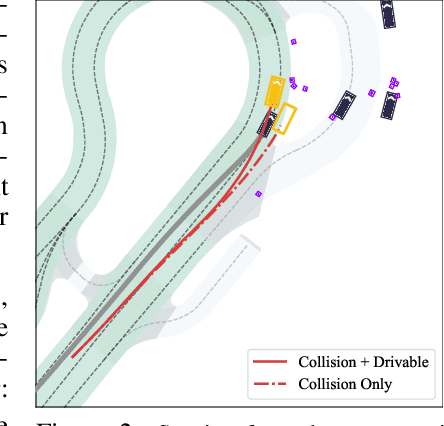
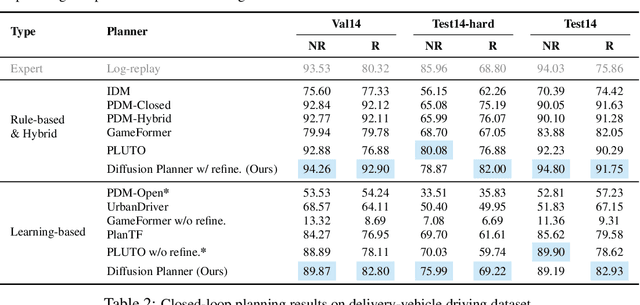
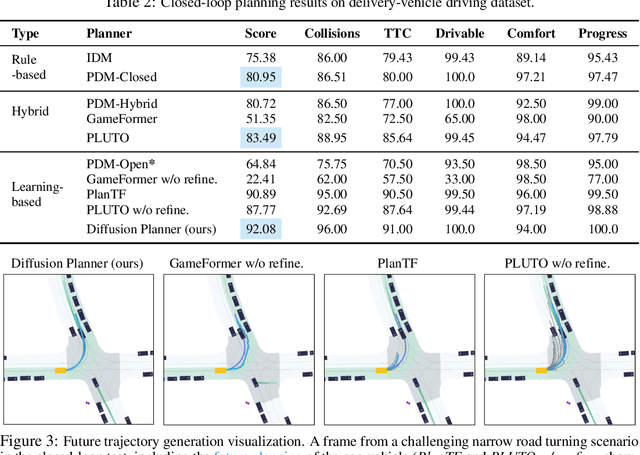
Achieving human-like driving behaviors in complex open-world environments is a critical challenge in autonomous driving. Contemporary learning-based planning approaches such as imitation learning methods often struggle to balance competing objectives and lack of safety assurance,due to limited adaptability and inadequacy in learning complex multi-modal behaviors commonly exhibited in human planning, not to mention their strong reliance on the fallback strategy with predefined rules. We propose a novel transformer-based Diffusion Planner for closed-loop planning, which can effectively model multi-modal driving behavior and ensure trajectory quality without any rule-based refinement. Our model supports joint modeling of both prediction and planning tasks under the same architecture, enabling cooperative behaviors between vehicles. Moreover, by learning the gradient of the trajectory score function and employing a flexible classifier guidance mechanism, Diffusion Planner effectively achieves safe and adaptable planning behaviors. Evaluations on the large-scale real-world autonomous planning benchmark nuPlan and our newly collected 200-hour delivery-vehicle driving dataset demonstrate that Diffusion Planner achieves state-of-the-art closed-loop performance with robust transferability in diverse driving styles.