 Add to Chrome
 Add to Firefox
 Add to Edge
The Llama 4 Herd: Architecture, Training, Evaluation, and Deployment Notes
Jan 15, 2026
This document consolidates publicly reported technical details about Metas Llama 4 model family. It summarizes (i) released variants (Scout and Maverick) and the broader herd context including the previewed Behemoth teacher model, (ii) architectural characteristics beyond a high-level MoE description covering routed/shared-expert structure, early-fusion multimodality, and long-context design elements reported for Scout (iRoPE and length generalization strategies), (iii) training disclosures spanning pre-training, mid-training for long-context extension, and post-training methodology (lightweight SFT, online RL, and lightweight DPO) as described in release materials, (iv) developer-reported benchmark results for both base and instruction-tuned checkpoints, and (v) practical deployment constraints observed across major serving environments, including provider-specific context limits and quantization packaging. The manuscript also summarizes licensing obligations relevant to redistribution and derivative naming, and reviews publicly described safeguards and evaluation practices. The goal is to provide a compact technical reference for researchers and practitioners who need precise, source-backed facts about Llama 4.

ELLA: Efficient Lifelong Learning for Adapters in Large Language Models
Jan 07, 2026Large Language Models (LLMs) suffer severe catastrophic forgetting when adapted sequentially to new tasks in a continual learning (CL) setting. Existing approaches are fundamentally limited: replay-based methods are impractical and privacy-violating, while strict orthogonality-based methods collapse under scale: each new task is projected onto an orthogonal complement, progressively reducing the residual degrees of freedom and eliminating forward transfer by forbidding overlap in shared representations. In this work, we introduce ELLA, a training framework built on the principle of selective subspace de-correlation. Rather than forbidding all overlap, ELLA explicitly characterizes the structure of past updates and penalizes alignments along their high-energy, task-specific directions, while preserving freedom in the low-energy residual subspaces to enable transfer. Formally, this is realized via a lightweight regularizer on a single aggregated update matrix. We prove this mechanism corresponds to an anisotropic shrinkage operator that bounds interference, yielding a penalty that is both memory- and compute-constant regardless of task sequence length. ELLA requires no data replay, no architectural expansion, and negligible storage. Empirically, it achieves state-of-the-art CL performance on three popular benchmarks, with relative accuracy gains of up to $9.6\%$ and a $35\times$ smaller memory footprint. Further, ELLA scales robustly across architectures and actively enhances the model's zero-shot generalization performance on unseen tasks, establishing a principled and scalable solution for constructive lifelong LLM adaptation.
The Empirical Impact of Data Sanitization on Language Models
Nov 08, 2024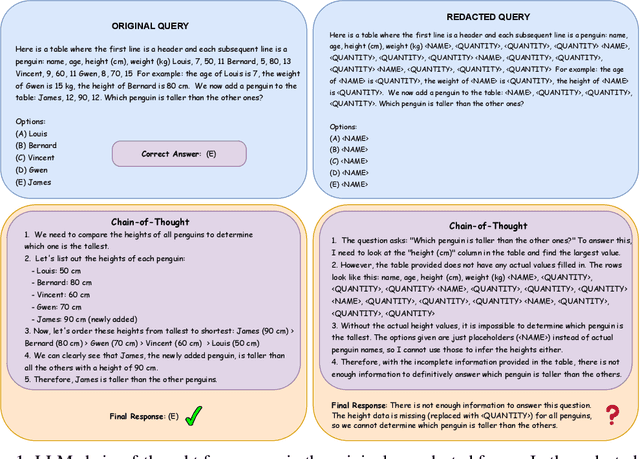
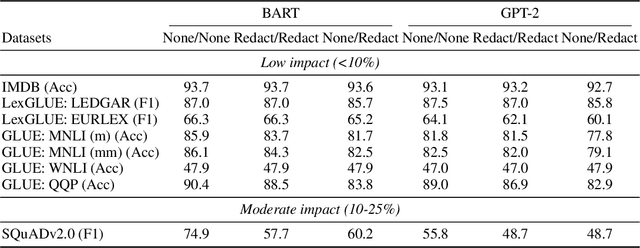
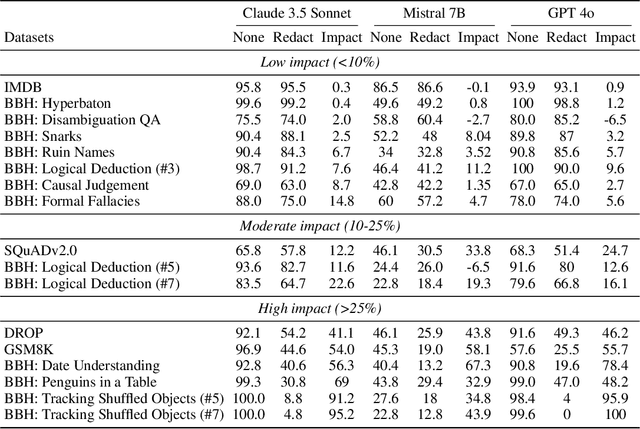
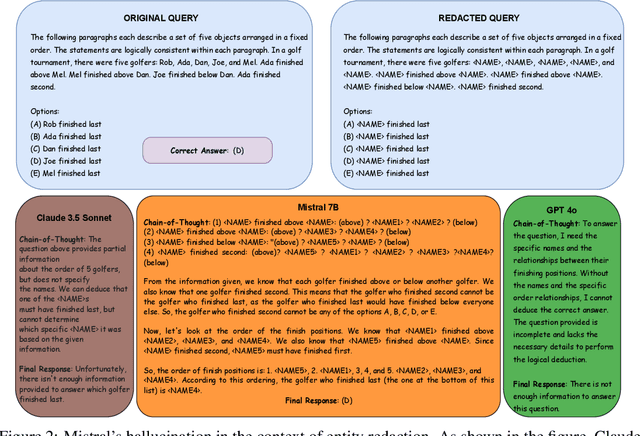
Data sanitization in the context of language modeling involves identifying sensitive content, such as personally identifiable information (PII), and redacting them from a dataset corpus. It is a common practice used in natural language processing (NLP) to maintain privacy. Nevertheless, the impact of data sanitization on the language understanding capability of a language model remains less studied. This paper empirically analyzes the effects of data sanitization across several benchmark language-modeling tasks including comprehension question answering (Q&A), entailment, sentiment analysis, and text classification. Our experiments cover a wide spectrum comprising finetuning small-scale language models, to prompting large language models (LLMs), on both original and sanitized datasets, and comparing their performance across the tasks. Interestingly, our results suggest that for some tasks such as sentiment analysis or entailment, the impact of redaction is quite low, typically around 1-5%, while for tasks such as comprehension Q&A there is a big drop of >25% in performance observed in redacted queries as compared to the original. For tasks that have a higher impact, we perform a deeper dive to inspect the presence of task-critical entities. Finally, we investigate correlation between performance and number of redacted entities, and also suggest a strategy to repair an already redacted dataset by means of content-based subsampling. Additional details are available at https://sites.google.com/view/datasan.