 Add to Chrome
 Add to Firefox
 Add to Edge
CooperBench: Why Coding Agents Cannot be Your Teammates Yet
Jan 19, 2026
Resolving team conflicts requires not only task-specific competence, but also social intelligence to find common ground and build consensus. As AI agents increasingly collaborate on complex work, they must develop coordination capabilities to function as effective teammates. Yet we hypothesize that current agents lack these capabilities. To test this, we introduce CooperBench, a benchmark of over 600 collaborative coding tasks across 12 libraries in 4 programming languages. Each task assigns two agents different features that can be implemented independently but may conflict without proper coordination. Tasks are grounded in real open-source repositories with expert-written tests. Evaluating state-of-the-art coding agents, we observe the curse of coordination: agents achieve on average 30% lower success rates when working together compared to performing both tasks individually. This contrasts sharply with human teams, where adding teammates typically improves productivity. Our analysis reveals three key issues: (1) communication channels become jammed with vague, ill-timed, and inaccurate messages; (2) even with effective communication, agents deviate from their commitments; and (3) agents often hold incorrect expectations about others' plans and communication. Through large-scale simulation, we also observe rare but interesting emergent coordination behavior including role division, resource division, and negotiation. Our research presents a novel benchmark for collaborative coding and calls for a shift from pursuing individual agent capability to developing social intelligence.

Reasoning and Sampling-Augmented MCQ Difficulty Prediction via LLMs
Mar 11, 2025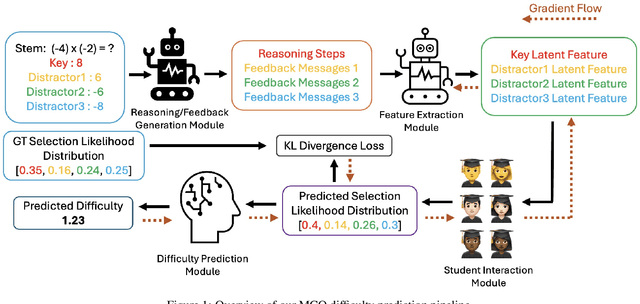
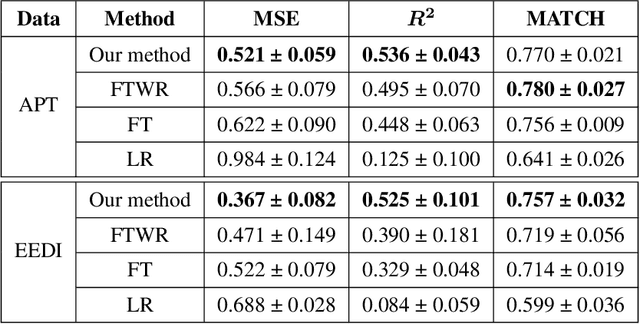
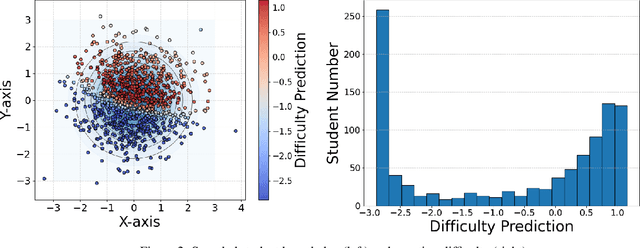
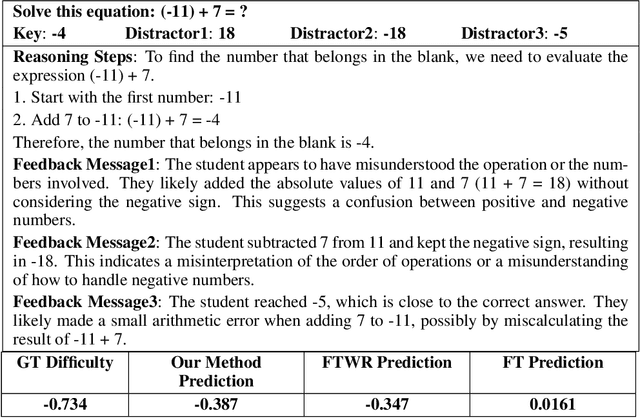
The difficulty of multiple-choice questions (MCQs) is a crucial factor for educational assessments. Predicting MCQ difficulty is challenging since it requires understanding both the complexity of reaching the correct option and the plausibility of distractors, i.e., incorrect options. In this paper, we propose a novel, two-stage method to predict the difficulty of MCQs. First, to better estimate the complexity of each MCQ, we use large language models (LLMs) to augment the reasoning steps required to reach each option. We use not just the MCQ itself but also these reasoning steps as input to predict the difficulty. Second, to capture the plausibility of distractors, we sample knowledge levels from a distribution to account for variation among students responding to the MCQ. This setup, inspired by item response theory (IRT), enable us to estimate the likelihood of students selecting each (both correct and incorrect) option. We align these predictions with their ground truth values, using a Kullback-Leibler (KL) divergence-based regularization objective, and use estimated likelihoods to predict MCQ difficulty. We evaluate our method on two real-world \emph{math} MCQ and response datasets with ground truth difficulty values estimated using IRT. Experimental results show that our method outperforms all baselines, up to a 28.3\% reduction in mean squared error and a 34.6\% improvement in the coefficient of determination. We also qualitatively discuss how our novel method results in higher accuracy in predicting MCQ difficulty.