 Add to Chrome
 Add to Firefox
 Add to Edge
Illusions of Confidence? Diagnosing LLM Truthfulness via Neighborhood Consistency
Jan 09, 2026
As Large Language Models (LLMs) are increasingly deployed in real-world settings, correctness alone is insufficient. Reliable deployment requires maintaining truthful beliefs under contextual perturbations. Existing evaluations largely rely on point-wise confidence like Self-Consistency, which can mask brittle belief. We show that even facts answered with perfect self-consistency can rapidly collapse under mild contextual interference. To address this gap, we propose Neighbor-Consistency Belief (NCB), a structural measure of belief robustness that evaluates response coherence across a conceptual neighborhood. To validate the efficiency of NCB, we introduce a new cognitive stress-testing protocol that probes outputs stability under contextual interference. Experiments across multiple LLMs show that the performance of high-NCB data is relatively more resistant to interference. Finally, we present Structure-Aware Training (SAT), which optimizes context-invariant belief structure and reduces long-tail knowledge brittleness by approximately 30%. Code will be available at https://github.com/zjunlp/belief.

ZJUKLAB at SemEval-2025 Task 4: Unlearning via Model Merging
Mar 27, 2025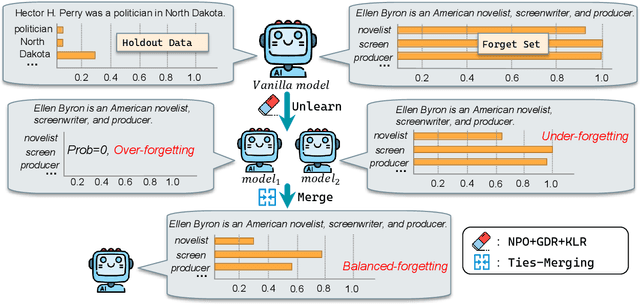
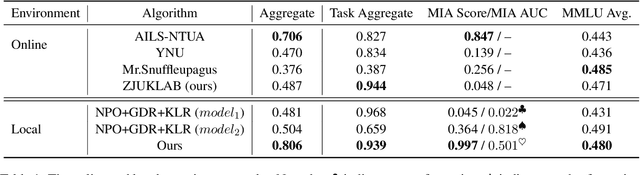
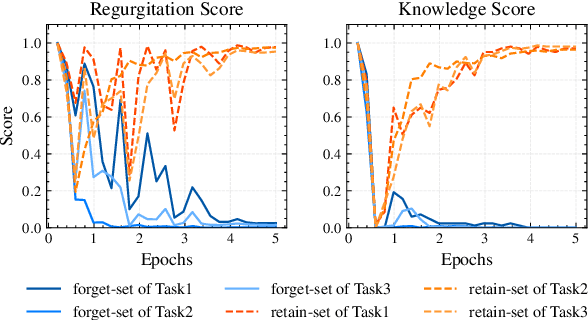
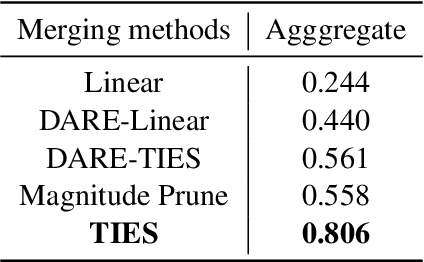
This paper presents the ZJUKLAB team's submission for SemEval-2025 Task 4: Unlearning Sensitive Content from Large Language Models. This task aims to selectively erase sensitive knowledge from large language models, avoiding both over-forgetting and under-forgetting issues. We propose an unlearning system that leverages Model Merging (specifically TIES-Merging), combining two specialized models into a more balanced unlearned model. Our system achieves competitive results, ranking second among 26 teams, with an online score of 0.944 for Task Aggregate and 0.487 for overall Aggregate. In this paper, we also conduct local experiments and perform a comprehensive analysis of the unlearning process, examining performance trajectories, loss dynamics, and weight perspectives, along with several supplementary experiments, to understand the effectiveness of our method. Furthermore, we analyze the shortcomings of our method and evaluation metrics, emphasizing that MIA scores and ROUGE-based metrics alone are insufficient to fully evaluate successful unlearning. Finally, we emphasize the need for more comprehensive evaluation methodologies and rethinking of unlearning objectives in future research. Code is available at https://github.com/zjunlp/unlearn/tree/main/semeval25.