 Add to Chrome
 Add to Firefox
 Add to Edge
BrainSegNet: A Novel Framework for Whole-Brain MRI Parcellation Enhanced by Large Models
Jan 14, 2026
Whole-brain parcellation from MRI is a critical yet challenging task due to the complexity of subdividing the brain into numerous small, irregular shaped regions. Traditionally, template-registration methods were used, but recent advances have shifted to deep learning for faster workflows. While large models like the Segment Anything Model (SAM) offer transferable feature representations, they are not tailored for the high precision required in brain parcellation. To address this, we propose BrainSegNet, a novel framework that adapts SAM for accurate whole-brain parcellation into 95 regions. We enhance SAM by integrating U-Net skip connections and specialized modules into its encoder and decoder, enabling fine-grained anatomical precision. Key components include a hybrid encoder combining U-Net skip connections with SAM's transformer blocks, a multi-scale attention decoder with pyramid pooling for varying-sized structures, and a boundary refinement module to sharpen edges. Experimental results on the Human Connectome Project (HCP) dataset demonstrate that BrainSegNet outperforms several state-of-the-art methods, achieving higher accuracy and robustness in complex, multi-label parcellation.

A Novel Streamline-based diffusion MRI Tractography Registration Method with Probabilistic Keypoint Detection
Mar 04, 2025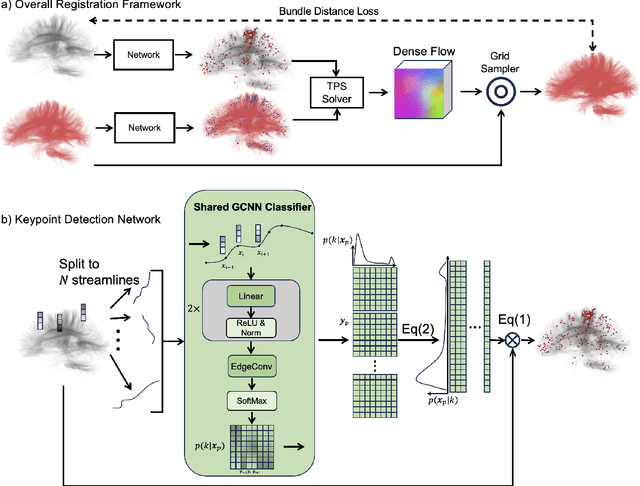
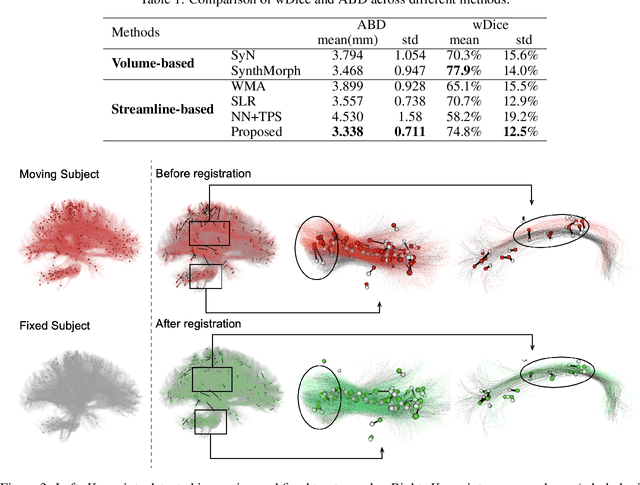
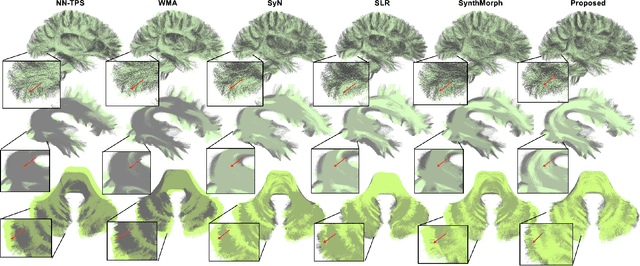
Registration of diffusion MRI tractography is an essential step for analyzing group similarities and variations in the brain's white matter (WM). Streamline-based registration approaches can leverage the 3D geometric information of fiber pathways to enable spatial alignment after registration. Existing methods usually rely on the optimization of the spatial distances to identify the optimal transformation. However, such methods overlook point connectivity patterns within the streamline itself, limiting their ability to identify anatomical correspondences across tractography datasets. In this work, we propose a novel unsupervised approach using deep learning to perform streamline-based dMRI tractography registration. The overall idea is to identify corresponding keypoint pairs across subjects for spatial alignment of tractography datasets. We model tractography as point clouds to leverage the graph connectivity along streamlines. We propose a novel keypoint detection method for streamlines, framed as a probabilistic classification task to identify anatomically consistent correspondences across unstructured streamline sets. In the experiments, we compare several existing methods and show highly effective and efficient tractography registration performance.