 Add to Chrome
 Add to Firefox
 Add to Edge
LongCat-Flash-Thinking-2601 Technical Report
Jan 23, 2026
We introduce LongCat-Flash-Thinking-2601, a 560-billion-parameter open-source Mixture-of-Experts (MoE) reasoning model with superior agentic reasoning capability. LongCat-Flash-Thinking-2601 achieves state-of-the-art performance among open-source models on a wide range of agentic benchmarks, including agentic search, agentic tool use, and tool-integrated reasoning. Beyond benchmark performance, the model demonstrates strong generalization to complex tool interactions and robust behavior under noisy real-world environments. Its advanced capability stems from a unified training framework that combines domain-parallel expert training with subsequent fusion, together with an end-to-end co-design of data construction, environments, algorithms, and infrastructure spanning from pre-training to post-training. In particular, the model's strong generalization capability in complex tool-use are driven by our in-depth exploration of environment scaling and principled task construction. To optimize long-tailed, skewed generation and multi-turn agentic interactions, and to enable stable training across over 10,000 environments spanning more than 20 domains, we systematically extend our asynchronous reinforcement learning framework, DORA, for stable and efficient large-scale multi-environment training. Furthermore, recognizing that real-world tasks are inherently noisy, we conduct a systematic analysis and decomposition of real-world noise patterns, and design targeted training procedures to explicitly incorporate such imperfections into the training process, resulting in improved robustness for real-world applications. To further enhance performance on complex reasoning tasks, we introduce a Heavy Thinking mode that enables effective test-time scaling by jointly expanding reasoning depth and width through intensive parallel thinking.

PathSeqSAM: Sequential Modeling for Pathology Image Segmentation with SAM2
Apr 12, 2025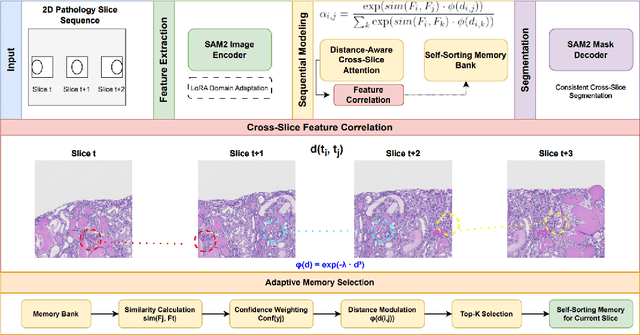
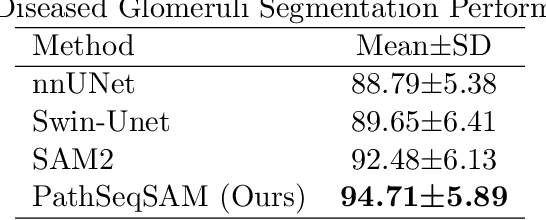
Current methods for pathology image segmentation typically treat 2D slices independently, ignoring valuable cross-slice information. We present PathSeqSAM, a novel approach that treats 2D pathology slices as sequential video frames using SAM2's memory mechanisms. Our method introduces a distance-aware attention mechanism that accounts for variable physical distances between slices and employs LoRA for domain adaptation. Evaluated on the KPI Challenge 2024 dataset for glomeruli segmentation, PathSeqSAM demonstrates improved segmentation quality, particularly in challenging cases that benefit from cross-slice context. We have publicly released our code at https://github.com/JackyyyWang/PathSeqSAM.
CTI-Unet: Cascaded Threshold Integration for Improved U-Net Segmentation of Pathology Images
Apr 08, 2025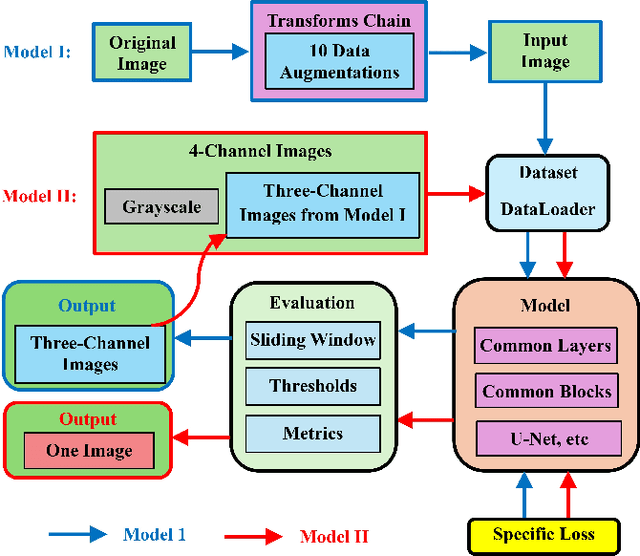

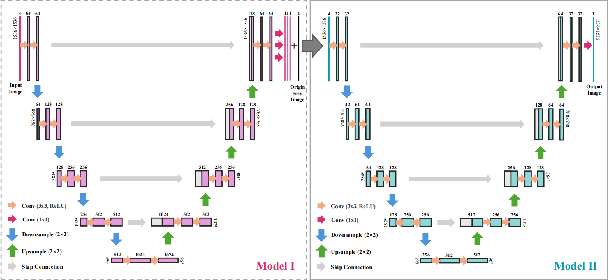
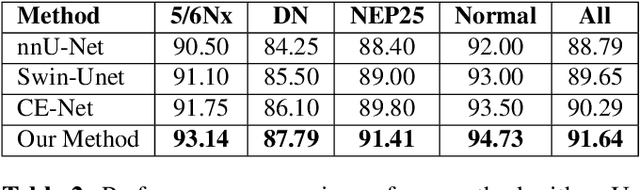
Chronic kidney disease (CKD) is a growing global health concern, necessitating precise and efficient image analysis to aid diagnosis and treatment planning. Automated segmentation of kidney pathology images plays a central role in facilitating clinical workflows, yet conventional segmentation models often require delicate threshold tuning. This paper proposes a novel \textit{Cascaded Threshold-Integrated U-Net (CTI-Unet)} to overcome the limitations of single-threshold segmentation. By sequentially integrating multiple thresholded outputs, our approach can reconcile noise suppression with the preservation of finer structural details. Experiments on the challenging KPIs2024 dataset demonstrate that CTI-Unet outperforms state-of-the-art architectures such as nnU-Net, Swin-Unet, and CE-Net, offering a robust and flexible framework for kidney pathology image segmentation.