 Add to Chrome
 Add to Firefox
 Add to Edge
EpiQAL: Benchmarking Large Language Models in Epidemiological Question Answering for Enhanced Alignment and Reasoning
Jan 06, 2026
Reliable epidemiological reasoning requires synthesizing study evidence to infer disease burden, transmission dynamics, and intervention effects at the population level. Existing medical question answering benchmarks primarily emphasize clinical knowledge or patient-level reasoning, yet few systematically evaluate evidence-grounded epidemiological inference. We present EpiQAL, the first diagnostic benchmark for epidemiological question answering across diverse diseases, comprising three subsets built from open-access literature. The subsets respectively evaluate text-grounded factual recall, multi-step inference linking document evidence with epidemiological principles, and conclusion reconstruction with the Discussion section withheld. Construction combines expert-designed taxonomy guidance, multi-model verification, and retrieval-based difficulty control. Experiments on ten open models reveal that current LLMs show limited performance on epidemiological reasoning, with multi-step inference posing the greatest challenge. Model rankings shift across subsets, and scale alone does not predict success. Chain-of-Thought prompting benefits multi-step inference but yields mixed results elsewhere. EpiQAL provides fine-grained diagnostic signals for evidence grounding, inferential reasoning, and conclusion reconstruction.

EpiLearn: A Python Library for Machine Learning in Epidemic Modeling
Jun 10, 2024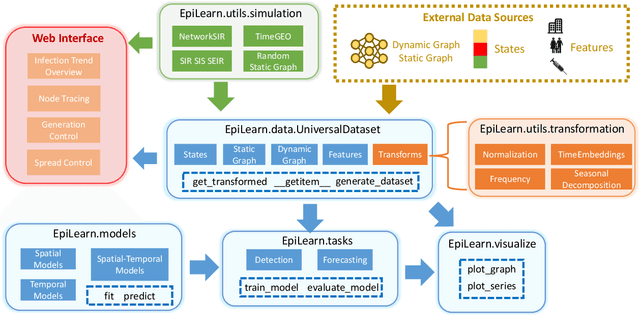
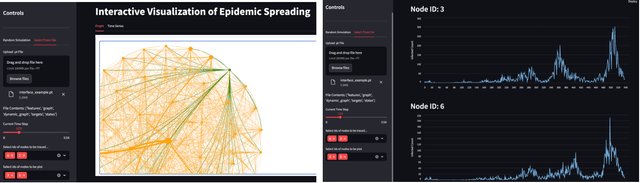
EpiLearn is a Python toolkit developed for modeling, simulating, and analyzing epidemic data. Although there exist several packages that also deal with epidemic modeling, they are often restricted to mechanistic models or traditional statistical tools. As machine learning continues to shape the world, the gap between these packages and the latest models has become larger. To bridge the gap and inspire innovative research in epidemic modeling, EpiLearn not only provides support for evaluating epidemic models based on machine learning, but also incorporates comprehensive tools for analyzing epidemic data, such as simulation, visualization, transformations, etc. For the convenience of both epidemiologists and data scientists, we provide a unified framework for training and evaluation of epidemic models on two tasks: Forecasting and Source Detection. To facilitate the development of new models, EpiLearn follows a modular design, making it flexible and easy to use. In addition, an interactive web application is also developed to visualize the real-world or simulated epidemic data. Our package is available at https://github.com/Emory-Melody/EpiLearn.