 Add to Chrome
 Add to Firefox
 Add to Edge
NTIRE 2026 Challenge on Short-form UGC Video Restoration in the Wild with Generative Models: Datasets, Methods and Results
Apr 12, 2026
This paper presents an overview of the NTIRE 2026 Challenge on Short-form UGC Video Restoration in the Wild with Generative Models. This challenge utilizes a new short-form UGC (S-UGC) video restoration benchmark, termed KwaiVIR, which is contributed by USTC and Kuaishou Technology. It contains both synthetically distorted videos and real-world short-form UGC videos in the wild. For this edition, the released data include 200 synthetic training videos, 48 wild training videos, 11 validation videos, and 20 testing videos. The primary goal of this challenge is to establish a strong and practical benchmark for restoring short-form UGC videos under complex real-world degradations, especially in the emerging paradigm of generative-model-based S-UGC video restoration. This challenge has two tracks: (i) the primary track is a subjective track, where the evaluation is based on a user study; (ii) the second track is an objective track. These two tracks enable a comprehensive assessment of restoration quality. In total, 95 teams have registered for this competition. And 12 teams submitted valid final solutions and fact sheets for the testing phase. The submitted methods achieved strong performance on the KwaiVIR benchmark, demonstrating encouraging progress in short-form UGC video restoration in the wild.

NTIRE 2025 Challenge on UGC Video Enhancement: Methods and Results
May 05, 2025This paper presents an overview of the NTIRE 2025 Challenge on UGC Video Enhancement. The challenge constructed a set of 150 user-generated content videos without reference ground truth, which suffer from real-world degradations such as noise, blur, faded colors, compression artifacts, etc. The goal of the participants was to develop an algorithm capable of improving the visual quality of such videos. Given the widespread use of UGC on short-form video platforms, this task holds substantial practical importance. The evaluation was based on subjective quality assessment in crowdsourcing, obtaining votes from over 8000 assessors. The challenge attracted more than 25 teams submitting solutions, 7 of which passed the final phase with source code verification. The outcomes may provide insights into the state-of-the-art in UGC video enhancement and highlight emerging trends and effective strategies in this evolving research area. All data, including the processed videos and subjective comparison votes and scores, is made publicly available at https://github.com/msu-video-group/NTIRE25_UGC_Video_Enhancement.
Enhancing Quality of Compressed Images by Mitigating Enhancement Bias Towards Compression Domain
Mar 10, 2024Existing quality enhancement methods for compressed images focus on aligning the enhancement domain with the raw domain to yield realistic images. However, these methods exhibit a pervasive enhancement bias towards the compression domain, inadvertently regarding it as more realistic than the raw domain. This bias makes enhanced images closely resemble their compressed counterparts, thus degrading their perceptual quality. In this paper, we propose a simple yet effective method to mitigate this bias and enhance the quality of compressed images. Our method employs a conditional discriminator with the compressed image as a key condition, and then incorporates a domain-divergence regularization to actively distance the enhancement domain from the compression domain. Through this dual strategy, our method enables the discrimination against the compression domain, and brings the enhancement domain closer to the raw domain. Comprehensive quality evaluations confirm the superiority of our method over other state-of-the-art methods without incurring inference overheads.
NTIRE 2022 Challenge on Super-Resolution and Quality Enhancement of Compressed Video: Dataset, Methods and Results
Apr 25, 2022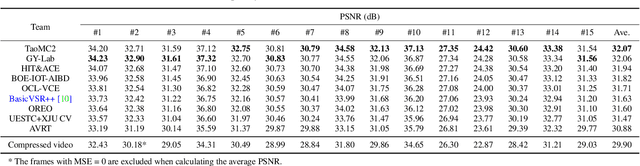
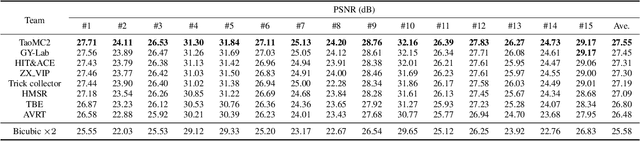
This paper reviews the NTIRE 2022 Challenge on Super-Resolution and Quality Enhancement of Compressed Video. In this challenge, we proposed the LDV 2.0 dataset, which includes the LDV dataset (240 videos) and 95 additional videos. This challenge includes three tracks. Track 1 aims at enhancing the videos compressed by HEVC at a fixed QP. Track 2 and Track 3 target both the super-resolution and quality enhancement of HEVC compressed video. They require x2 and x4 super-resolution, respectively. The three tracks totally attract more than 600 registrations. In the test phase, 8 teams, 8 teams and 12 teams submitted the final results to Tracks 1, 2 and 3, respectively. The proposed methods and solutions gauge the state-of-the-art of super-resolution and quality enhancement of compressed video. The proposed LDV 2.0 dataset is available at https://github.com/RenYang-home/LDV_dataset. The homepage of this challenge (including open-sourced codes) is at https://github.com/RenYang-home/NTIRE22_VEnh_SR.
Progressive Training of A Two-Stage Framework for Video Restoration
Apr 21, 2022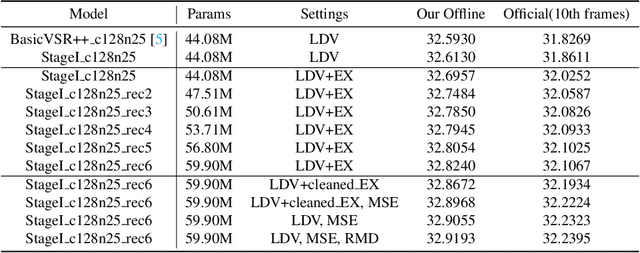
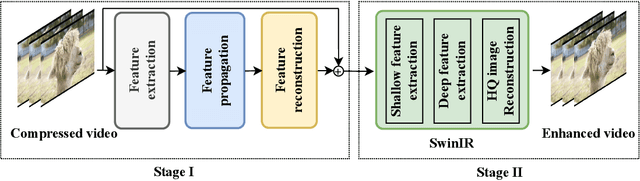
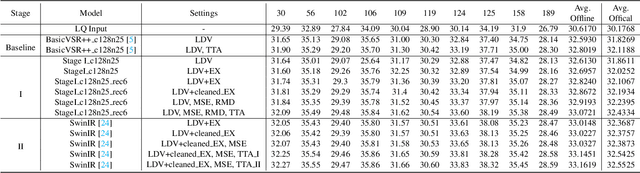
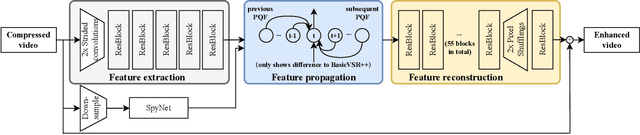
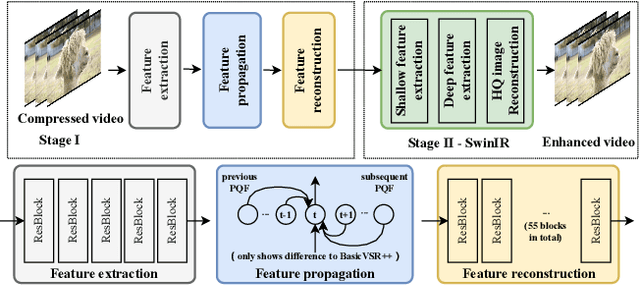
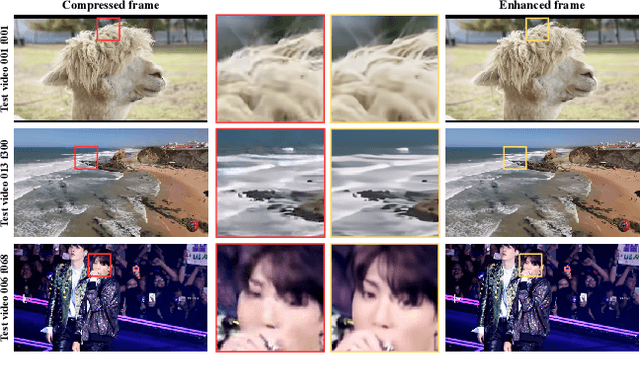
As a widely studied task, video restoration aims to enhance the quality of the videos with multiple potential degradations, such as noises, blurs and compression artifacts. Among video restorations, compressed video quality enhancement and video super-resolution are two of the main tacks with significant values in practical scenarios. Recently, recurrent neural networks and transformers attract increasing research interests in this field, due to their impressive capability in sequence-to-sequence modeling. However, the training of these models is not only costly but also relatively hard to converge, with gradient exploding and vanishing problems. To cope with these problems, we proposed a two-stage framework including a multi-frame recurrent network and a single-frame transformer. Besides, multiple training strategies, such as transfer learning and progressive training, are developed to shorten the training time and improve the model performance. Benefiting from the above technical contributions, our solution wins two champions and a runner-up in the NTIRE 2022 super-resolution and quality enhancement of compressed video challenges.