 Add to Chrome
 Add to Firefox
 Add to Edge
Seek and You Shall Find: Design & Evaluation of a Context-Aware Interactive Search Companion
Jan 16, 2026
Many users struggle with effective online search and critical evaluation, especially in high-stakes domains like health, while often overestimating their digital literacy. Thus, in this demo, we present an interactive search companion that seamlessly integrates expert search strategies into existing search engine result pages. Providing context-aware tips on clarifying information needs, improving query formulation, encouraging result exploration, and mitigating biases, our companion aims to foster reflective search behaviour while minimising cognitive burden. A user study demonstrates the companion's successful encouragement of more active and exploratory search, leading users to submit 75 % more queries and view roughly twice as many results, as well as performance gains in difficult tasks. This demo illustrates how lightweight, contextual guidance can enhance search literacy and empower users through micro-learning opportunities. While the vision involves real-time LLM adaptivity, this study utilises a controlled implementation to test the underlying intervention strategies.

"Can You Tell Me?": Designing Copilots to Support Human Judgement in Online Information Seeking
Jan 16, 2026Generative AI (GenAI) tools are transforming information seeking, but their fluent, authoritative responses risk overreliance and discourage independent verification and reasoning. Rather than replacing the cognitive work of users, GenAI systems should be designed to support and scaffold it. Therefore, this paper introduces an LLM-based conversational copilot designed to scaffold information evaluation rather than provide answers and foster digital literacy skills. In a pre-registered, randomised controlled trial (N=261) examining three interface conditions including a chat-based copilot, our mixed-methods analysis reveals that users engaged deeply with the copilot, demonstrating metacognitive reflection. However, the copilot did not significantly improve answer correctness or search engagement, largely due to a "time-on-chat vs. exploration" trade-off and users' bias toward positive information. Qualitative findings reveal tension between the copilot's Socratic approach and users' desire for efficiency. These results highlight both the promise and pitfalls of pedagogical copilots, and we outline design pathways to reconcile literacy goals with efficiency demands.
Query Smarter, Trust Better? Exploring Search Behaviours for Verifying News Accuracy
Apr 07, 2025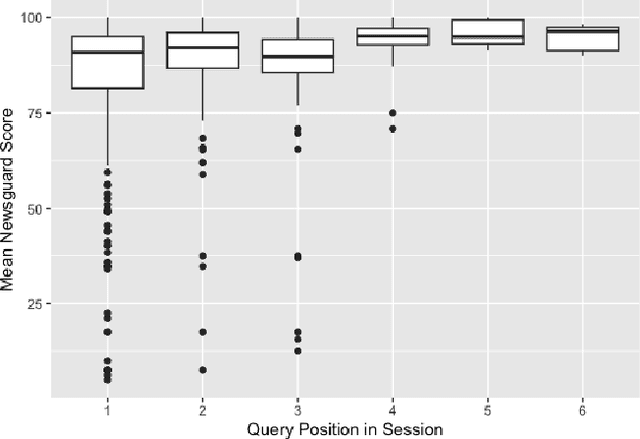
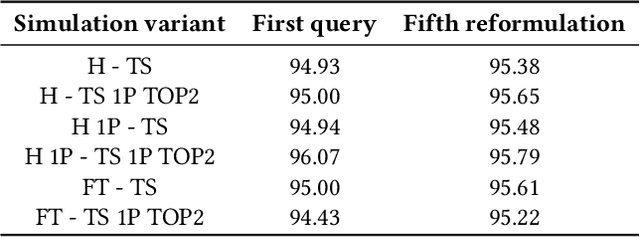
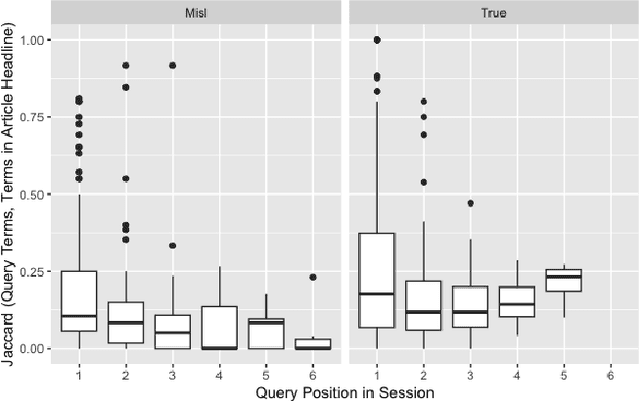
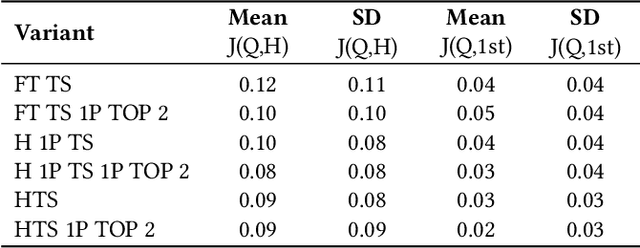
While it is often assumed that searching for information to evaluate misinformation will help identify false claims, recent work suggests that search behaviours can instead reinforce belief in misleading news, particularly when users generate queries using vocabulary from the source articles. Our research explores how different query generation strategies affect news verification and whether the way people search influences the accuracy of their information evaluation. A mixed-methods approach was used, consisting of three parts: (1) an analysis of existing data to understand how search behaviour influences trust in fake news, (2) a simulation of query generation strategies using a Large Language Model (LLM) to assess the impact of different query formulations on search result quality, and (3) a user study to examine how 'Boost' interventions in interface design can guide users to adopt more effective query strategies. The results show that search behaviour significantly affects trust in news, with successful searches involving multiple queries and yielding higher-quality results. Queries inspired by different parts of a news article produced search results of varying quality, and weak initial queries improved when reformulated using full SERP information. Although 'Boost' interventions had limited impact, the study suggests that interface design encouraging users to thoroughly review search results can enhance query formulation. This study highlights the importance of query strategies in evaluating news and proposes that interface design can play a key role in promoting more effective search practices, serving as one component of a broader set of interventions to combat misinformation.
GERestaurant: A German Dataset of Annotated Restaurant Reviews for Aspect-Based Sentiment Analysis
Aug 15, 2024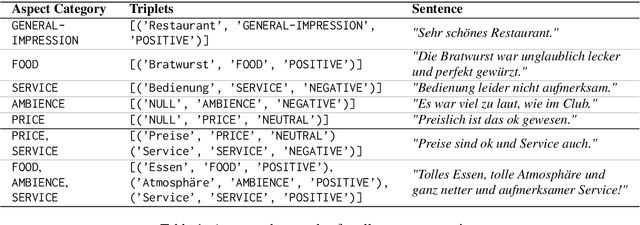
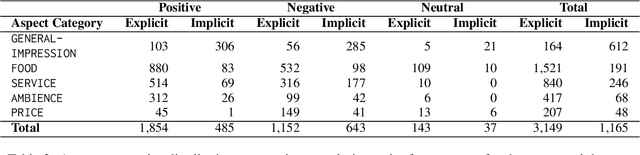
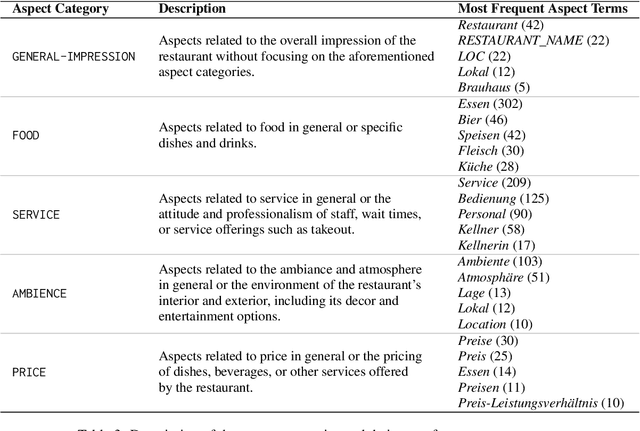

We present GERestaurant, a novel dataset consisting of 3,078 German language restaurant reviews manually annotated for Aspect-Based Sentiment Analysis (ABSA). All reviews were collected from Tripadvisor, covering a diverse selection of restaurants, including regional and international cuisine with various culinary styles. The annotations encompass both implicit and explicit aspects, including all aspect terms, their corresponding aspect categories, and the sentiments expressed towards them. Furthermore, we provide baseline scores for the four ABSA tasks Aspect Category Detection, Aspect Category Sentiment Analysis, End-to-End ABSA and Target Aspect Sentiment Detection as a reference point for future advances. The dataset fills a gap in German language resources and facilitates exploration of ABSA in the restaurant domain.