 Add to Chrome
 Add to Firefox
 Add to Edge
The Llama 4 Herd: Architecture, Training, Evaluation, and Deployment Notes
Jan 15, 2026
This document consolidates publicly reported technical details about Metas Llama 4 model family. It summarizes (i) released variants (Scout and Maverick) and the broader herd context including the previewed Behemoth teacher model, (ii) architectural characteristics beyond a high-level MoE description covering routed/shared-expert structure, early-fusion multimodality, and long-context design elements reported for Scout (iRoPE and length generalization strategies), (iii) training disclosures spanning pre-training, mid-training for long-context extension, and post-training methodology (lightweight SFT, online RL, and lightweight DPO) as described in release materials, (iv) developer-reported benchmark results for both base and instruction-tuned checkpoints, and (v) practical deployment constraints observed across major serving environments, including provider-specific context limits and quantization packaging. The manuscript also summarizes licensing obligations relevant to redistribution and derivative naming, and reviews publicly described safeguards and evaluation practices. The goal is to provide a compact technical reference for researchers and practitioners who need precise, source-backed facts about Llama 4.

FOLIO: Natural Language Reasoning with First-Order Logic
Sep 02, 2022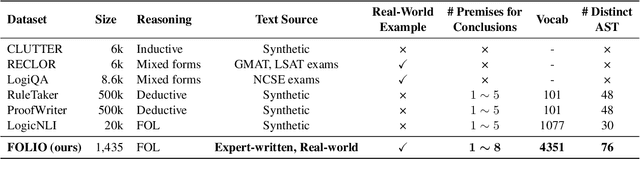
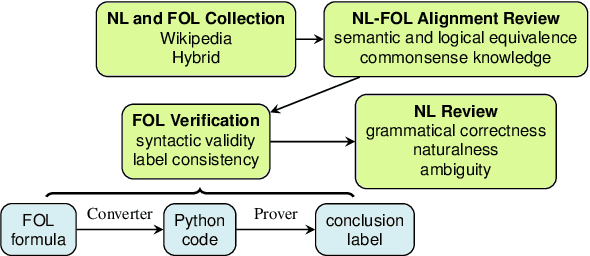
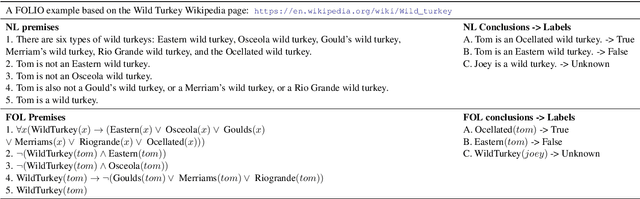
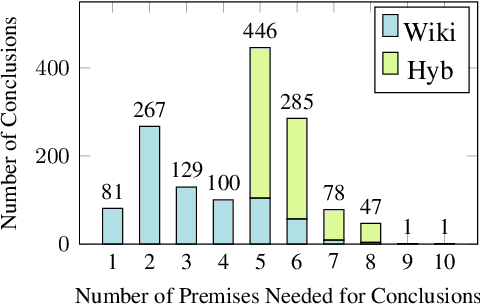
We present FOLIO, a human-annotated, open-domain, and logically complex and diverse dataset for reasoning in natural language (NL), equipped with first order logic (FOL) annotations. FOLIO consists of 1,435 examples (unique conclusions), each paired with one of 487 sets of premises which serve as rules to be used to deductively reason for the validity of each conclusion. The logical correctness of premises and conclusions is ensured by their parallel FOL annotations, which are automatically verified by our FOL inference engine. In addition to the main NL reasoning task, NL-FOL pairs in FOLIO automatically constitute a new NL-FOL translation dataset using FOL as the logical form. Our experiments on FOLIO systematically evaluate the FOL reasoning ability of supervised fine-tuning on medium-sized language models (BERT, RoBERTa) and few-shot prompting on large language models (GPT-NeoX, OPT, GPT-3, Codex). For NL-FOL translation, we experiment with GPT-3 and Codex. Our results show that one of the most capable Large Language Model (LLM) publicly available, GPT-3 davinci, achieves only slightly better than random results with few-shot prompting on a subset of FOLIO, and the model is especially bad at predicting the correct truth values for False and Unknown conclusions. Our dataset and code are available at https://github.com/Yale-LILY/FOLIO.