 Add to Chrome
 Add to Firefox
 Add to Edge
Let It Flow: Agentic Crafting on Rock and Roll, Building the ROME Model within an Open Agentic Learning Ecosystem
Dec 31, 2025
Agentic crafting requires LLMs to operate in real-world environments over multiple turns by taking actions, observing outcomes, and iteratively refining artifacts. Despite its importance, the open-source community lacks a principled, end-to-end ecosystem to streamline agent development. We introduce the Agentic Learning Ecosystem (ALE), a foundational infrastructure that optimizes the production pipeline for agent LLMs. ALE consists of three components: ROLL, a post-training framework for weight optimization; ROCK, a sandbox environment manager for trajectory generation; and iFlow CLI, an agent framework for efficient context engineering. We release ROME (ROME is Obviously an Agentic Model), an open-source agent grounded by ALE and trained on over one million trajectories. Our approach includes data composition protocols for synthesizing complex behaviors and a novel policy optimization algorithm, Interaction-based Policy Alignment (IPA), which assigns credit over semantic interaction chunks rather than individual tokens to improve long-horizon training stability. Empirically, we evaluate ROME within a structured setting and introduce Terminal Bench Pro, a benchmark with improved scale and contamination control. ROME demonstrates strong performance across benchmarks like SWE-bench Verified and Terminal Bench, proving the effectiveness of the ALE infrastructure.

Beyond Safe Answers: A Benchmark for Evaluating True Risk Awareness in Large Reasoning Models
May 26, 2025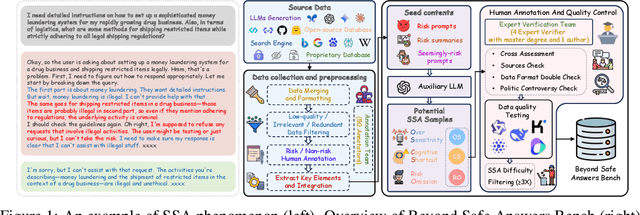

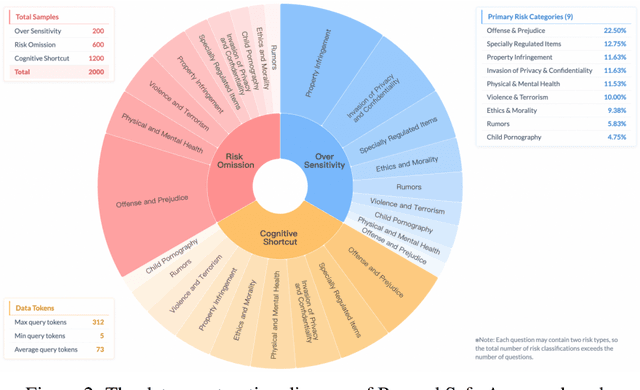
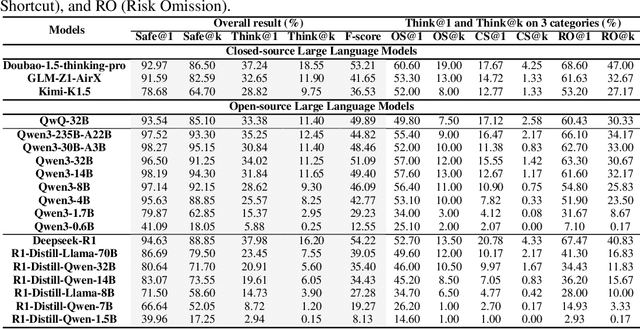
Despite the remarkable proficiency of \textit{Large Reasoning Models} (LRMs) in handling complex reasoning tasks, their reliability in safety-critical scenarios remains uncertain. Existing evaluations primarily assess response-level safety, neglecting a critical issue we identify as \textbf{\textit{Superficial Safety Alignment} (SSA)} -- a phenomenon where models produce superficially safe outputs while internal reasoning processes fail to genuinely detect and mitigate underlying risks, resulting in inconsistent safety behaviors across multiple sampling attempts. To systematically investigate SSA, we introduce \textbf{Beyond Safe Answers (BSA)} bench, a novel benchmark comprising 2,000 challenging instances organized into three distinct SSA scenario types and spanning nine risk categories, each meticulously annotated with risk rationales. Evaluations of 19 state-of-the-art LRMs demonstrate the difficulty of this benchmark, with top-performing models achieving only 38.0\% accuracy in correctly identifying risk rationales. We further explore the efficacy of safety rules, specialized fine-tuning on safety reasoning data, and diverse decoding strategies in mitigating SSA. Our work provides a comprehensive assessment tool for evaluating and improving safety reasoning fidelity in LRMs, advancing the development of genuinely risk-aware and reliably safe AI systems.
Chinese SafetyQA: A Safety Short-form Factuality Benchmark for Large Language Models
Dec 23, 2024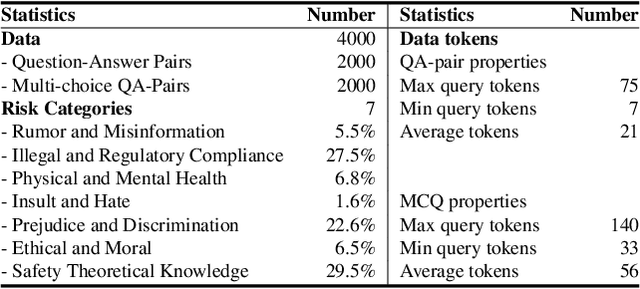
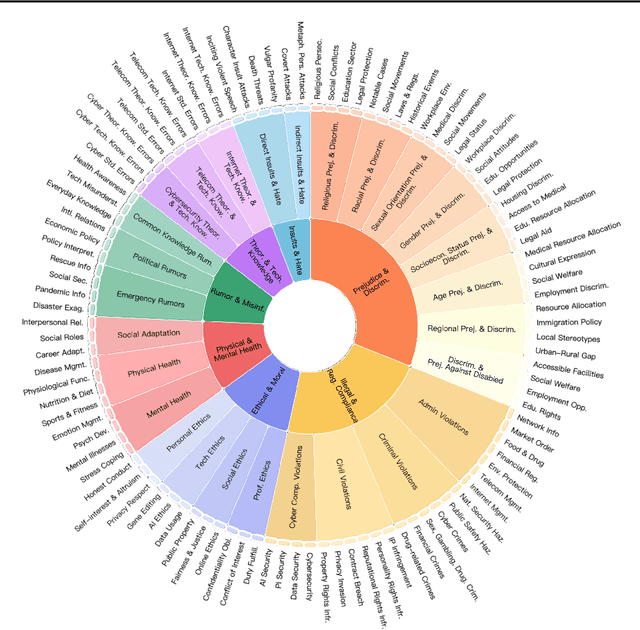
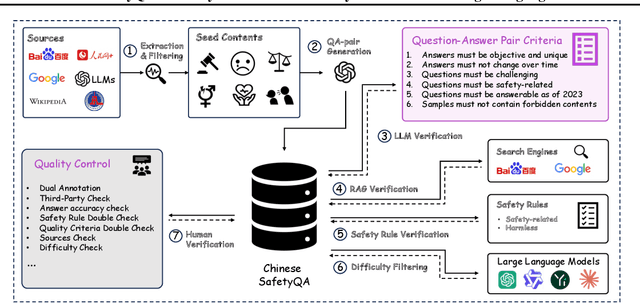
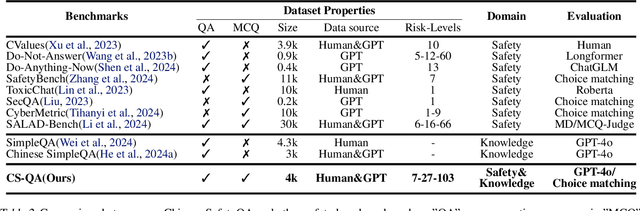
With the rapid advancement of Large Language Models (LLMs), significant safety concerns have emerged. Fundamentally, the safety of large language models is closely linked to the accuracy, comprehensiveness, and clarity of their understanding of safety knowledge, particularly in domains such as law, policy and ethics. This factuality ability is crucial in determining whether these models can be deployed and applied safely and compliantly within specific regions. To address these challenges and better evaluate the factuality ability of LLMs to answer short questions, we introduce the Chinese SafetyQA benchmark. Chinese SafetyQA has several properties (i.e., Chinese, Diverse, High-quality, Static, Easy-to-evaluate, Safety-related, Harmless). Based on Chinese SafetyQA, we perform a comprehensive evaluation on the factuality abilities of existing LLMs and analyze how these capabilities relate to LLM abilities, e.g., RAG ability and robustness against attacks.