 Add to Chrome
 Add to Firefox
 Add to Edge
ReCUBE: Evaluating Repository-Level Context Utilization in Code Generation
Mar 26, 2026
Large Language Models (LLMs) have recently emerged as capable coding assistants that operate over large codebases through either agentic exploration or full-context generation. Existing benchmarks capture a broad range of coding capabilities, such as resolving GitHub issues, but none of them directly isolate and measure how effectively LLMs leverage repository-level context during code generation. To address this, we introduce ReCUBE, a benchmark in which LLMs reconstruct a masked file within a real-world repository, using all remaining source files, dependency specifications, and documentation as their only source of context. ReCUBE evaluates reconstructed code with usage-aware test cases that simulate both internal module logic and external cross-file integration, reflecting real-world software usage patterns. We further propose the Caller-Centric Exploration (CCE) toolkit, a set of dependency graph-based tools that can be integrated into agentic frameworks to guide agents toward the most relevant caller files during repository exploration. Experiments across eight models in four settings show that repository-level context utilization remains highly challenging even for state-of-the-art models, with GPT-5 achieving only 37.57% strict pass rate in the full-context setting. Agents augmented with our CCE toolkit consistently outperform all baselines across all evaluated models, with improvements of up to 7.56% in strict pass rate. We release our benchmark, code, and evaluation framework as open source for the NLP research community.

Tinker Tales: Supporting Child-AI Collaboration through Co-Creative Storytelling with Educational Scaffolding
Feb 04, 2026Artificial intelligence (AI) is increasingly framed as a collaborative partner in creative activities, yet children's interactions with AI have largely been studied in AI-led instructional settings rather than co-creative collaboration. This leaves open questions about how children can meaningfully engage with AI through iterative co-creation. We present Tinker Tales, a tangible storytelling system designed with narrative and social-emotional scaffolding to support child-AI collaboration. The system combines a physical storytelling board, NFC-embedded toys representing story elements (e.g., characters, places, items, and emotions), and a mobile app that mediates child-AI interaction. Children shape and refine stories by placing and moving story elements and interacting with the AI through tangible and voice-based interaction. We conducted an exploratory user study with 10 children to examine how they interacted with Tinker Tales. Our findings show that children treated the AI as an attentive, responsive collaborator, while scaffolding supported coherent narrative refinement without diminishing children's agency.
Measuring Sycophancy of Language Models in Multi-turn Dialogues
May 28, 2025Large Language Models (LLMs) are expected to provide helpful and harmless responses, yet they often exhibit sycophancy--conforming to user beliefs regardless of factual accuracy or ethical soundness. Prior research on sycophancy has primarily focused on single-turn factual correctness, overlooking the dynamics of real-world interactions. In this work, we introduce SYCON Bench, a novel benchmark for evaluating sycophantic behavior in multi-turn, free-form conversational settings. Our benchmark measures how quickly a model conforms to the user (Turn of Flip) and how frequently it shifts its stance under sustained user pressure (Number of Flip). Applying SYCON Bench to 17 LLMs across three real-world scenarios, we find that sycophancy remains a prevalent failure mode. Our analysis shows that alignment tuning amplifies sycophantic behavior, whereas model scaling and reasoning optimization strengthen the model's ability to resist undesirable user views. Reasoning models generally outperform instruction-tuned models but often fail when they over-index on logical exposition instead of directly addressing the user's underlying beliefs. Finally, we evaluate four additional prompting strategies and demonstrate that adopting a third-person perspective reduces sycophancy by up to 63.8% in debate scenario. We release our code and data at https://github.com/JiseungHong/SYCON-Bench.
SIn-NeRF2NeRF: Editing 3D Scenes with Instructions through Segmentation and Inpainting
Aug 23, 2024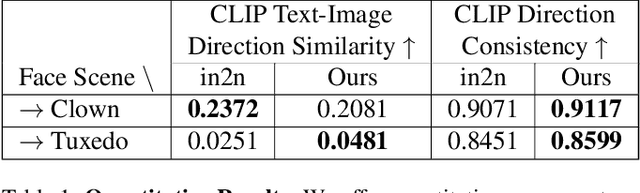
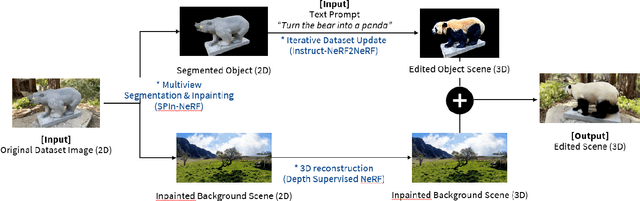
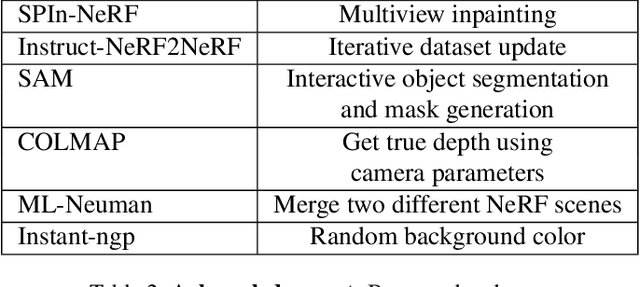
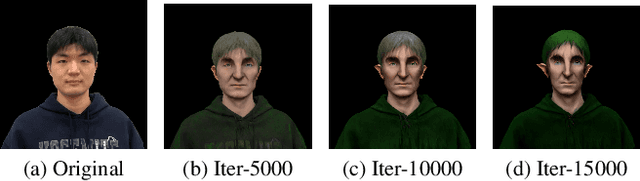
TL;DR Perform 3D object editing selectively by disentangling it from the background scene. Instruct-NeRF2NeRF (in2n) is a promising method that enables editing of 3D scenes composed of Neural Radiance Field (NeRF) using text prompts. However, it is challenging to perform geometrical modifications such as shrinking, scaling, or moving on both the background and object simultaneously. In this project, we enable geometrical changes of objects within the 3D scene by selectively editing the object after separating it from the scene. We perform object segmentation and background inpainting respectively, and demonstrate various examples of freely resizing or moving disentangled objects within the three-dimensional space.
Korean Bio-Medical Corpus for Medical Named Entity Recognition
Mar 24, 2024Named Entity Recognition (NER) plays a pivotal role in medical Natural Language Processing (NLP). Yet, there has not been an open-source medical NER dataset specifically for the Korean language. To address this, we utilized ChatGPT to assist in constructing the KBMC (Korean Bio-Medical Corpus), which we are now presenting to the public. With the KBMC dataset, we noticed an impressive 20% increase in medical NER performance compared to models trained on general Korean NER datasets. This research underscores the significant benefits and importance of using specialized tools and datasets, like ChatGPT, to enhance language processing in specialized fields such as healthcare.