 Add to Chrome
 Add to Firefox
 Add to Edge
Ling and Ring 2.6 Technical Report: Efficient and Instant Agentic Intelligence at Trillion-Parameter Scale
Jun 13, 2026
Efficient and scalable agentic intelligence requires models that can deliver both low-latency responses and strong reasoning capabilities while remaining practical to train, serve, and deploy. In this report, we present Ling-2.6 and Ring-2.6, a family of models designed to address this challenge at scale. Ling-2.6 is optimized for instant response generation and high capability per output token, whereas Ring-2.6 is tailored for deeper reasoning and more advanced agentic workflows. Instead of training from scratch, we upgrade the Ling-2.0 base model through architectural migration pre-training and large-scale post-training. This upgrade is guided by a unified co-design of model architecture, optimization objectives, serving systems, and agent training environments, enabling improvements in both model capability and deployment efficiency. At the architectural level, we introduce a hybrid linear attention design that integrates Lightning Attention with MLA, improving the efficiency of long-context training and decoding. To further enhance token efficiency, we optimize capability per output token through Evolutionary Chain-of-Thought, Linguistic Unit Policy Optimization, bidirectional preference alignment, and shortest-correct-response distillation. For agentic capabilities, we propose KPop, a reinforcement learning framework designed to support stable training of Ring-2.6-1T on large-scale environment-grounded data. KPop improves training efficiency through asynchronous scheduling across coding, search, tool use, and workflow execution, enabling scalable learning from complex agent-environment interactions. Together, Ling-2.6 and Ring-2.6 provide a practical pathway toward efficient, scalable, and open agentic systems. We open-source all checkpoints in the 2.6 family to support further research and development in practical agentic intelligence.

ERNIE 5.0 Technical Report
Feb 04, 2026In this report, we introduce ERNIE 5.0, a natively autoregressive foundation model desinged for unified multimodal understanding and generation across text, image, video, and audio. All modalities are trained from scratch under a unified next-group-of-tokens prediction objective, based on an ultra-sparse mixture-of-experts (MoE) architecture with modality-agnostic expert routing. To address practical challenges in large-scale deployment under diverse resource constraints, ERNIE 5.0 adopts a novel elastic training paradigm. Within a single pre-training run, the model learns a family of sub-models with varying depths, expert capacities, and routing sparsity, enabling flexible trade-offs among performance, model size, and inference latency in memory- or time-constrained scenarios. Moreover, we systematically address the challenges of scaling reinforcement learning to unified foundation models, thereby guaranteeing efficient and stable post-training under ultra-sparse MoE architectures and diverse multimodal settings. Extensive experiments demonstrate that ERNIE 5.0 achieves strong and balanced performance across multiple modalities. To the best of our knowledge, among publicly disclosed models, ERNIE 5.0 represents the first production-scale realization of a trillion-parameter unified autoregressive model that supports both multimodal understanding and generation. To facilitate further research, we present detailed visualizations of modality-agnostic expert routing in the unified model, alongside comprehensive empirical analysis of elastic training, aiming to offer profound insights to the community.
BadSR: Stealthy Label Backdoor Attacks on Image Super-Resolution
May 21, 2025With the widespread application of super-resolution (SR) in various fields, researchers have begun to investigate its security. Previous studies have demonstrated that SR models can also be subjected to backdoor attacks through data poisoning, affecting downstream tasks. A backdoor SR model generates an attacker-predefined target image when given a triggered image while producing a normal high-resolution (HR) output for clean images. However, prior backdoor attacks on SR models have primarily focused on the stealthiness of poisoned low-resolution (LR) images while ignoring the stealthiness of poisoned HR images, making it easy for users to detect anomalous data. To address this problem, we propose BadSR, which improves the stealthiness of poisoned HR images. The key idea of BadSR is to approximate the clean HR image and the pre-defined target image in the feature space while ensuring that modifications to the clean HR image remain within a constrained range. The poisoned HR images generated by BadSR can be integrated with existing triggers. To further improve the effectiveness of BadSR, we design an adversarially optimized trigger and a backdoor gradient-driven poisoned sample selection method based on a genetic algorithm. The experimental results show that BadSR achieves a high attack success rate in various models and data sets, significantly affecting downstream tasks.
A Simple Strategy for Body Estimation from Partial-View Images
Apr 16, 2024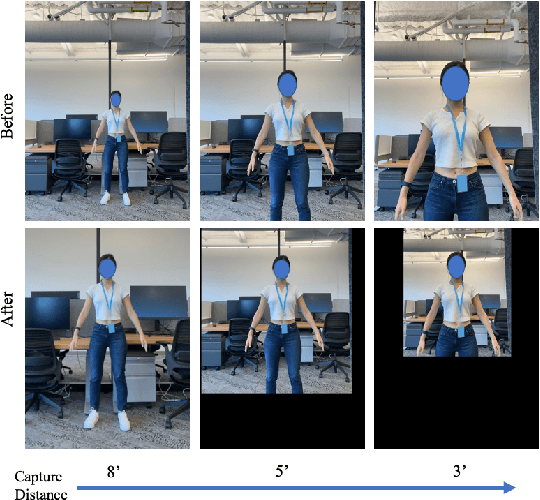
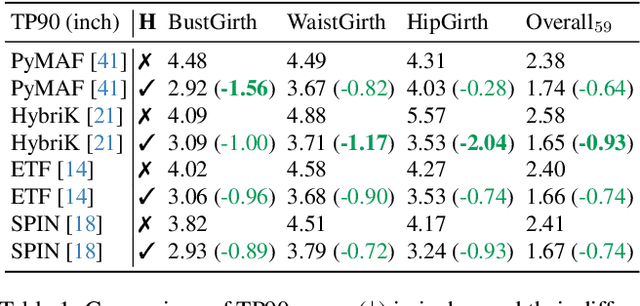
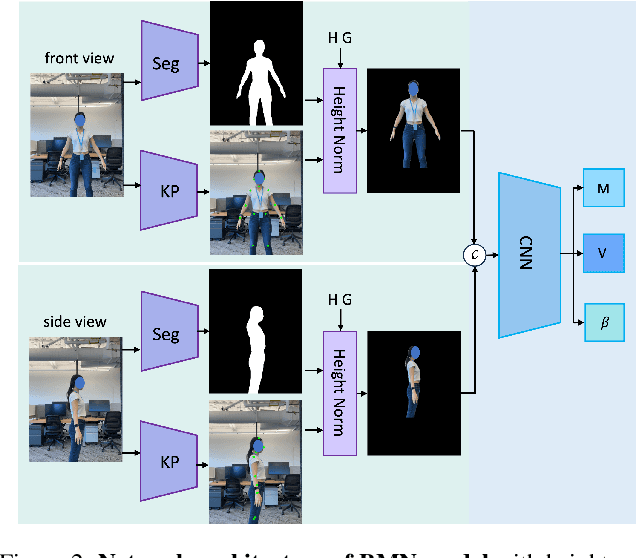
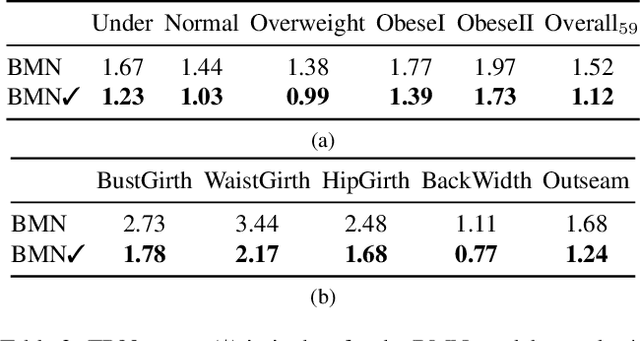
Virtual try-on and product personalization have become increasingly important in modern online shopping, highlighting the need for accurate body measurement estimation. Although previous research has advanced in estimating 3D body shapes from RGB images, the task is inherently ambiguous as the observed scale of human subjects in the images depends on two unknown factors: capture distance and body dimensions. This ambiguity is particularly pronounced in partial-view scenarios. To address this challenge, we propose a modular and simple height normalization solution. This solution relocates the subject skeleton to the desired position, thereby normalizing the scale and disentangling the relationship between the two variables. Our experimental results demonstrate that integrating this technique into state-of-the-art human mesh reconstruction models significantly enhances partial body measurement estimation. Additionally, we illustrate the applicability of this approach to multi-view settings, showcasing its versatility.
The language of pre-topology in knowledge spaces
Nov 29, 2021We systematically study some basic properties of the theory of pre-topological spaces, such as, pre-base, subspace, axioms of separation, connectedness, etc. Pre-topology is also known as knowledge space in the theory of knowledge structures. We discuss the language of axioms of separation of pre-topology in the theory of knowledge spaces, the relation of Alexandroff spaces and quasi ordinal spaces, and the applications of the density of pre-topological spaces in primary items for knowledge spaces. In particular, we give a characterization of a skill multimap such that the delineate knowledge structure is a knowledge space, which gives an answer to a problem in \cite{falmagne2011learning} or \cite{XGLJ} whenever each item with finitely many competencies; moreover, we give an algorithm to find the set of atom primary items for any finite knowledge spaces.