 Add to Chrome
 Add to Firefox
 Add to Edge
STAR: Similarity-guided Teacher-Assisted Refinement for Super-Tiny Function Calling Models
Feb 03, 2026
The proliferation of Large Language Models (LLMs) in function calling is pivotal for creating advanced AI agents, yet their large scale hinders widespread adoption, necessitating transferring their capabilities into smaller ones. However, existing paradigms are often plagued by overfitting, training instability, ineffective binary rewards for multi-solution tasks, and the difficulty of synergizing techniques. We introduce STAR: Similarity-guided Teacher-Assisted Refinement, a novel holistic framework that effectively transfers LLMs' capabilities to super-tiny models. STAR consists of two core technical innovations: (1) Constrained Knowledge Distillation (CKD), a training objective that augments top-k forward KL divergence to suppress confidently incorrect predictions, ensuring training stability while preserving exploration capacity for downstream RL. STAR holistically synergizes these strategies within a cohesive training curriculum, enabling super-tiny models to achieve exceptional performance on complex function calling tasks; (2) Similarity-guided RL (Sim-RL), a RL mechanism that introduces a fine-grained, similarity-based reward. This provides a robust, continuous, and rich signal for better policy optimization by evaluating the similarity between generated outputs and the ground truth. Extensive experiments on challenging and renowned benchmarks demonstrate the effectiveness of our method. Our STAR models establish SOTA in their size classes, significantly outperforming baselines. Remarkably, our 0.6B STAR model achieves the best performance among all open models under 1B, surpassing even several well-known open models at a larger scale. STAR demonstrates a training framework that distills capabilities of LLMs into super-tiny models, paving the way for powerful, accessible, and efficient AI agents.

DeKeyNLU: Enhancing Natural Language to SQL Generation through Task Decomposition and Keyword Extraction
Sep 18, 2025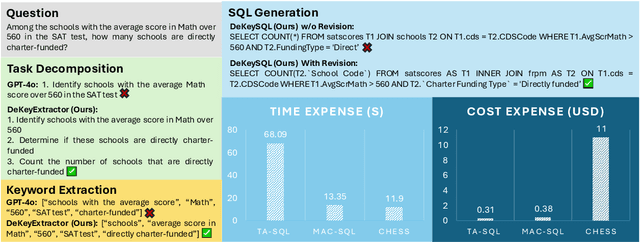
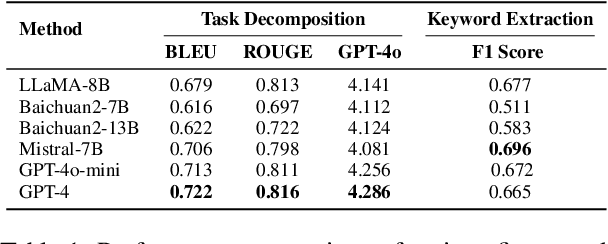
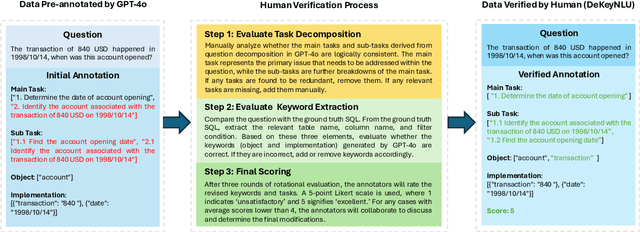
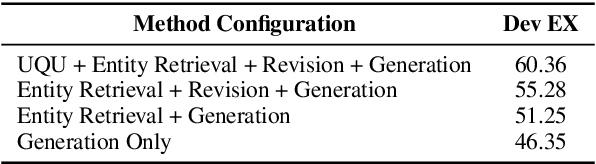
Natural Language to SQL (NL2SQL) provides a new model-centric paradigm that simplifies database access for non-technical users by converting natural language queries into SQL commands. Recent advancements, particularly those integrating Retrieval-Augmented Generation (RAG) and Chain-of-Thought (CoT) reasoning, have made significant strides in enhancing NL2SQL performance. However, challenges such as inaccurate task decomposition and keyword extraction by LLMs remain major bottlenecks, often leading to errors in SQL generation. While existing datasets aim to mitigate these issues by fine-tuning models, they struggle with over-fragmentation of tasks and lack of domain-specific keyword annotations, limiting their effectiveness. To address these limitations, we present DeKeyNLU, a novel dataset which contains 1,500 meticulously annotated QA pairs aimed at refining task decomposition and enhancing keyword extraction precision for the RAG pipeline. Fine-tuned with DeKeyNLU, we propose DeKeySQL, a RAG-based NL2SQL pipeline that employs three distinct modules for user question understanding, entity retrieval, and generation to improve SQL generation accuracy. We benchmarked multiple model configurations within DeKeySQL RAG pipeline. Experimental results demonstrate that fine-tuning with DeKeyNLU significantly improves SQL generation accuracy on both BIRD (62.31% to 69.10%) and Spider (84.2% to 88.7%) dev datasets.
From Large to Super-Tiny: End-to-End Optimization for Cost-Efficient LLMs
Apr 18, 2025In recent years, Large Language Models (LLMs) have significantly advanced artificial intelligence by optimizing traditional Natural Language Processing (NLP) pipelines, improving performance and generalization. This has spurred their integration into various systems. Many NLP systems, including ours, employ a "one-stage" pipeline directly incorporating LLMs. While effective, this approach incurs substantial costs and latency due to the need for large model parameters to achieve satisfactory outcomes. This paper introduces a three-stage cost-efficient end-to-end LLM deployment pipeline-including prototyping, knowledge transfer, and model compression-to tackle the cost-performance dilemma in LLM-based frameworks. Our approach yields a super tiny model optimized for cost and performance in online systems, simplifying the system architecture. Initially, by transforming complex tasks into a function call-based LLM-driven pipeline, an optimal performance prototype system is constructed to produce high-quality data as a teacher model. The second stage combine techniques like rejection fine-tuning, reinforcement learning and knowledge distillation to transfer knowledge to a smaller 0.5B student model, delivering effective performance at minimal cost. The final stage applies quantization and pruning to extremely compress model to 0.4B, achieving ultra-low latency and cost. The framework's modular design and cross-domain capabilities suggest potential applicability in other NLP areas.