 Add to Chrome
 Add to Firefox
 Add to Edge
HACHIMI: Scalable and Controllable Student Persona Generation via Orchestrated Agents
Mar 05, 2026
Student Personas (SPs) are emerging as infrastructure for educational LLMs, yet prior work often relies on ad-hoc prompting or hand-crafted profiles with limited control over educational theory and population distributions. We formalize this as Theory-Aligned and Distribution-Controllable Persona Generation (TAD-PG) and introduce HACHIMI, a multi-agent Propose-Validate-Revise framework that generates theory-aligned, quota-controlled personas. HACHIMI factorizes each persona into a theory-anchored educational schema, enforces developmental and psychological constraints via a neuro-symbolic validator, and combines stratified sampling with semantic deduplication to reduce mode collapse. The resulting HACHIMI-1M corpus comprises 1 million personas for Grades 1-12. Intrinsic evaluation shows near-perfect schema validity, accurate quotas, and substantial diversity, while external evaluation instantiates personas as student agents answering CEPS and PISA 2022 surveys; across 16 cohorts, math and curiosity/growth constructs align strongly between humans and agents, whereas classroom-climate and well-being constructs are only moderately aligned, revealing a fidelity gradient. All personas are generated with Qwen2.5-72B, and HACHIMI provides a standardized synthetic student population for group-level benchmarking and social-science simulations. Resources available at https://github.com/ZeroLoss-Lab/HACHIMI

Precise Drive with VLM: First Prize Solution for PRCV 2024 Drive LM challenge
Nov 05, 2024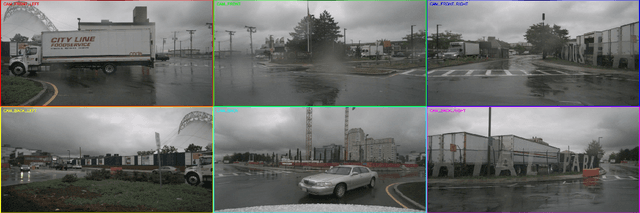
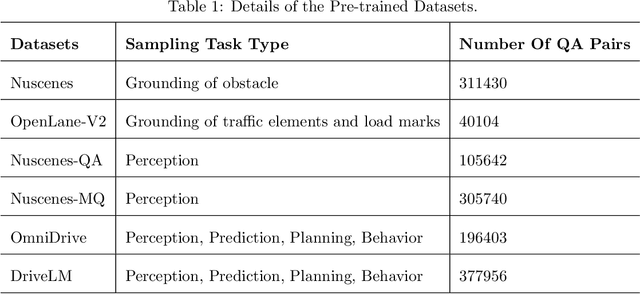
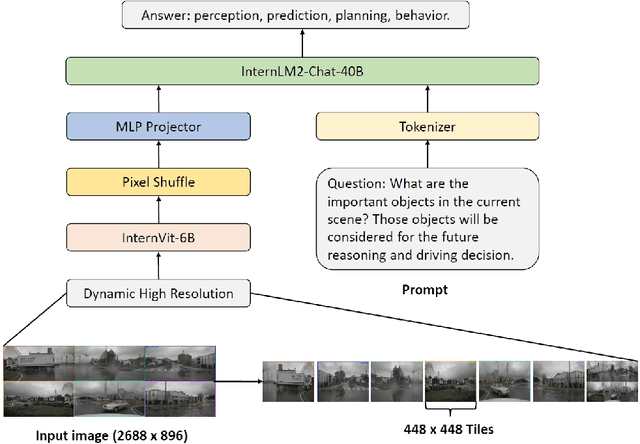

This technical report outlines the methodologies we applied for the PRCV Challenge, focusing on cognition and decision-making in driving scenarios. We employed InternVL-2.0, a pioneering open-source multi-modal model, and enhanced it by refining both the model input and training methodologies. For the input data, we strategically concatenated and formatted the multi-view images. It is worth mentioning that we utilized the coordinates of the original images without transformation. In terms of model training, we initially pre-trained the model on publicly available autonomous driving scenario datasets to bolster its alignment capabilities of the challenge tasks, followed by fine-tuning on the DriveLM-nuscenes Dataset. During the fine-tuning phase, we innovatively modified the loss function to enhance the model's precision in predicting coordinate values. These approaches ensure that our model possesses advanced cognitive and decision-making capabilities in driving scenarios. Consequently, our model achieved a score of 0.6064, securing the first prize on the competition's final results.