 Add to Chrome
 Add to Firefox
 Add to Edge
UniGRec: Unified Generative Recommendation with Soft Identifiers for End-to-End Optimization
Jan 24, 2026
Generative recommendation has recently emerged as a transformative paradigm that directly generates target items, surpassing traditional cascaded approaches. It typically involves two components: a tokenizer that learns item identifiers and a recommender trained on them. Existing methods often decouple tokenization from recommendation or rely on asynchronous alternating optimization, limiting full end-to-end alignment. To address this, we unify the tokenizer and recommender under the ultimate recommendation objective via differentiable soft item identifiers, enabling joint end-to-end training. However, this introduces three challenges: training-inference discrepancy due to soft-to-hard mismatch, item identifier collapse from codeword usage imbalance, and collaborative signal deficiency due to an overemphasis on fine-grained token-level semantics. To tackle these challenges, we propose UniGRec, a unified generative recommendation framework that addresses them from three perspectives. UniGRec employs Annealed Inference Alignment during tokenization to smoothly bridge soft training and hard inference, a Codeword Uniformity Regularization to prevent identifier collapse and encourage codebook diversity, and a Dual Collaborative Distillation mechanism that distills collaborative priors from a lightweight teacher model to jointly guide both the tokenizer and the recommender. Extensive experiments on real-world datasets demonstrate that UniGRec consistently outperforms state-of-the-art baseline methods. Our codes are available at https://github.com/Jialei-03/UniGRec.

Advanced Equalization in 112 Gb/s Upstream PON Using a Novel Fourier Convolution-based Network
May 04, 2024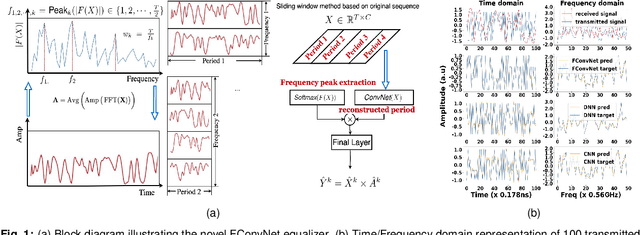

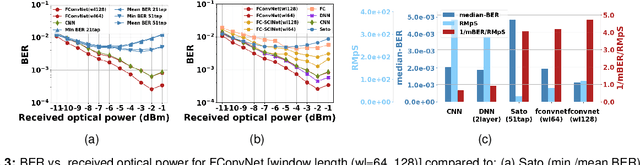
We experimentally demonstrate a novel, low-complexity Fourier Convolution-based Network (FConvNet) based equalizer for 112 Gb/s upstream PAM4-PON. At a BER of 0.005, FConvNet enhances the receiver sensitivity by 2 and 1 dB compared to a 51-tap Sato equalizer and benchmark machine learning algorithms respectively.
Machine Learning in Short-Reach Optical Systems: A Comprehensive Survey
May 02, 2024
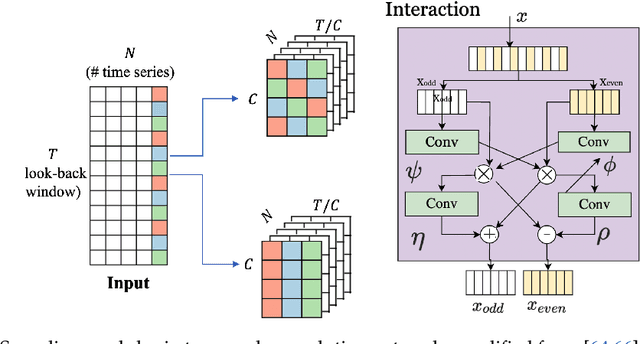

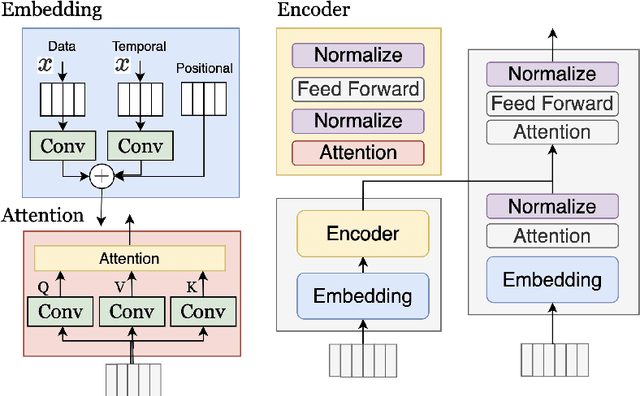
In recent years, extensive research has been conducted to explore the utilization of machine learning algorithms in various direct-detected and self-coherent short-reach communication applications. These applications encompass a wide range of tasks, including bandwidth request prediction, signal quality monitoring, fault detection, traffic prediction, and digital signal processing (DSP)-based equalization. As a versatile approach, machine learning demonstrates the ability to address stochastic phenomena in optical systems networks where deterministic methods may fall short. However, when it comes to DSP equalization algorithms, their performance improvements are often marginal, and their complexity is prohibitively high, especially in cost-sensitive short-reach communications scenarios such as passive optical networks (PONs). They excel in capturing temporal dependencies, handling irregular or nonlinear patterns effectively, and accommodating variable time intervals. Within this extensive survey, we outline the application of machine learning techniques in short-reach communications, specifically emphasizing their utilization in high-bandwidth demanding PONs. Notably, we introduce a novel taxonomy for time-series methods employed in machine learning signal processing, providing a structured classification framework. Our taxonomy categorizes current time series methods into four distinct groups: traditional methods, Fourier convolution-based methods, transformer-based models, and time-series convolutional networks. Finally, we highlight prospective research directions within this rapidly evolving field and outline specific solutions to mitigate the complexity associated with hardware implementations. We aim to pave the way for more practical and efficient deployment of machine learning approaches in short-reach optical communication systems by addressing complexity concerns.
A Novel Machine Learning-based Equalizer for a Downstream 100G PAM-4 PON
Apr 25, 2024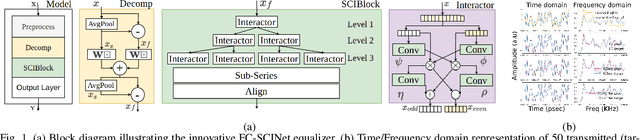

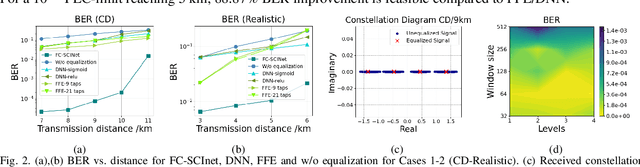
A frequency-calibrated SCINet (FC-SCINet) equalizer is proposed for down-stream 100G PON with 28.7 dB path loss. At 5 km, FC-SCINet improves the BER by 88.87% compared to FFE and a 3-layer DNN with 10.57% lower complexity.