 Add to Chrome
 Add to Firefox
 Add to Edge
NaviHydra: Controllable Navigation-guided End-to-end Autonomous Driving with Hydra-distillation
Dec 11, 2025

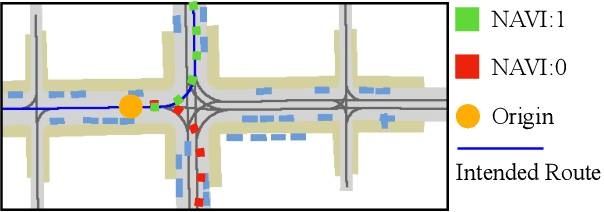
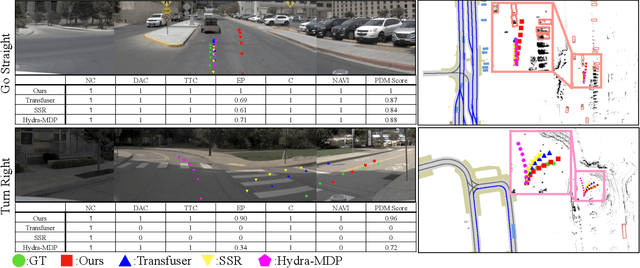
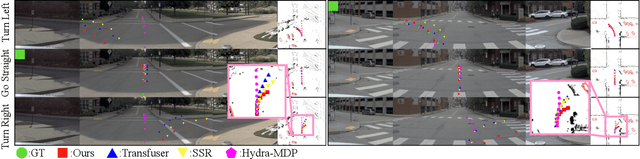
The complexity of autonomous driving scenarios requires robust models that can interpret high-level navigation commands and generate safe trajectories. While traditional rule-based systems can react to these commands, they often struggle in dynamic environments, and end-to-end methods face challenges in complying with explicit navigation commands. To address this, we present NaviHydra, a controllable navigation-guided end-to-end model distilled from an existing rule-based simulator. Our framework accepts high-level navigation commands as control signals, generating trajectories that align with specified intentions. We utilize a Bird's Eye View (BEV) based trajectory gathering method to enhance the trajectory feature extraction. Additionally, we introduce a novel navigation compliance metric to evaluate adherence to intended route, improving controllability and navigation safety. To comprehensively assess our model's controllability, we design a test that evaluates its response to various navigation commands. Our method significantly outperforms baseline models, achieving state-of-the-art results in the NAVSIM benchmark, demonstrating its effectiveness in advancing autonomous driving.

Dynamic LiDAR Re-simulation using Compositional Neural Fields
Dec 08, 2023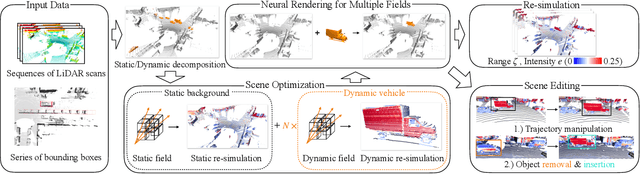
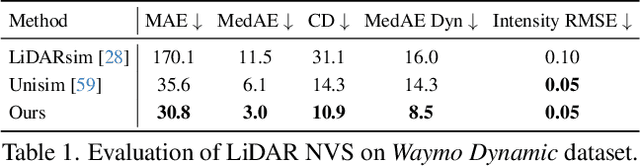
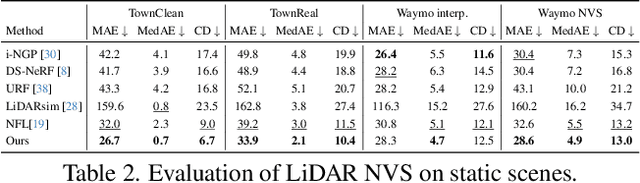
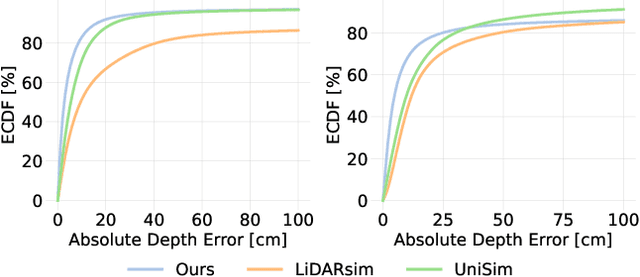
We introduce DyNFL, a novel neural field-based approach for high-fidelity re-simulation of LiDAR scans in dynamic driving scenes. DyNFL processes LiDAR measurements from dynamic environments, accompanied by bounding boxes of moving objects, to construct an editable neural field. This field, comprising separately reconstructed static backgrounds and dynamic objects, allows users to modify viewpoints, adjust object positions, and seamlessly add or remove objects in the re-simulated scene. A key innovation of our method is the neural field composition technique, which effectively integrates reconstructed neural assets from various scenes through a ray drop test, accounting for occlusions and transparent surfaces. Our evaluation with both synthetic and real-world environments demonstrates that \ShortName substantial improves dynamic scene simulation based on LiDAR scans, offering a combination of physical fidelity and flexible editing capabilities.