 Add to Chrome
 Add to Firefox
 Add to Edge
Dual-Mapping Sparse Vector Transmission for Short Packet URLLC
Jan 22, 2026
Sparse vector coding (SVC) is a promising short-packet transmission method for ultra reliable low latency communication (URLLC) in next generation communication systems. In this paper, a dual-mapping SVC (DM-SVC) based short packet transmission scheme is proposed to further enhance the transmission performance of SVC. The core idea behind the proposed scheme lies in mapping the transmitted information bits onto sparse vectors via block and single-element sparse mappings. The block sparse mapping pattern is able to concentrate the transmit power in a small number of non-zero blocks thus improving the decoding accuracy, while the single-element sparse mapping pattern ensures that the code length does not increase dramatically with the number of transmitted information bits. At the receiver, a two-stage decoding algorithm is proposed to sequentially identify non-zero block indexes and single-element non-zero indexes. Extensive simulation results verify that proposed DM-SVC scheme outperforms the existing SVC schemes in terms of block error rate and spectral efficiency.

Toward UL-DL Rate Balancing: Joint Resource Allocation and Hybrid-Mode Multiple Access for UAV-BS Assisted Communication Systems
Nov 16, 2021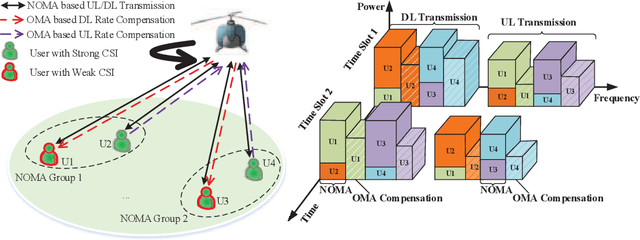
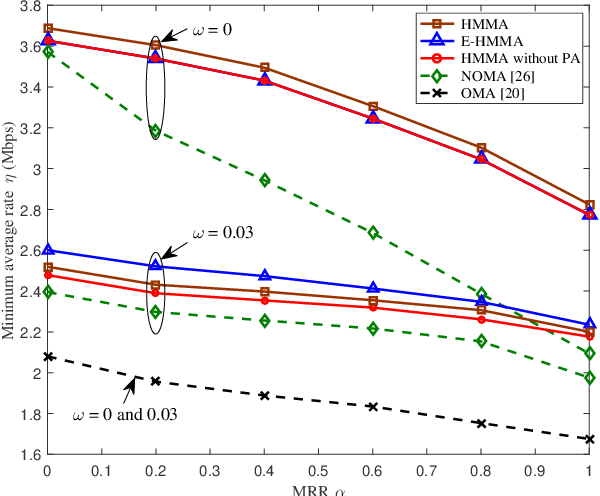

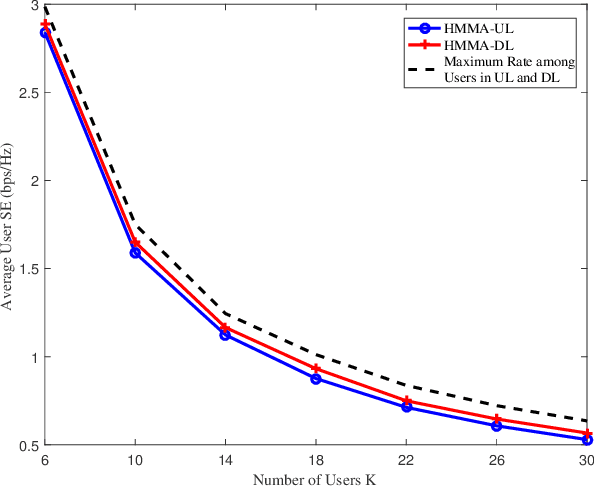
In this paper, we investigate unmanned aerial vehicle (UAV) assisted communication systems that require quasi-balanced data rates in uplink (UL) and downlink (DL), as well as users' heterogeneous traffic. To the best of our knowledge, this is the first work to explicitly investigate joint UL-DL optimization for UAV assisted systems under heterogeneous requirements. A hybrid-mode multiple access (HMMA) scheme is proposed toward heterogeneous traffic, where non-orthogonal multiple access (NOMA) targets high average data rate, while orthogonal multiple access (OMA) aims to meet users' instantaneous rate demands by compensating for their rates. HMMA enables a higher degree of freedom in multiple access and achieves a superior minimum average rate among users than the UAV assisted NOMA or OMA schemes. Under HMMA, a joint UL-DL resource allocation algorithm is proposed with a closed-form optimal solution for UL/DL power allocation to achieve quasi-balanced average rates for UL and DL. Furthermore, considering the error propagation in successive interference cancellation (SIC) of NOMA, an enhanced-HMMA scheme is proposed, which demonstrates high robustness against SIC error and a higher minimum average rate than the HMMA scheme.