 Add to Chrome
 Add to Firefox
 Add to Edge
Improving Few-Shot Change Detection Visual Question Answering via Decision-Ambiguity-guided Reinforcement Fine-Tuning
Dec 31, 2025
Change detection visual question answering (CDVQA) requires answering text queries by reasoning about semantic changes in bi-temporal remote sensing images. A straightforward approach is to boost CDVQA performance with generic vision-language models via supervised fine-tuning (SFT). Despite recent progress, we observe that a significant portion of failures do not stem from clearly incorrect predictions, but from decision ambiguity, where the model assigns similar confidence to the correct answer and strong distractors. To formalize this challenge, we define Decision-Ambiguous Samples (DAS) as instances with a small probability margin between the ground-truth answer and the most competitive alternative. We argue that explicitly optimizing DAS is crucial for improving the discriminability and robustness of CDVQA models. To this end, we propose DARFT, a Decision-Ambiguity-guided Reinforcement Fine-Tuning framework that first mines DAS using an SFT-trained reference policy and then applies group-relative policy optimization on the mined subset. By leveraging multi-sample decoding and intra-group relative advantages, DARFT suppresses strong distractors and sharpens decision boundaries without additional supervision. Extensive experiments demonstrate consistent gains over SFT baselines, particularly under few-shot settings.

Show Me What and Where has Changed? Question Answering and Grounding for Remote Sensing Change Detection
Oct 31, 2024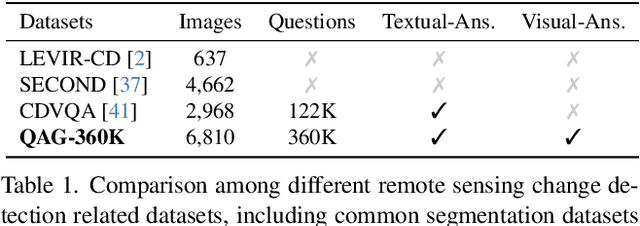
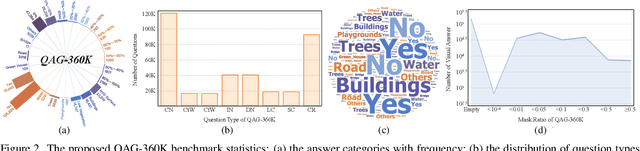
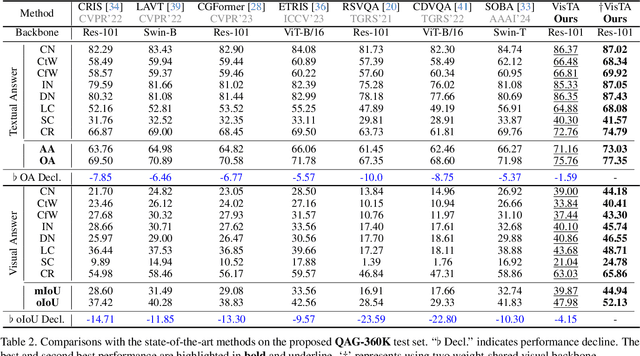
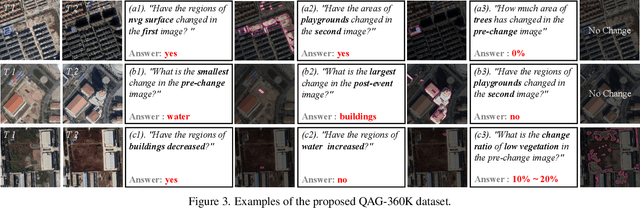
Remote sensing change detection aims to perceive changes occurring on the Earth's surface from remote sensing data in different periods, and feed these changes back to humans. However, most existing methods only focus on detecting change regions, lacking the ability to interact with users to identify changes that the users expect. In this paper, we introduce a new task named Change Detection Question Answering and Grounding (CDQAG), which extends the traditional change detection task by providing interpretable textual answers and intuitive visual evidence. To this end, we construct the first CDQAG benchmark dataset, termed QAG-360K, comprising over 360K triplets of questions, textual answers, and corresponding high-quality visual masks. It encompasses 10 essential land-cover categories and 8 comprehensive question types, which provides a large-scale and diverse dataset for remote sensing applications. Based on this, we present VisTA, a simple yet effective baseline method that unifies the tasks of question answering and grounding by delivering both visual and textual answers. Our method achieves state-of-the-art results on both the classic CDVQA and the proposed CDQAG datasets. Extensive qualitative and quantitative experimental results provide useful insights for the development of better CDQAG models, and we hope that our work can inspire further research in this important yet underexplored direction. The proposed benchmark dataset and method are available at https://github.com/like413/VisTA.