 Add to Chrome
 Add to Firefox
 Add to Edge
Learning Semantic-Geometric Task Graph-Representations from Human Demonstrations
Jan 16, 2026
Learning structured task representations from human demonstrations is essential for understanding long-horizon manipulation behaviors, particularly in bimanual settings where action ordering, object involvement, and interaction geometry can vary significantly. A key challenge lies in jointly capturing the discrete semantic structure of tasks and the temporal evolution of object-centric geometric relations in a form that supports reasoning over task progression. In this work, we introduce a semantic-geometric task graph-representation that encodes object identities, inter-object relations, and their temporal geometric evolution from human demonstrations. Building on this formulation, we propose a learning framework that combines a Message Passing Neural Network (MPNN) encoder with a Transformer-based decoder, decoupling scene representation learning from action-conditioned reasoning about task progression. The encoder operates solely on temporal scene graphs to learn structured representations, while the decoder conditions on action-context to predict future action sequences, associated objects, and object motions over extended time horizons. Through extensive evaluation on human demonstration datasets, we show that semantic-geometric task graph-representations are particularly beneficial for tasks with high action and object variability, where simpler sequence-based models struggle to capture task progression. Finally, we demonstrate that task graph representations can be transferred to a physical bimanual robot and used for online action selection, highlighting their potential as reusable task abstractions for downstream decision-making in manipulation systems.

A Representative Study on Human Detection of Artificially Generated Media Across Countries
Dec 10, 2023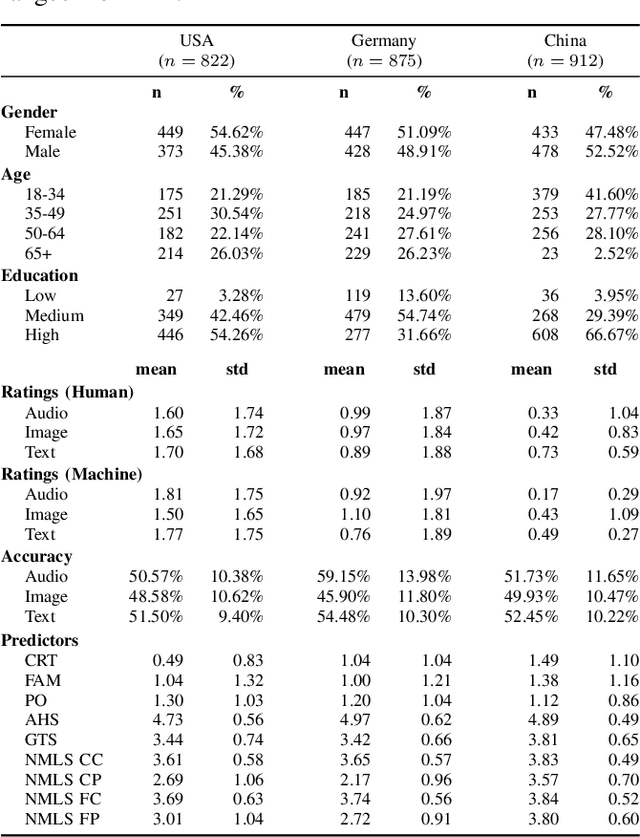
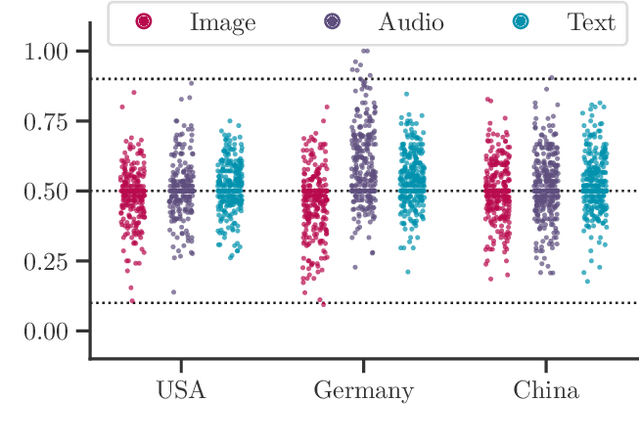
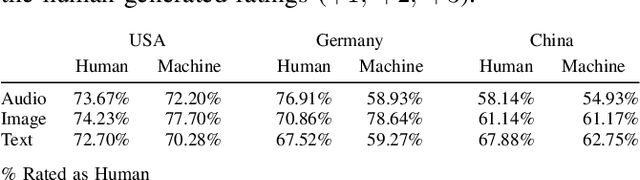
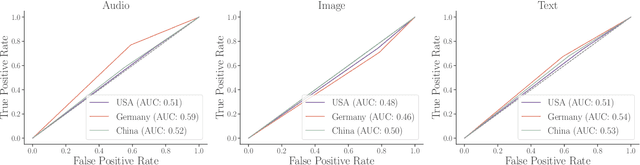
AI-generated media has become a threat to our digital society as we know it. These forgeries can be created automatically and on a large scale based on publicly available technology. Recognizing this challenge, academics and practitioners have proposed a multitude of automatic detection strategies to detect such artificial media. However, in contrast to these technical advances, the human perception of generated media has not been thoroughly studied yet. In this paper, we aim at closing this research gap. We perform the first comprehensive survey into people's ability to detect generated media, spanning three countries (USA, Germany, and China) with 3,002 participants across audio, image, and text media. Our results indicate that state-of-the-art forgeries are almost indistinguishable from "real" media, with the majority of participants simply guessing when asked to rate them as human- or machine-generated. In addition, AI-generated media receive is voted more human like across all media types and all countries. To further understand which factors influence people's ability to detect generated media, we include personal variables, chosen based on a literature review in the domains of deepfake and fake news research. In a regression analysis, we found that generalized trust, cognitive reflection, and self-reported familiarity with deepfakes significantly influence participant's decision across all media categories.