 Add to Chrome
 Add to Firefox
 Add to Edge
LongCat-Flash-Thinking-2601 Technical Report
Jan 23, 2026
We introduce LongCat-Flash-Thinking-2601, a 560-billion-parameter open-source Mixture-of-Experts (MoE) reasoning model with superior agentic reasoning capability. LongCat-Flash-Thinking-2601 achieves state-of-the-art performance among open-source models on a wide range of agentic benchmarks, including agentic search, agentic tool use, and tool-integrated reasoning. Beyond benchmark performance, the model demonstrates strong generalization to complex tool interactions and robust behavior under noisy real-world environments. Its advanced capability stems from a unified training framework that combines domain-parallel expert training with subsequent fusion, together with an end-to-end co-design of data construction, environments, algorithms, and infrastructure spanning from pre-training to post-training. In particular, the model's strong generalization capability in complex tool-use are driven by our in-depth exploration of environment scaling and principled task construction. To optimize long-tailed, skewed generation and multi-turn agentic interactions, and to enable stable training across over 10,000 environments spanning more than 20 domains, we systematically extend our asynchronous reinforcement learning framework, DORA, for stable and efficient large-scale multi-environment training. Furthermore, recognizing that real-world tasks are inherently noisy, we conduct a systematic analysis and decomposition of real-world noise patterns, and design targeted training procedures to explicitly incorporate such imperfections into the training process, resulting in improved robustness for real-world applications. To further enhance performance on complex reasoning tasks, we introduce a Heavy Thinking mode that enables effective test-time scaling by jointly expanding reasoning depth and width through intensive parallel thinking.

Embedding Space Allocation with Angle-Norm Joint Classifiers for Few-Shot Class-Incremental Learning
Nov 14, 2024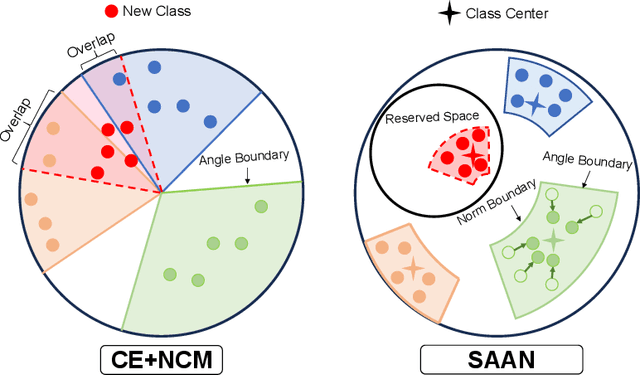
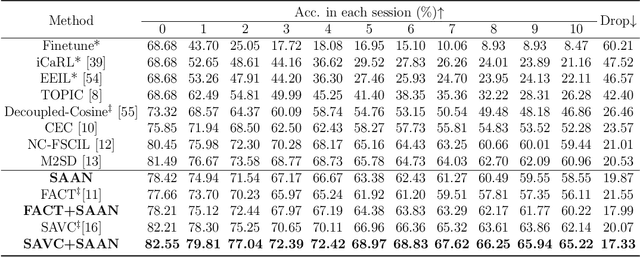
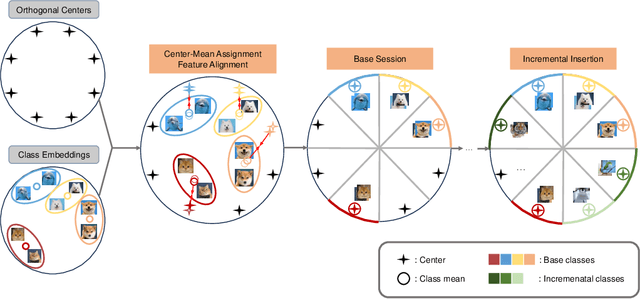
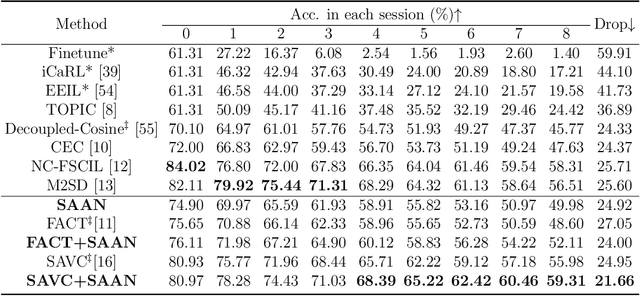
Few-shot class-incremental learning (FSCIL) aims to continually learn new classes from only a few samples without forgetting previous ones, requiring intelligent agents to adapt to dynamic environments. FSCIL combines the characteristics and challenges of class-incremental learning and few-shot learning: (i) Current classes occupy the entire feature space, which is detrimental to learning new classes. (ii) The small number of samples in incremental rounds is insufficient for fully training. In existing mainstream virtual class methods, for addressing the challenge (i), they attempt to use virtual classes as placeholders. However, new classes may not necessarily align with the virtual classes. For the challenge (ii), they replace trainable fully connected layers with Nearest Class Mean (NCM) classifiers based on cosine similarity, but NCM classifiers do not account for sample imbalance issues. To address these issues in previous methods, we propose the class-center guided embedding Space Allocation with Angle-Norm joint classifiers (SAAN) learning framework, which provides balanced space for all classes and leverages norm differences caused by sample imbalance to enhance classification criteria. Specifically, for challenge (i), SAAN divides the feature space into multiple subspaces and allocates a dedicated subspace for each session by guiding samples with the pre-set category centers. For challenge (ii), SAAN establishes a norm distribution for each class and generates angle-norm joint logits. Experiments demonstrate that SAAN can achieve state-of-the-art performance and it can be directly embedded into other SOTA methods as a plug-in, further enhancing their performance.