 Add to Chrome
 Add to Firefox
 Add to Edge
Learning from Prompt itself: the Hierarchical Attribution Prompt Optimization
Jan 06, 2026
Optimization is fundamental across numerous disciplines, typically following an iterative process of refining an initial solution to enhance performance. This principle is equally critical in prompt engineering, where designing effective prompts for large language models constitutes a complex optimization challenge. A structured optimization approach requires automated or semi-automated procedures to develop improved prompts, thereby reducing manual effort, improving performance, and yielding an interpretable process. However, current prompt optimization methods often induce prompt drift, where new prompts fix prior failures but impair performance on previously successful tasks. Additionally, generating prompts from scratch can compromise interpretability. To address these limitations, this study proposes the Hierarchical Attribution Prompt Optimization (HAPO) framework, which introduces three innovations: (1) a dynamic attribution mechanism targeting error patterns in training data and prompting history, (2) semantic-unit optimization for editing functional prompt segments, and (3) multimodal-friendly progression supporting both end-to-end LLM and LLM-MLLM workflows. Applied in contexts like single/multi-image QA (e.g., OCRV2) and complex task analysis (e.g., BBH), HAPO demonstrates enhanced optimization efficiency, outperforming comparable automated prompt optimization methods and establishing an extensible paradigm for scalable prompt engineering.

A Comprehensive Dataset and Automated Pipeline for Nailfold Capillary Analysis
Dec 10, 2023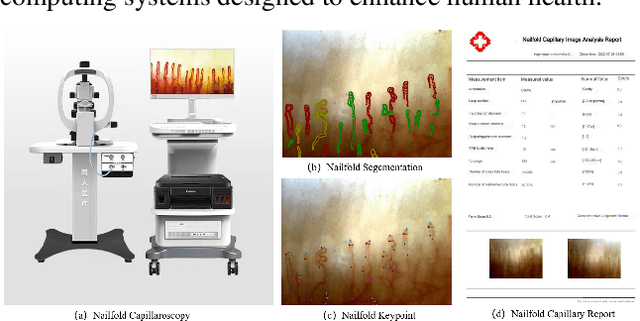

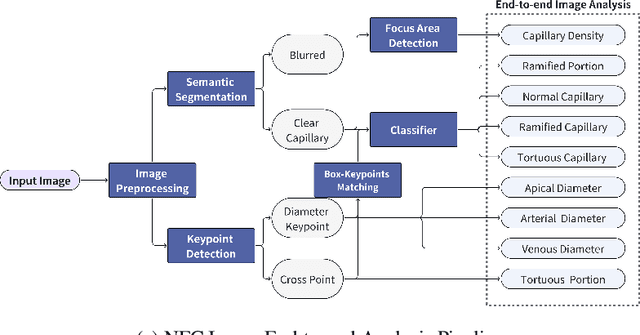
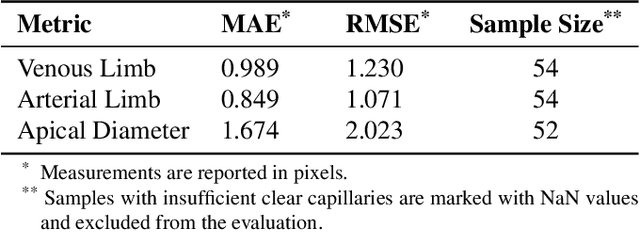
Nailfold capillaroscopy is a well-established method for assessing health conditions, but the untapped potential of automated medical image analysis using machine learning remains despite recent advancements. In this groundbreaking study, we present a pioneering effort in constructing a comprehensive dataset-321 images, 219 videos, 68 clinic reports, with expert annotations-that serves as a crucial resource for training deep-learning models. Leveraging this dataset, we propose an end-to-end nailfold capillary analysis pipeline capable of automatically detecting and measuring diverse morphological and dynamic features. Experimental results demonstrate sub-pixel measurement accuracy and 90% accuracy in predicting abnormality portions, highlighting its potential for advancing quantitative medical research and enabling pervasive computing in healthcare. We've shared our open-source codes and data (available at https://github.com/THU-CS-PI-LAB/ANFC-Automated-Nailfold-Capillary) to contribute to transformative progress in computational medical image analysis.