 Add to Chrome
 Add to Firefox
 Add to Edge
Multi-Source Retrieval and Reasoning for Legal Sentencing Prediction
Feb 04, 2026
Legal judgment prediction (LJP) aims to predict judicial outcomes from case facts and typically includes law article, charge, and sentencing prediction. While recent methods perform well on the first two subtasks, legal sentencing prediction (LSP) remains difficult due to its need for fine-grained objective knowledge and flexible subjective reasoning. To address these limitations, we propose $MSR^2$, a framework that integrates multi-source retrieval and reasoning in LLMs with reinforcement learning. $MSR^2$ enables LLMs to perform multi-source retrieval based on reasoning needs and applies a process-level reward to guide intermediate subjective reasoning steps. Experiments on two real-world datasets show that $MSR^2$ improves both accuracy and interpretability in LSP, providing a promising step toward practical legal AI. Our code is available at https://anonymous.4open.science/r/MSR2-FC3B.

SinTra: Learning an inspiration model from a single multi-track music segment
Apr 21, 2022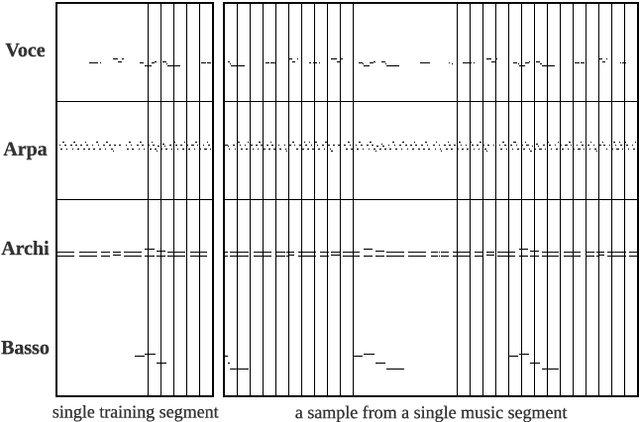
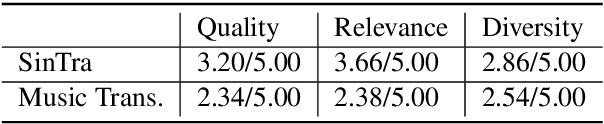
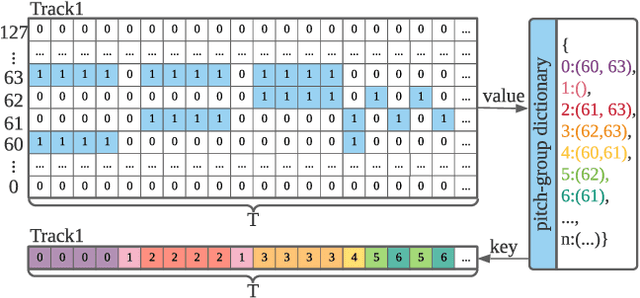

In this paper, we propose SinTra, an auto-regressive sequential generative model that can learn from a single multi-track music segment, to generate coherent, aesthetic, and variable polyphonic music of multi-instruments with an arbitrary length of bar. For this task, to ensure the relevance of generated samples and training music, we present a novel pitch-group representation. SinTra, consisting of a pyramid of Transformer-XL with a multi-scale training strategy, can learn both the musical structure and the relative positional relationship between notes of the single training music segment. Additionally, for maintaining the inter-track correlation, we use the convolution operation to process multi-track music, and when decoding, the tracks are independent to each other to prevent interference. We evaluate SinTra with both subjective study and objective metrics. The comparison results show that our framework can learn information from a single music segment more sufficiently than Music Transformer. Also the comparison between SinTra and its variant, i.e., the single-stage SinTra with the first stage only, shows that the pyramid structure can effectively suppress overly-fragmented notes.