 Add to Chrome
 Add to Firefox
 Add to Edge
ATLANTIS: AI-driven Threat Localization, Analysis, and Triage Intelligence System
Sep 18, 2025
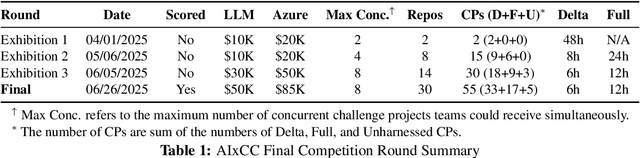
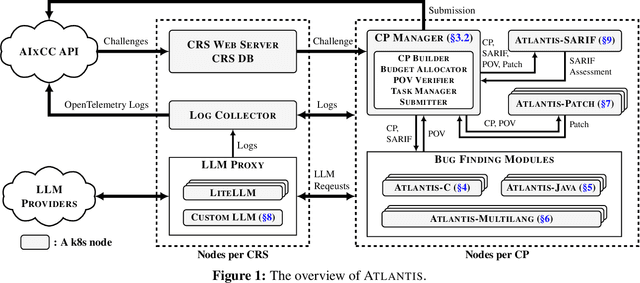
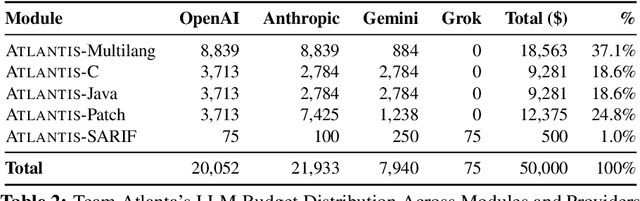
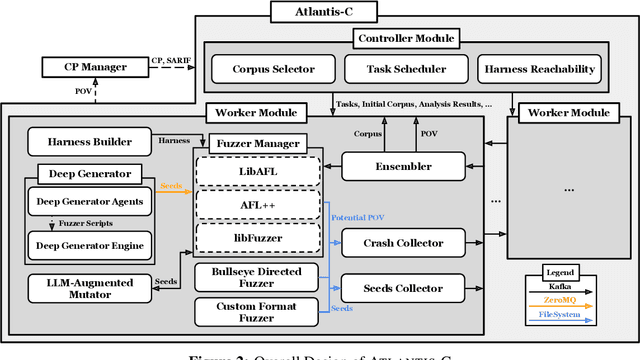
We present ATLANTIS, the cyber reasoning system developed by Team Atlanta that won 1st place in the Final Competition of DARPA's AI Cyber Challenge (AIxCC) at DEF CON 33 (August 2025). AIxCC (2023-2025) challenged teams to build autonomous cyber reasoning systems capable of discovering and patching vulnerabilities at the speed and scale of modern software. ATLANTIS integrates large language models (LLMs) with program analysis -- combining symbolic execution, directed fuzzing, and static analysis -- to address limitations in automated vulnerability discovery and program repair. Developed by researchers at Georgia Institute of Technology, Samsung Research, KAIST, and POSTECH, the system addresses core challenges: scaling across diverse codebases from C to Java, achieving high precision while maintaining broad coverage, and producing semantically correct patches that preserve intended behavior. We detail the design philosophy, architectural decisions, and implementation strategies behind ATLANTIS, share lessons learned from pushing the boundaries of automated security when program analysis meets modern AI, and release artifacts to support reproducibility and future research.

Relational Knowledge Distillation
May 01, 2019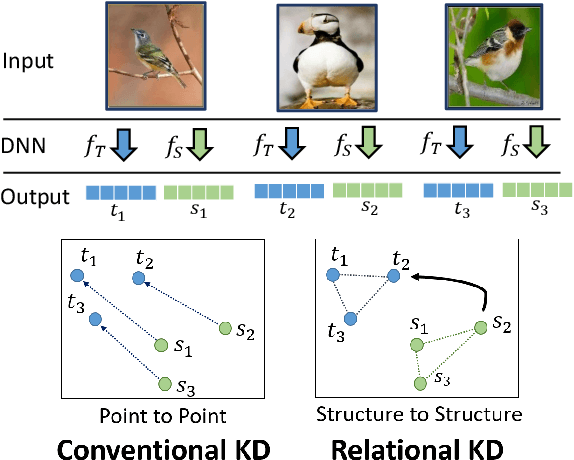


Knowledge distillation aims at transferring knowledge acquired in one model (a teacher) to another model (a student) that is typically smaller. Previous approaches can be expressed as a form of training the student to mimic output activations of individual data examples represented by the teacher. We introduce a novel approach, dubbed relational knowledge distillation (RKD), that transfers mutual relations of data examples instead. For concrete realizations of RKD, we propose distance-wise and angle-wise distillation losses that penalize structural differences in relations. Experiments conducted on different tasks show that the proposed method improves educated student models with a significant margin. In particular for metric learning, it allows students to outperform their teachers' performance, achieving the state of the arts on standard benchmark datasets.