 Add to Chrome
 Add to Firefox
 Add to Edge
Robust Energy-Efficient Sleep-Mode Strategy for Multi-RIS-Aided Cell-Free Massive MIMO
Dec 13, 2025
With the explosive growth of data traffic and the ubiquitous connectivity of wireless devices, the energy demands of wireless networks have inevitably escalated. Reconfigurable intelligent surface (RIS) has emerged as a promising solution for 6G networks due to its energy efficiency (EE) and low cost, while cell-free massive multiple-input multiple-output (CF-mMIMO) was proposed as an innovative network architecture without fixed cell boundaries to enhance these measures even further. However, existing studies often assume consistently high traffic loads, neglecting the dynamic nature of user demand. This can result in underutilized access points (APs) and unnecessary energy expenditure during low-demand periods. To tackle the challenge of EE in CF-mMIMO systems during low load periods, this paper proposes a novel energy-efficient transmission scheme that jointly coordinates active APs and multiple passive RISs. Specifically, a dynamic AP sleep-mode strategy is designed, where certain APs are selectively deactivated while nearby RISs assist in maintaining coverage. We formulate the EE maximization objective as a fractional programming problem and adopt the Dinkelbach method in conjunction with alternating optimization (AO) to iteratively solve the three coupled subproblems: (i) AP selection via a hybrid branch-and-bound (BnB) and greedy algorithm, (ii) transmit power optimization using a sequential convex approximation (SCA) method, initialized by a heuristic zero-forcing strategy, and (iii) RIS phase shift optimization using gradient projection. Simulation results show that the proposed scheme achieves significantly higher EE than existing methods in both low and moderate user scenarios.

Empowering Large Language Models in Wireless Communication: A Novel Dataset and Fine-Tuning Framework
Jan 16, 2025In this work, we develop a specialized dataset aimed at enhancing the evaluation and fine-tuning of large language models (LLMs) specifically for wireless communication applications. The dataset includes a diverse set of multi-hop questions, including true/false and multiple-choice types, spanning varying difficulty levels from easy to hard. By utilizing advanced language models for entity extraction and question generation, rigorous data curation processes are employed to maintain high quality and relevance. Additionally, we introduce a Pointwise V-Information (PVI) based fine-tuning method, providing a detailed theoretical analysis and justification for its use in quantifying the information content of training data with 2.24\% and 1.31\% performance boost for different models compared to baselines, respectively. To demonstrate the effectiveness of the fine-tuned models with the proposed methodologies on practical tasks, we also consider different tasks, including summarizing optimization problems from technical papers and solving the mathematical problems related to non-orthogonal multiple access (NOMA), which are generated by using the proposed multi-agent framework. Simulation results show significant performance gain in summarization tasks with 20.9\% in the ROUGE-L metrics. We also study the scaling laws of fine-tuning LLMs and the challenges LLMs face in the field of wireless communications, offering insights into their adaptation to wireless communication tasks. This dataset and fine-tuning methodology aim to enhance the training and evaluation of LLMs, contributing to advancements in LLMs for wireless communication research and applications.
Optimal Power Allocation in Uplink NOMA with Simultaneous Cache-Enabled D2D Communications
Dec 01, 2024Non-orthogonal multiple access (NOMA) is widely viewed as a potential candidate for providing enhanced multiple access in future mobile networks by eliminating the orthogonal distribution of radio resources amongst the users. Nevertheless, the performance of NOMA can be significantly improved by combining it with other sophisticated technologies such as wireless data caching and device-to-device (D2D) communications. In this letter, we propose a novel cellular system model which integrates uplink NOMA with cache based device-to-device (D2D) communications. The proposed system would enable a cellular user to upload data file to base station while simultaneously exchanging useful cache content with another nearby user. We maximize the system sum rate by deriving closed form solutions for optimal power allocation. Simulation results demonstrate the superior performance of our proposed model over other potential combinations of uplink NOMA and D2D communications.
Exploring Age-of-Information Weighting in Federated Learning under Data Heterogeneity
May 24, 2024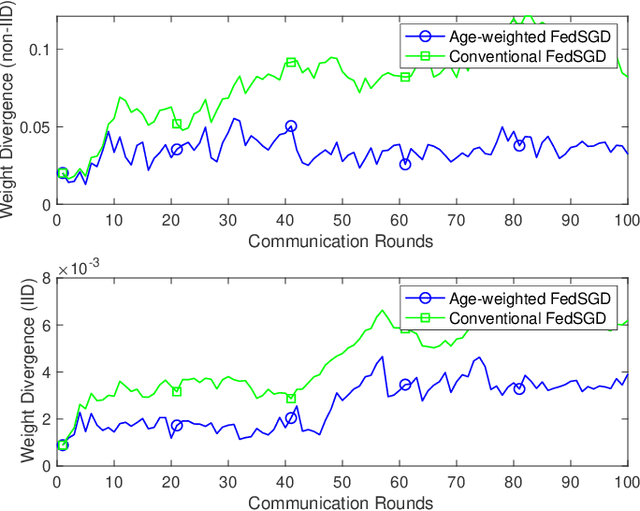
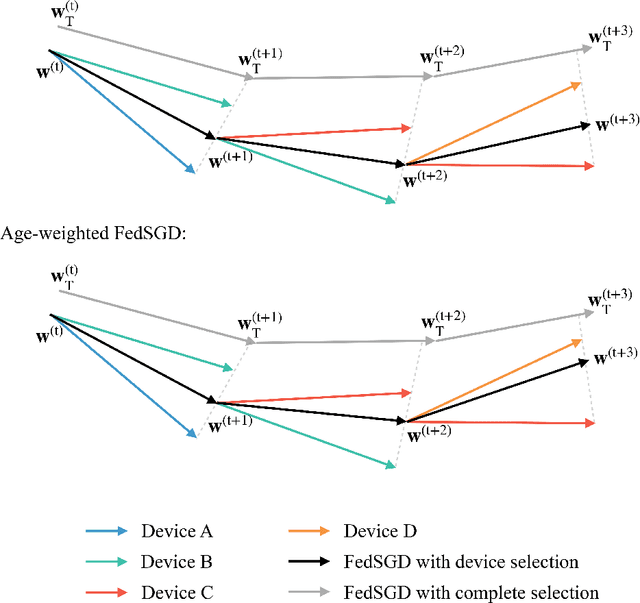
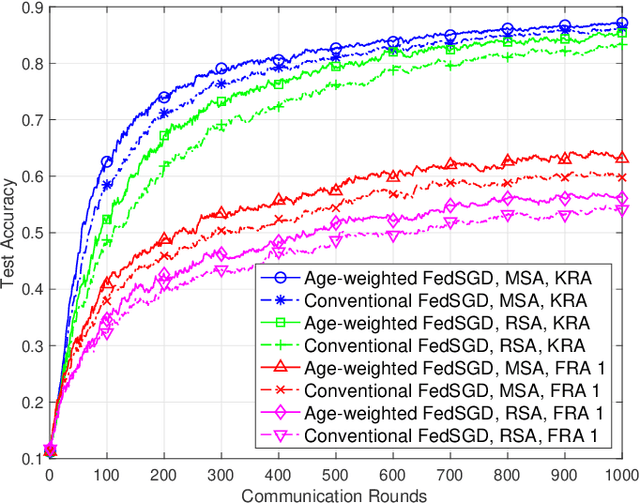
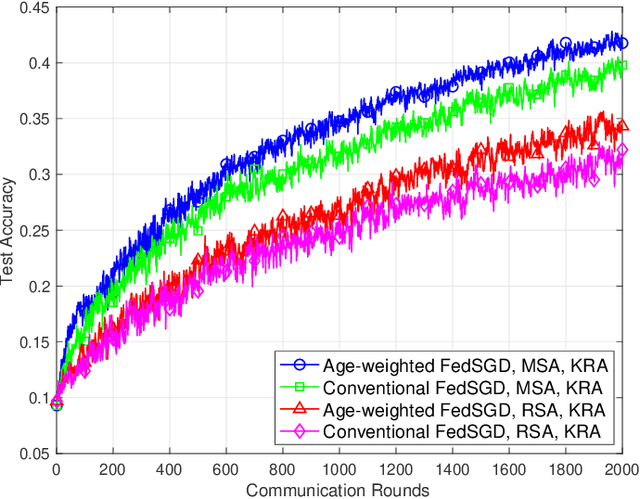
This paper investigates federated learning in a wireless communication system, where random device selection is employed with non-independent and identically distributed (non-IID) data. The analysis indicates that while training deep learning networks using federated stochastic gradient descent (FedSGD) on non-IID datasets, device selection can generate gradient errors that accumulate, leading to potential weight divergence. To mitigate training divergence, we design an age-weighted FedSGD to scale local gradients according to the previous state of devices. To further improve learning performance by increasing device participation under the maximum time consumption constraint, we formulate an energy consumption minimization problem by including resource allocation and sub-channel assignment. By transforming the resource allocation problem into convex and utilizing KKT conditions, we derived the optimal resource allocation solution. Moreover, this paper develops a matching based algorithm to generate the enhanced sub-channel assignment. Simulation results indicate that i) age-weighted FedSGD is able to outperform conventional FedSGD in terms of convergence rate and achievable accuracy, and ii) the proposed resource allocation and sub-channel assignment strategies can significantly reduce energy consumption and improve learning performance by increasing the number of selected devices.