 Add to Chrome
 Add to Firefox
 Add to Edge
The Great March 100: 100 Detail-oriented Tasks for Evaluating Embodied AI Agents
Jan 16, 2026
Recently, with the rapid development of robot learning and imitation learning, numerous datasets and methods have emerged. However, these datasets and their task designs often lack systematic consideration and principles. This raises important questions: Do the current datasets and task designs truly advance the capabilities of robotic agents? Do evaluations on a few common tasks accurately reflect the differentiated performance of various methods proposed by different teams and evaluated on different tasks? To address these issues, we introduce the Great March 100 (\textbf{GM-100}) as the first step towards a robot learning Olympics. GM-100 consists of 100 carefully designed tasks that cover a wide range of interactions and long-tail behaviors, aiming to provide a diverse and challenging set of tasks to comprehensively evaluate the capabilities of robotic agents and promote diversity and complexity in robot dataset task designs. These tasks are developed through systematic analysis and expansion of existing task designs, combined with insights from human-object interaction primitives and object affordances. We collect a large amount of trajectory data on different robotic platforms and evaluate several baseline models. Experimental results demonstrate that the GM-100 tasks are 1) feasible to execute and 2) sufficiently challenging to effectively differentiate the performance of current VLA models. Our data and code are available at https://rhos.ai/research/gm-100.

Reconstructing In-the-Wild Open-Vocabulary Human-Object Interactions
Mar 20, 2025Reconstructing human-object interactions (HOI) from single images is fundamental in computer vision. Existing methods are primarily trained and tested on indoor scenes due to the lack of 3D data, particularly constrained by the object variety, making it challenging to generalize to real-world scenes with a wide range of objects. The limitations of previous 3D HOI datasets were primarily due to the difficulty in acquiring 3D object assets. However, with the development of 3D reconstruction from single images, recently it has become possible to reconstruct various objects from 2D HOI images. We therefore propose a pipeline for annotating fine-grained 3D humans, objects, and their interactions from single images. We annotated 2.5k+ 3D HOI assets from existing 2D HOI datasets and built the first open-vocabulary in-the-wild 3D HOI dataset Open3DHOI, to serve as a future test set. Moreover, we design a novel Gaussian-HOI optimizer, which efficiently reconstructs the spatial interactions between humans and objects while learning the contact regions. Besides the 3D HOI reconstruction, we also propose several new tasks for 3D HOI understanding to pave the way for future work. Data and code will be publicly available at https://wenboran2002.github.io/3dhoi.
Interacted Object Grounding in Spatio-Temporal Human-Object Interactions
Dec 27, 2024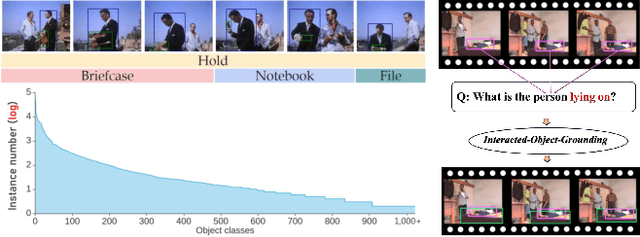
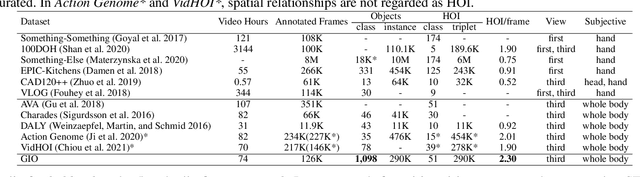
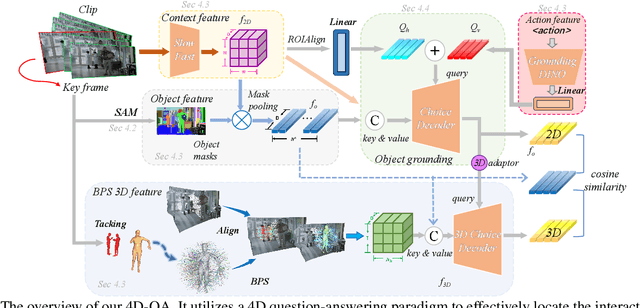
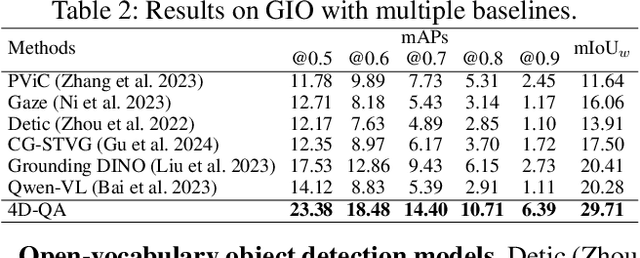
Spatio-temporal Human-Object Interaction (ST-HOI) understanding aims at detecting HOIs from videos, which is crucial for activity understanding. However, existing whole-body-object interaction video benchmarks overlook the truth that open-world objects are diverse, that is, they usually provide limited and predefined object classes. Therefore, we introduce a new open-world benchmark: Grounding Interacted Objects (GIO) including 1,098 interacted objects class and 290K interacted object boxes annotation. Accordingly, an object grounding task is proposed expecting vision systems to discover interacted objects. Even though today's detectors and grounding methods have succeeded greatly, they perform unsatisfactorily in localizing diverse and rare objects in GIO. This profoundly reveals the limitations of current vision systems and poses a great challenge. Thus, we explore leveraging spatio-temporal cues to address object grounding and propose a 4D question-answering framework (4D-QA) to discover interacted objects from diverse videos. Our method demonstrates significant superiority in extensive experiments compared to current baselines. Data and code will be publicly available at https://github.com/DirtyHarryLYL/HAKE-AVA.