 Add to Chrome
 Add to Firefox
 Add to Edge
A Brain-like Synergistic Core in LLMs Drives Behaviour and Learning
Jan 11, 2026
The independent evolution of intelligence in biological and artificial systems offers a unique opportunity to identify its fundamental computational principles. Here we show that large language models spontaneously develop synergistic cores -- components where information integration exceeds individual parts -- remarkably similar to those in the human brain. Using principles of information decomposition across multiple LLM model families and architectures, we find that areas in middle layers exhibit synergistic processing while early and late layers rely on redundancy, mirroring the informational organisation in biological brains. This organisation emerges through learning and is absent in randomly initialised networks. Crucially, ablating synergistic components causes disproportionate behavioural changes and performance loss, aligning with theoretical predictions about the fragility of synergy. Moreover, fine-tuning synergistic regions through reinforcement learning yields significantly greater performance gains than training redundant components, yet supervised fine-tuning shows no such advantage. This convergence suggests that synergistic information processing is a fundamental property of intelligence, providing targets for principled model design and testable predictions for biological intelligence.

Synergistic information supports modality integration and flexible learning in neural networks solving multiple tasks
Oct 06, 2022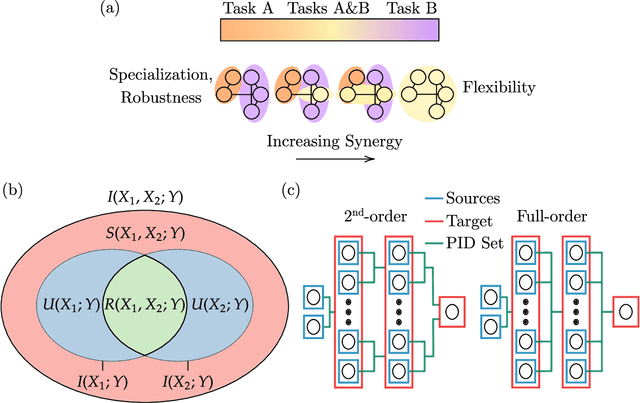
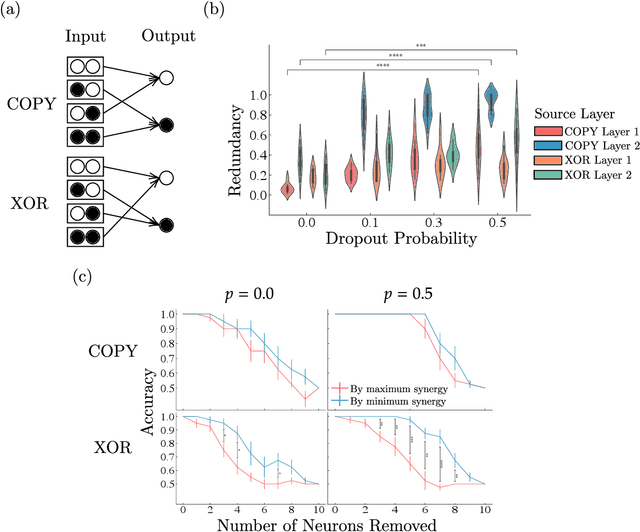
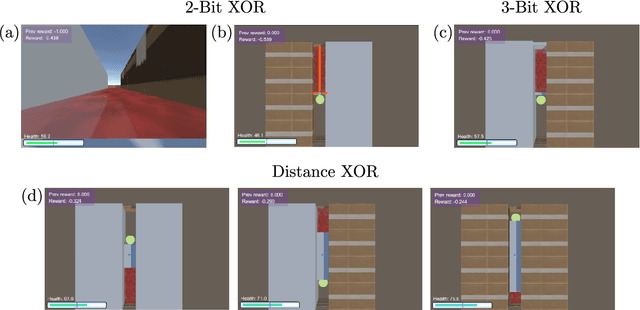
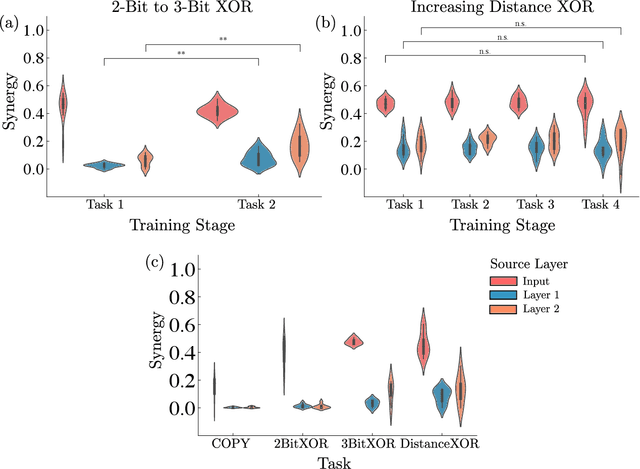
Striking progress has recently been made in understanding human cognition by analyzing how its neuronal underpinnings are engaged in different modes of information processing. Specifically, neural information can be decomposed into synergistic, redundant, and unique features, with synergistic components being particularly aligned with complex cognition. However, two fundamental questions remain unanswered: (a) precisely how and why a cognitive system can become highly synergistic; and (b) how these informational states map onto artificial neural networks in various learning modes. To address these questions, here we employ an information-decomposition framework to investigate the information processing strategies adopted by simple artificial neural networks performing a variety of cognitive tasks in both supervised and reinforcement learning settings. Our results show that synergy increases as neural networks learn multiple diverse tasks. Furthermore, performance in tasks requiring integration of multiple information sources critically relies on synergistic neurons. Finally, randomly turning off neurons during training through dropout increases network redundancy, corresponding to an increase in robustness. Overall, our results suggest that while redundant information is required for robustness to perturbations in the learning process, synergistic information is used to combine information from multiple modalities -- and more generally for flexible and efficient learning. These findings open the door to new ways of investigating how and why learning systems employ specific information-processing strategies, and support the principle that the capacity for general-purpose learning critically relies in the system's information dynamics.