 Add to Chrome
 Add to Firefox
 Add to Edge
DevBench: A Realistic, Developer-Informed Benchmark for Code Generation Models
Jan 17, 2026
DevBench is a telemetry-driven benchmark designed to evaluate Large Language Models (LLMs) on realistic code completion tasks. It includes 1,800 evaluation instances across six programming languages and six task categories derived from real developer telemetry, such as API usage and code purpose understanding. Unlike prior benchmarks, it emphasizes ecological validity, avoids training data contamination, and enables detailed diagnostics. The evaluation combines functional correctness, similarity-based metrics, and LLM-judge assessments focused on usefulness and contextual relevance. 9 state-of-the-art models were assessed, revealing differences in syntactic precision, semantic reasoning, and practical utility. Our benchmark provides actionable insights to guide model selection and improvement-detail that is often missing from other benchmarks but is essential for both practical deployment and targeted model development.

LeanAgent: Lifelong Learning for Formal Theorem Proving
Oct 08, 2024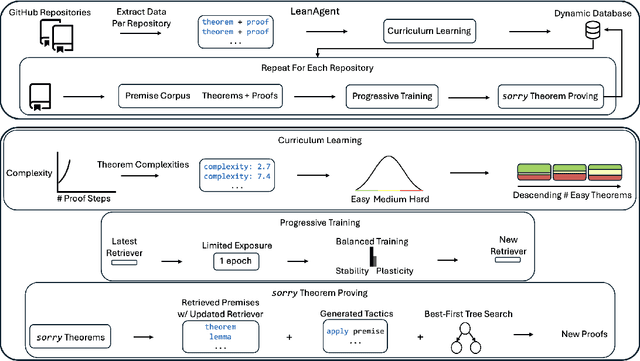
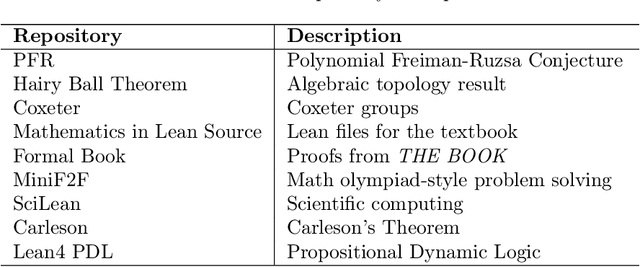
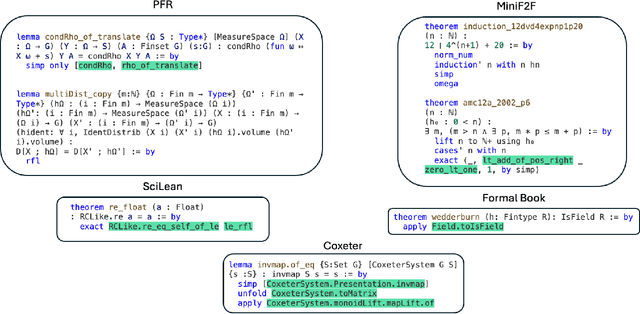
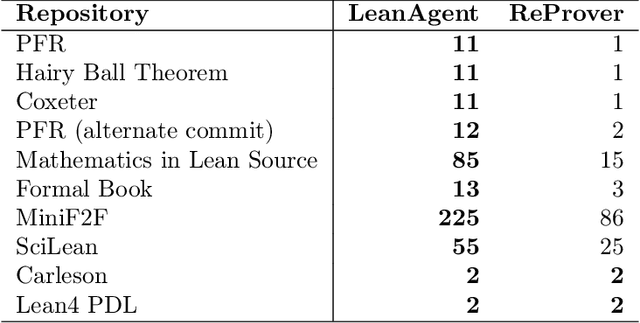
Large Language Models (LLMs) have been successful in mathematical reasoning tasks such as formal theorem proving when integrated with interactive proof assistants like Lean. Existing approaches involve training or fine-tuning an LLM on a specific dataset to perform well on particular domains, such as undergraduate-level mathematics. These methods struggle with generalizability to advanced mathematics. A fundamental limitation is that these approaches operate on static domains, failing to capture how mathematicians often work across multiple domains and projects simultaneously or cyclically. We present LeanAgent, a novel lifelong learning framework for theorem proving that continuously generalizes to and improves on ever-expanding mathematical knowledge without forgetting previously learned knowledge. LeanAgent introduces several key innovations, including a curriculum learning strategy that optimizes the learning trajectory in terms of mathematical difficulty, a dynamic database for efficient management of evolving mathematical knowledge, and progressive training to balance stability and plasticity. LeanAgent successfully proves 162 theorems previously unproved by humans across 23 diverse Lean repositories, many from advanced mathematics. It performs up to 11$\times$ better than the static LLM baseline, proving challenging theorems in domains like abstract algebra and algebraic topology while showcasing a clear progression of learning from basic concepts to advanced topics. In addition, we analyze LeanAgent's superior performance on key lifelong learning metrics. LeanAgent achieves exceptional scores in stability and backward transfer, where learning new tasks improves performance on previously learned tasks. This emphasizes LeanAgent's continuous generalizability and improvement, explaining its superior theorem proving performance.