 Add to Chrome
 Add to Firefox
 Add to Edge
Morphe: High-Fidelity Generative Video Streaming with Vision Foundation Model
Feb 03, 2026
Video streaming is a fundamental Internet service, while the quality still cannot be guaranteed especially in poor network conditions such as bandwidth-constrained and remote areas. Existing works mainly work towards two directions: traditional pixel-codec streaming nearly approaches its limit and is hard to step further in compression; the emerging neural-enhanced or generative streaming usually fall short in latency and visual fidelity, hindering their practical deployment. Inspired by the recent success of vision foundation model (VFM), we strive to harness the powerful video understanding and processing capacities of VFM to achieve generalization, high fidelity and loss resilience for real-time video streaming with even higher compression rate. We present the first revolutionized paradigm that enables VFM-based end-to-end generative video streaming towards this goal. Specifically, Morphe employs joint training of visual tokenizers and variable-resolution spatiotemporal optimization under simulated network constraints. Additionally, a robust streaming system is constructed that leverages intelligent packet dropping to resist real-world network perturbations. Extensive evaluation demonstrates that Morphe achieves comparable visual quality while saving 62.5\% bandwidth compared to H.265, and accomplishes real-time, loss-resilient video delivery in challenging network environments, representing a milestone in VFM-enabled multimedia streaming solutions.

Task-Oriented Semantic Communication for Stereo-Vision 3D Object Detection
Feb 18, 2025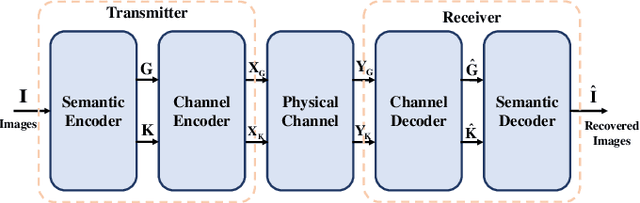
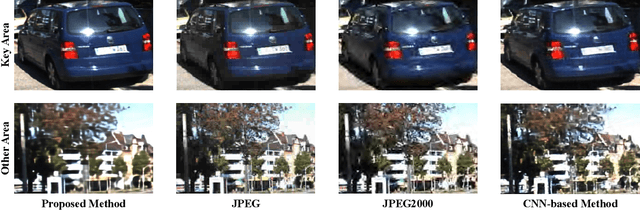

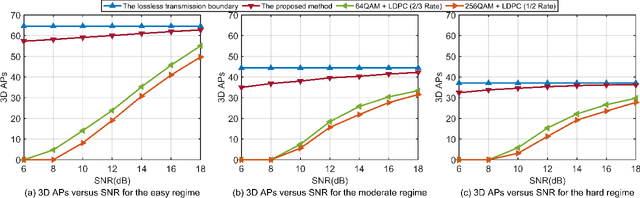
With the development of computer vision, 3D object detection has become increasingly important in many real-world applications. Limited by the computing power of sensor-side hardware, the detection task is sometimes deployed on remote computing devices or the cloud to execute complex algorithms, which brings massive data transmission overhead. In response, this paper proposes an optical flow-driven semantic communication framework for the stereo-vision 3D object detection task. The proposed framework fully exploits the dependence of stereo-vision 3D detection on semantic information in images and prioritizes the transmission of this semantic information to reduce total transmission data sizes while ensuring the detection accuracy. Specifically, we develop an optical flow-driven module to jointly extract and recover semantics from the left and right images to reduce the loss of the left-right photometric alignment semantic information and improve the accuracy of depth inference. Then, we design a 2D semantic extraction module to identify and extract semantic meaning around the objects to enhance the transmission of semantic information in the key areas. Finally, a fusion network is used to fuse the recovered semantics, and reconstruct the stereo-vision images for 3D detection. Simulation results show that the proposed method improves the detection accuracy by nearly 70% and outperforms the traditional method, especially for the low signal-to-noise ratio regime.