 Add to Chrome
 Add to Firefox
 Add to Edge
Probing Scientific General Intelligence of LLMs with Scientist-Aligned Workflows
Dec 18, 2025
Despite advances in scientific AI, a coherent framework for Scientific General Intelligence (SGI)-the ability to autonomously conceive, investigate, and reason across scientific domains-remains lacking. We present an operational SGI definition grounded in the Practical Inquiry Model (PIM: Deliberation, Conception, Action, Perception) and operationalize it via four scientist-aligned tasks: deep research, idea generation, dry/wet experiments, and experimental reasoning. SGI-Bench comprises over 1,000 expert-curated, cross-disciplinary samples inspired by Science's 125 Big Questions, enabling systematic evaluation of state-of-the-art LLMs. Results reveal gaps: low exact match (10--20%) in deep research despite step-level alignment; ideas lacking feasibility and detail; high code executability but low execution result accuracy in dry experiments; low sequence fidelity in wet protocols; and persistent multimodal comparative-reasoning challenges. We further introduce Test-Time Reinforcement Learning (TTRL), which optimizes retrieval-augmented novelty rewards at inference, enhancing hypothesis novelty without reference answer. Together, our PIM-grounded definition, workflow-centric benchmark, and empirical insights establish a foundation for AI systems that genuinely participate in scientific discovery.

SynBrain: Enhancing Visual-to-fMRI Synthesis via Probabilistic Representation Learning
Aug 14, 2025Deciphering how visual stimuli are transformed into cortical responses is a fundamental challenge in computational neuroscience. This visual-to-neural mapping is inherently a one-to-many relationship, as identical visual inputs reliably evoke variable hemodynamic responses across trials, contexts, and subjects. However, existing deterministic methods struggle to simultaneously model this biological variability while capturing the underlying functional consistency that encodes stimulus information. To address these limitations, we propose SynBrain, a generative framework that simulates the transformation from visual semantics to neural responses in a probabilistic and biologically interpretable manner. SynBrain introduces two key components: (i) BrainVAE models neural representations as continuous probability distributions via probabilistic learning while maintaining functional consistency through visual semantic constraints; (ii) A Semantic-to-Neural Mapper acts as a semantic transmission pathway, projecting visual semantics into the neural response manifold to facilitate high-fidelity fMRI synthesis. Experimental results demonstrate that SynBrain surpasses state-of-the-art methods in subject-specific visual-to-fMRI encoding performance. Furthermore, SynBrain adapts efficiently to new subjects with few-shot data and synthesizes high-quality fMRI signals that are effective in improving data-limited fMRI-to-image decoding performance. Beyond that, SynBrain reveals functional consistency across trials and subjects, with synthesized signals capturing interpretable patterns shaped by biological neural variability. The code will be made publicly available.
MindAligner: Explicit Brain Functional Alignment for Cross-Subject Visual Decoding from Limited fMRI Data
Feb 07, 2025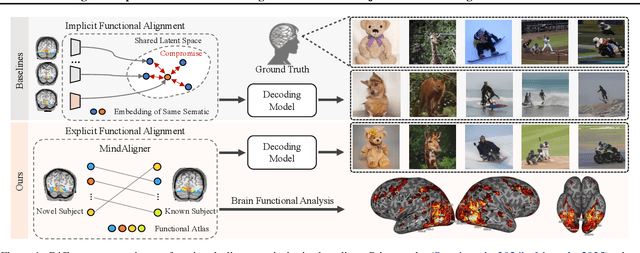
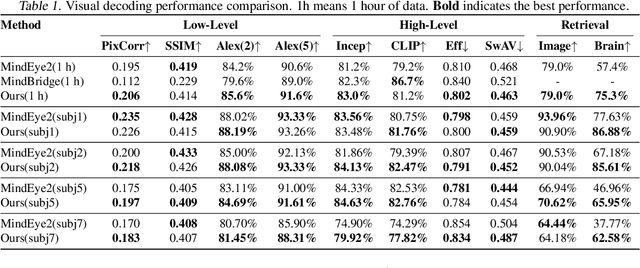
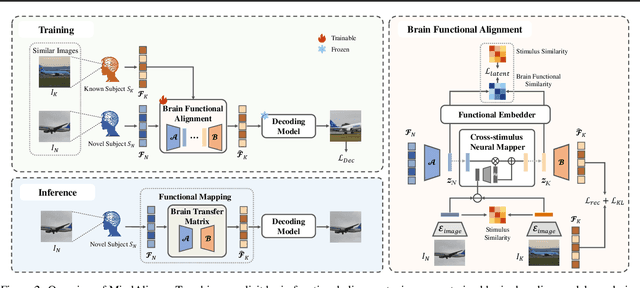

Brain decoding aims to reconstruct visual perception of human subject from fMRI signals, which is crucial for understanding brain's perception mechanisms. Existing methods are confined to the single-subject paradigm due to substantial brain variability, which leads to weak generalization across individuals and incurs high training costs, exacerbated by limited availability of fMRI data. To address these challenges, we propose MindAligner, an explicit functional alignment framework for cross-subject brain decoding from limited fMRI data. The proposed MindAligner enjoys several merits. First, we learn a Brain Transfer Matrix (BTM) that projects the brain signals of an arbitrary new subject to one of the known subjects, enabling seamless use of pre-trained decoding models. Second, to facilitate reliable BTM learning, a Brain Functional Alignment module is proposed to perform soft cross-subject brain alignment under different visual stimuli with a multi-level brain alignment loss, uncovering fine-grained functional correspondences with high interpretability. Experiments indicate that MindAligner not only outperforms existing methods in visual decoding under data-limited conditions, but also provides valuable neuroscience insights in cross-subject functional analysis. The code will be made publicly available.