 Add to Chrome
 Add to Firefox
 Add to Edge
ERNIE 5.0 Technical Report
Feb 04, 2026
In this report, we introduce ERNIE 5.0, a natively autoregressive foundation model desinged for unified multimodal understanding and generation across text, image, video, and audio. All modalities are trained from scratch under a unified next-group-of-tokens prediction objective, based on an ultra-sparse mixture-of-experts (MoE) architecture with modality-agnostic expert routing. To address practical challenges in large-scale deployment under diverse resource constraints, ERNIE 5.0 adopts a novel elastic training paradigm. Within a single pre-training run, the model learns a family of sub-models with varying depths, expert capacities, and routing sparsity, enabling flexible trade-offs among performance, model size, and inference latency in memory- or time-constrained scenarios. Moreover, we systematically address the challenges of scaling reinforcement learning to unified foundation models, thereby guaranteeing efficient and stable post-training under ultra-sparse MoE architectures and diverse multimodal settings. Extensive experiments demonstrate that ERNIE 5.0 achieves strong and balanced performance across multiple modalities. To the best of our knowledge, among publicly disclosed models, ERNIE 5.0 represents the first production-scale realization of a trillion-parameter unified autoregressive model that supports both multimodal understanding and generation. To facilitate further research, we present detailed visualizations of modality-agnostic expert routing in the unified model, alongside comprehensive empirical analysis of elastic training, aiming to offer profound insights to the community.

Emotion Recognition with CLIP and Sequential Learning
Mar 13, 2025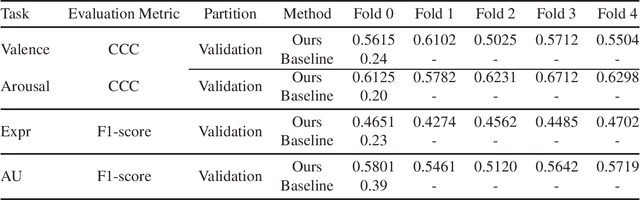
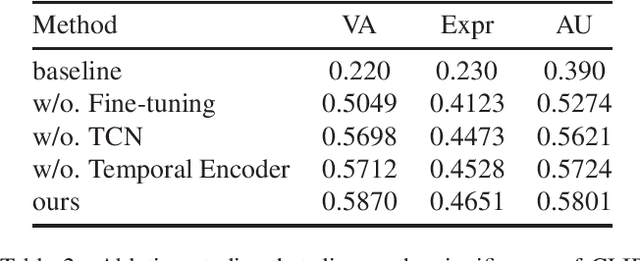
Human emotion recognition plays a crucial role in facilitating seamless interactions between humans and computers. In this paper, we present our innovative methodology for tackling the Valence-Arousal (VA) Estimation Challenge, the Expression Recognition Challenge, and the Action Unit (AU) Detection Challenge, all within the framework of the 8th Workshop and Competition on Affective Behavior Analysis in-the-wild (ABAW). Our approach introduces a novel framework aimed at enhancing continuous emotion recognition. This is achieved by fine-tuning the CLIP model with the aff-wild2 dataset, which provides annotated expression labels. The result is a fine-tuned model that serves as an efficient visual feature extractor, significantly improving its robustness. To further boost the performance of continuous emotion recognition, we incorporate Temporal Convolutional Network (TCN) modules alongside Transformer Encoder modules into our system architecture. The integration of these advanced components allows our model to outperform baseline performance, demonstrating its ability to recognize human emotions with greater accuracy and efficiency.