 Add to Chrome
 Add to Firefox
 Add to Edge
MM-OpenFGL: A Comprehensive Benchmark for Multimodal Federated Graph Learning
Jan 29, 2026
Multimodal-attributed graphs (MMAGs) provide a unified framework for modeling complex relational data by integrating heterogeneous modalities with graph structures. While centralized learning has shown promising performance, MMAGs in real-world applications are often distributed across isolated platforms and cannot be shared due to privacy concerns or commercial constraints. Federated graph learning (FGL) offers a natural solution for collaborative training under such settings; however, existing studies largely focus on single-modality graphs and do not adequately address the challenges unique to multimodal federated graph learning (MMFGL). To bridge this gap, we present MM-OpenFGL, the first comprehensive benchmark that systematically formalizes the MMFGL paradigm and enables rigorous evaluation. MM-OpenFGL comprises 19 multimodal datasets spanning 7 application domains, 8 simulation strategies capturing modality and topology variations, 6 downstream tasks, and 57 state-of-the-art methods implemented through a modular API. Extensive experiments investigate MMFGL from the perspectives of necessity, effectiveness, robustness, and efficiency, offering valuable insights for future research on MMFGL.

Rethinking Federated Graph Foundation Models: A Graph-Language Alignment-based Approach
Jan 29, 2026Recent studies of federated graph foundational models (FedGFMs) break the idealized and untenable assumption of having centralized data storage to train graph foundation models, and accommodate the reality of distributed, privacy-restricted data silos. Despite their simplicity and intuition, existing studies that project aligned generalizable knowledge onto a discrete token space via vector-quantized backbones suffer from irreversible knowledge loss during the quantization process. In this context, we argue that reconciling the semantic-structural orthogonality and integrity between pre-trained language models (PLMs) and graph neural networks (GNNs) is paramount for developing effective FedGFMs while simultaneously mitigating the severe data heterogeneity and communication constraints inherent in distributed, resource-limited environments. To address these issues, we propose FedGALA (Federated Graph And Language Alignment), a framework that resolves graph-based semantic-structural orthogonality and integrity in federated settings by employing unsupervised contrastive learning to align GNNs and frozen PLMs within a continuous embedding space, thereby capturing robust, transferable general knowledge. Subsequently, FedGALA leverages a communication-efficient prompt tuning mechanism to steer these pre-aligned encoders and frozen PLMs, facilitating effective adaptation to diverse downstream tasks while circumventing the prohibitive overhead of full-parameter fine-tuning. The comprehensive experiments validate that FedGALA outperforms all competitive baselines across multi-domain datasets on multiple tasks with up to 14.37% performance improvement.
A Comprehensive Data-centric Overview of Federated Graph Learning
Jul 22, 2025In the era of big data applications, Federated Graph Learning (FGL) has emerged as a prominent solution that reconcile the tradeoff between optimizing the collective intelligence between decentralized datasets holders and preserving sensitive information to maximum. Existing FGL surveys have contributed meaningfully but largely focus on integrating Federated Learning (FL) and Graph Machine Learning (GML), resulting in early stage taxonomies that emphasis on methodology and simulated scenarios. Notably, a data centric perspective, which systematically examines FGL methods through the lens of data properties and usage, remains unadapted to reorganize FGL research, yet it is critical to assess how FGL studies manage to tackle data centric constraints to enhance model performances. This survey propose a two-level data centric taxonomy: Data Characteristics, which categorizes studies based on the structural and distributional properties of datasets used in FGL, and Data Utilization, which analyzes the training procedures and techniques employed to overcome key data centric challenges. Each taxonomy level is defined by three orthogonal criteria, each representing a distinct data centric configuration. Beyond taxonomy, this survey examines FGL integration with Pretrained Large Models, showcases realistic applications, and highlights future direction aligned with emerging trends in GML.
OpenGU: A Comprehensive Benchmark for Graph Unlearning
Jan 06, 2025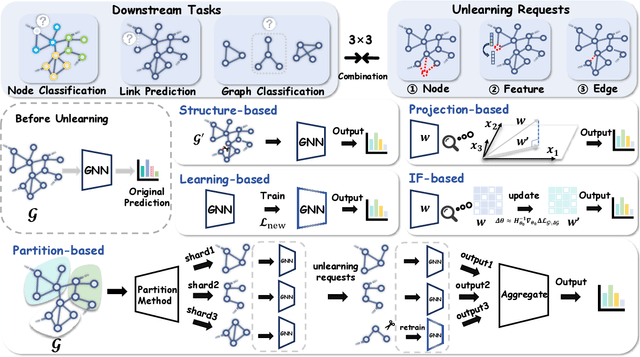
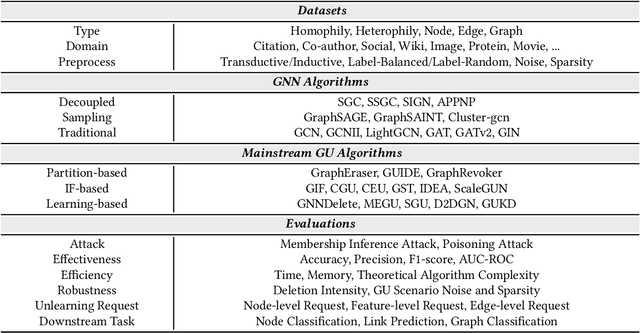
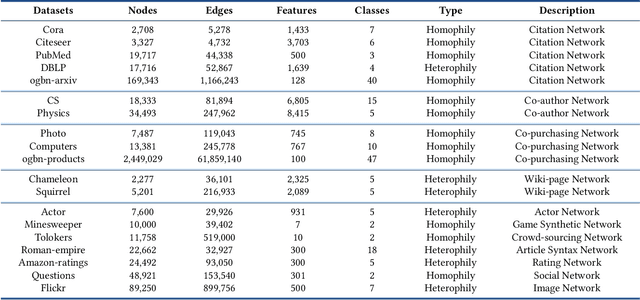
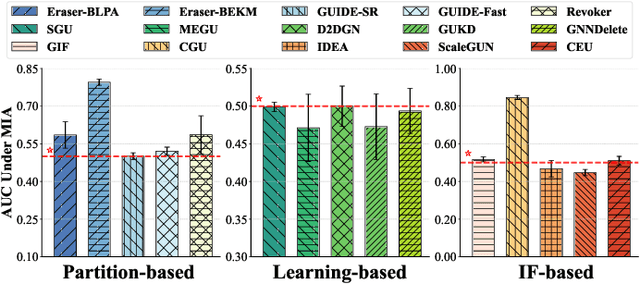
Graph Machine Learning is essential for understanding and analyzing relational data. However, privacy-sensitive applications demand the ability to efficiently remove sensitive information from trained graph neural networks (GNNs), avoiding the unnecessary time and space overhead caused by retraining models from scratch. To address this issue, Graph Unlearning (GU) has emerged as a critical solution, with the potential to support dynamic graph updates in data management systems and enable scalable unlearning in distributed data systems while ensuring privacy compliance. Unlike machine unlearning in computer vision or other fields, GU faces unique difficulties due to the non-Euclidean nature of graph data and the recursive message-passing mechanism of GNNs. Additionally, the diversity of downstream tasks and the complexity of unlearning requests further amplify these challenges. Despite the proliferation of diverse GU strategies, the absence of a benchmark providing fair comparisons for GU, and the limited flexibility in combining downstream tasks and unlearning requests, have yielded inconsistencies in evaluations, hindering the development of this domain. To fill this gap, we present OpenGU, the first GU benchmark, where 16 SOTA GU algorithms and 37 multi-domain datasets are integrated, enabling various downstream tasks with 13 GNN backbones when responding to flexible unlearning requests. Based on this unified benchmark framework, we are able to provide a comprehensive and fair evaluation for GU. Through extensive experimentation, we have drawn $8$ crucial conclusions about existing GU methods, while also gaining valuable insights into their limitations, shedding light on potential avenues for future research.