 Add to Chrome
 Add to Firefox
 Add to Edge
Rethinking Federated Graph Foundation Models: A Graph-Language Alignment-based Approach
Jan 29, 2026
Recent studies of federated graph foundational models (FedGFMs) break the idealized and untenable assumption of having centralized data storage to train graph foundation models, and accommodate the reality of distributed, privacy-restricted data silos. Despite their simplicity and intuition, existing studies that project aligned generalizable knowledge onto a discrete token space via vector-quantized backbones suffer from irreversible knowledge loss during the quantization process. In this context, we argue that reconciling the semantic-structural orthogonality and integrity between pre-trained language models (PLMs) and graph neural networks (GNNs) is paramount for developing effective FedGFMs while simultaneously mitigating the severe data heterogeneity and communication constraints inherent in distributed, resource-limited environments. To address these issues, we propose FedGALA (Federated Graph And Language Alignment), a framework that resolves graph-based semantic-structural orthogonality and integrity in federated settings by employing unsupervised contrastive learning to align GNNs and frozen PLMs within a continuous embedding space, thereby capturing robust, transferable general knowledge. Subsequently, FedGALA leverages a communication-efficient prompt tuning mechanism to steer these pre-aligned encoders and frozen PLMs, facilitating effective adaptation to diverse downstream tasks while circumventing the prohibitive overhead of full-parameter fine-tuning. The comprehensive experiments validate that FedGALA outperforms all competitive baselines across multi-domain datasets on multiple tasks with up to 14.37% performance improvement.

BGTplanner: Maximizing Training Accuracy for Differentially Private Federated Recommenders via Strategic Privacy Budget Allocation
Dec 04, 2024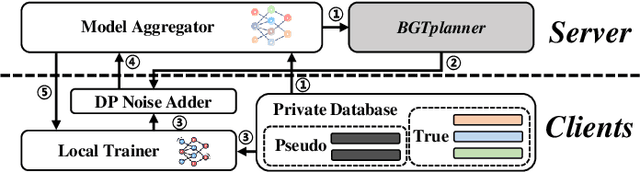

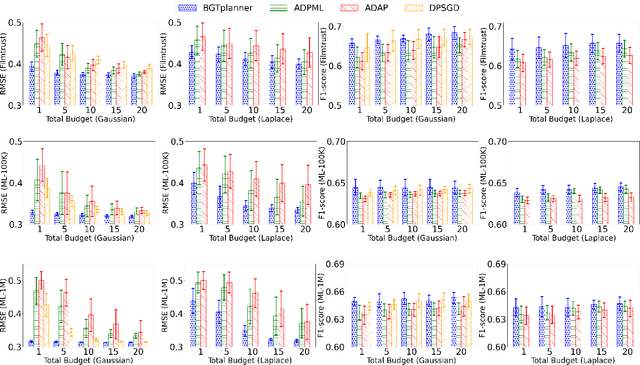
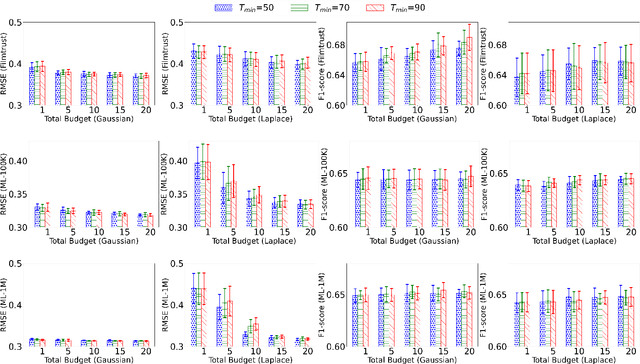
To mitigate the rising concern about privacy leakage, the federated recommender (FR) paradigm emerges, in which decentralized clients co-train the recommendation model without exposing their raw user-item rating data. The differentially private federated recommender (DPFR) further enhances FR by injecting differentially private (DP) noises into clients. Yet, current DPFRs, suffering from noise distortion, cannot achieve satisfactory accuracy. Various efforts have been dedicated to improving DPFRs by adaptively allocating the privacy budget over the learning process. However, due to the intricate relation between privacy budget allocation and model accuracy, existing works are still far from maximizing DPFR accuracy. To address this challenge, we develop BGTplanner (Budget Planner) to strategically allocate the privacy budget for each round of DPFR training, improving overall training performance. Specifically, we leverage the Gaussian process regression and historical information to predict the change in recommendation accuracy with a certain allocated privacy budget. Additionally, Contextual Multi-Armed Bandit (CMAB) is harnessed to make privacy budget allocation decisions by reconciling the current improvement and long-term privacy constraints. Our extensive experimental results on real datasets demonstrate that \emph{BGTplanner} achieves an average improvement of 6.76\% in training performance compared to state-of-the-art baselines.