 Add to Chrome
 Add to Firefox
 Add to Edge
SDiT: Semantic Region-Adaptive for Diffusion Transformers
Jan 18, 2026
Diffusion Transformers (DiTs) achieve state-of-the-art performance in text-to-image synthesis but remain computationally expensive due to the iterative nature of denoising and the quadratic cost of global attention. In this work, we observe that denoising dynamics are spatially non-uniform-background regions converge rapidly while edges and textured areas evolve much more actively. Building on this insight, we propose SDiT, a Semantic Region-Adaptive Diffusion Transformer that allocates computation according to regional complexity. SDiT introduces a training-free framework combining (1) semantic-aware clustering via fast Quickshift-based segmentation, (2) complexity-driven regional scheduling to selectively update informative areas, and (3) boundary-aware refinement to maintain spatial coherence. Without any model retraining or architectural modification, SDiT achieves up to 3.0x acceleration while preserving nearly identical perceptual and semantic quality to full-attention inference.

Analytical Characterization and Design Space Exploration for Optimization of CNNs
Jan 24, 2021


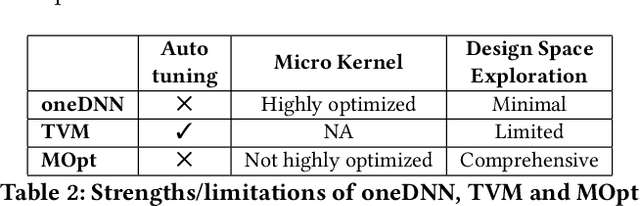
Moving data through the memory hierarchy is a fundamental bottleneck that can limit the performance of core algorithms of machine learning, such as convolutional neural networks (CNNs). Loop-level optimization, including loop tiling and loop permutation, are fundamental transformations to reduce data movement. However, the search space for finding the best loop-level optimization configuration is explosively large. This paper develops an analytical modeling approach for finding the best loop-level optimization configuration for CNNs on multi-core CPUs. Experimental evaluation shows that this approach achieves comparable or better performance than state-of-the-art libraries and auto-tuning based optimizers for CNNs.