 Add to Chrome
 Add to Firefox
 Add to Edge
Learning Flexible Job Shop Scheduling under Limited Buffers and Material Kitting Constraints
Feb 27, 2026
The Flexible Job Shop Scheduling Problem (FJSP) originates from real production lines, while some practical constraints are often ignored or idealized in current FJSP studies, among which the limited buffer problem has a particular impact on production efficiency. To this end, we study an extended problem that is closer to practical scenarios--the Flexible Job Shop Scheduling Problem with Limited Buffers and Material Kitting. In recent years, deep reinforcement learning (DRL) has demonstrated considerable potential in scheduling tasks. However, its capacity for state modeling remains limited when handling complex dependencies and long-term constraints. To address this, we leverage a heterogeneous graph network within the DRL framework to model the global state. By constructing efficient message passing among machines, operations, and buffers, the network focuses on avoiding decisions that may cause frequent pallet changes during long-sequence scheduling, thereby helping improve buffer utilization and overall decision quality. Experimental results on both synthetic and real production line datasets show that the proposed method outperforms traditional heuristics and advanced DRL methods in terms of makespan and pallet changes, and also achieves a good balance between solution quality and computational cost. Furthermore, a supplementary video is provided to showcase a simulation system that effectively visualizes the progression of the production line.

Weakly-Supervised Video Anomaly Detection with Snippet Anomalous Attention
Sep 28, 2023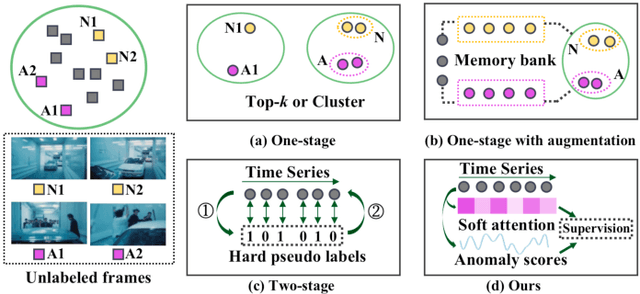
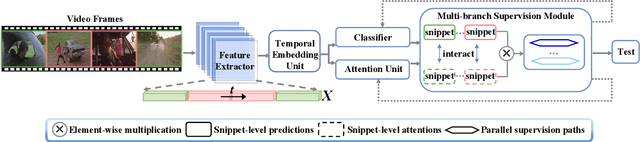
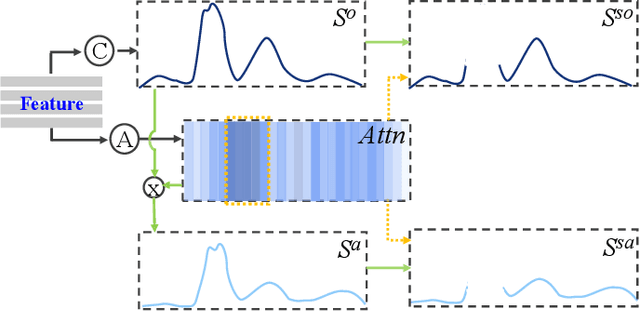
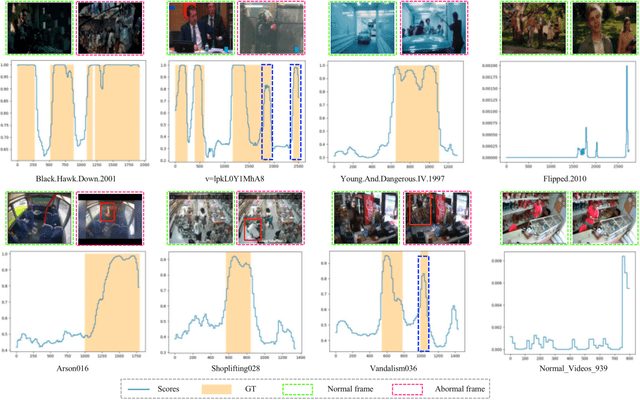
With a focus on abnormal events contained within untrimmed videos, there is increasing interest among researchers in video anomaly detection. Among different video anomaly detection scenarios, weakly-supervised video anomaly detection poses a significant challenge as it lacks frame-wise labels during the training stage, only relying on video-level labels as coarse supervision. Previous methods have made attempts to either learn discriminative features in an end-to-end manner or employ a twostage self-training strategy to generate snippet-level pseudo labels. However, both approaches have certain limitations. The former tends to overlook informative features at the snippet level, while the latter can be susceptible to noises. In this paper, we propose an Anomalous Attention mechanism for weakly-supervised anomaly detection to tackle the aforementioned problems. Our approach takes into account snippet-level encoded features without the supervision of pseudo labels. Specifically, our approach first generates snippet-level anomalous attention and then feeds it together with original anomaly scores into a Multi-branch Supervision Module. The module learns different areas of the video, including areas that are challenging to detect, and also assists the attention optimization. Experiments on benchmark datasets XDViolence and UCF-Crime verify the effectiveness of our method. Besides, thanks to the proposed snippet-level attention, we obtain a more precise anomaly localization.