 Add to Chrome
 Add to Firefox
 Add to Edge
Cross-Domain Fake News Detection on Unseen Domains via LLM-Based Domain-Aware User Modeling
Feb 02, 2026
Cross-domain fake news detection (CD-FND) transfers knowledge from a source domain to a target domain and is crucial for real-world fake news mitigation. This task becomes particularly important yet more challenging when the target domain is previously unseen (e.g., the COVID-19 outbreak or the Russia-Ukraine war). However, existing CD-FND methods overlook such scenarios and consequently suffer from the following two key limitations: (1) insufficient modeling of high-level semantics in news and user engagements; and (2) scarcity of labeled data in unseen domains. Targeting these limitations, we find that large language models (LLMs) offer strong potential for CD-FND on unseen domains, yet their effective use remains non-trivial. Nevertheless, two key challenges arise: (1) how to capture high-level semantics from both news content and user engagements using LLMs; and (2) how to make LLM-generated features more reliable and transferable for CD-FND on unseen domains. To tackle these challenges, we propose DAUD, a novel LLM-Based Domain-Aware framework for fake news detection on Unseen Domains. DAUD employs LLMs to extract high-level semantics from news content. It models users' single- and cross-domain engagements to generate domain-aware behavioral representations. In addition, DAUD captures the relations between original data-driven features and LLM-derived features of news, users, and user engagements. This allows it to extract more reliable domain-shared representations that improve knowledge transfer to unseen domains. Extensive experiments on real-world datasets demonstrate that DAUD outperforms state-of-the-art baselines in both general and unseen-domain CD-FND settings.

A Macro- and Micro-Hierarchical Transfer Learning Framework for Cross-Domain Fake News Detection
Feb 20, 2025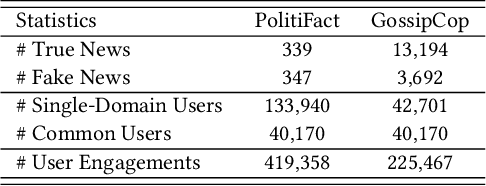
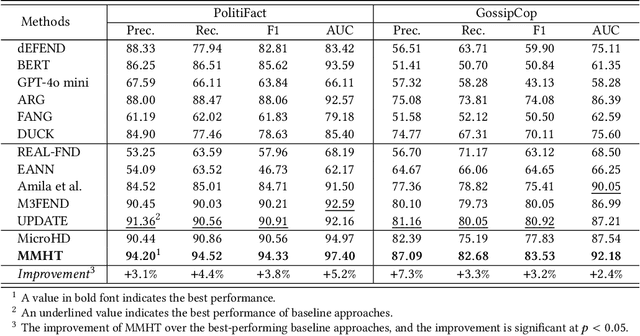
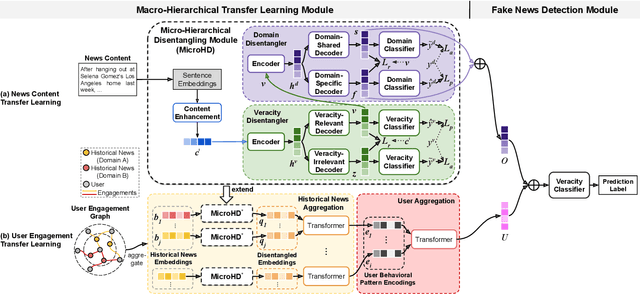
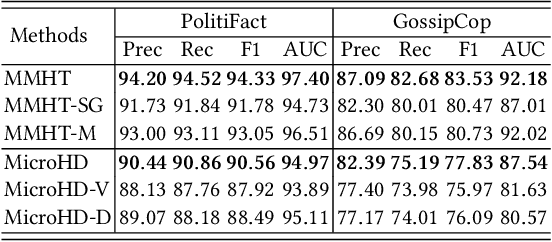
Cross-domain fake news detection aims to mitigate domain shift and improve detection performance by transferring knowledge across domains. Existing approaches transfer knowledge based on news content and user engagements from a source domain to a target domain. However, these approaches face two main limitations, hindering effective knowledge transfer and optimal fake news detection performance. Firstly, from a micro perspective, they neglect the negative impact of veracity-irrelevant features in news content when transferring domain-shared features across domains. Secondly, from a macro perspective, existing approaches ignore the relationship between user engagement and news content, which reveals shared behaviors of common users across domains and can facilitate more effective knowledge transfer. To address these limitations, we propose a novel macro- and micro- hierarchical transfer learning framework (MMHT) for cross-domain fake news detection. Firstly, we propose a micro-hierarchical disentangling module to disentangle veracity-relevant and veracity-irrelevant features from news content in the source domain for improving fake news detection performance in the target domain. Secondly, we propose a macro-hierarchical transfer learning module to generate engagement features based on common users' shared behaviors in different domains for improving effectiveness of knowledge transfer. Extensive experiments on real-world datasets demonstrate that our framework significantly outperforms the state-of-the-art baselines.