 Add to Chrome
 Add to Firefox
 Add to Edge
Reinforced Diffusion: Learning to Push the Limits of Anisotropic Diffusion for Image Denoising
Dec 30, 2025
Image denoising is an important problem in low-level vision and serves as a critical module for many image recovery tasks. Anisotropic diffusion is a wide family of image denoising approaches with promising performance. However, traditional anisotropic diffusion approaches use explicit diffusion operators which are not well adapted to complex image structures. As a result, their performance is limited compared to recent learning-based approaches. In this work, we describe a trainable anisotropic diffusion framework based on reinforcement learning. By modeling the denoising process as a series of naive diffusion actions with order learned by deep Q-learning, we propose an effective diffusion-based image denoiser. The diffusion actions selected by deep Q-learning at different iterations indeed composite a stochastic anisotropic diffusion process with strong adaptivity to different image structures, which enjoys improvement over the traditional ones. The proposed denoiser is applied to removing three types of often-seen noise. The experiments show that it outperforms existing diffusion-based methods and competes with the representative deep CNN-based methods.

Towards Flexible, Scalable, and Adaptive Multi-Modal Conditioned Face Synthesis
Dec 26, 2023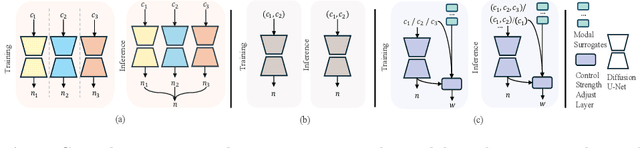

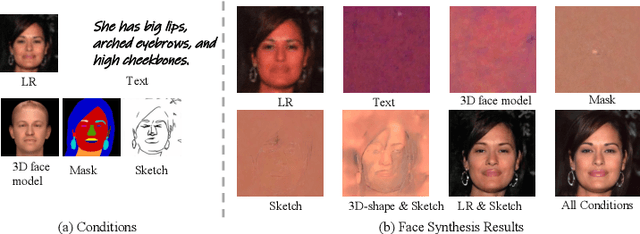
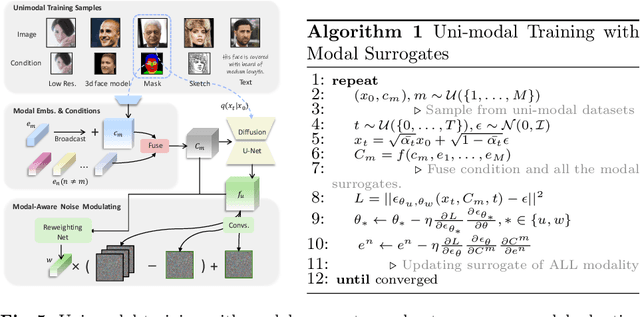
Recent progress in multi-modal conditioned face synthesis has enabled the creation of visually striking and accurately aligned facial images. Yet, current methods still face issues with scalability, limited flexibility, and a one-size-fits-all approach to control strength, not accounting for the differing levels of conditional entropy, a measure of unpredictability in data given some condition, across modalities. To address these challenges, we introduce a novel uni-modal training approach with modal surrogates, coupled with an entropy-aware modal-adaptive modulation, to support flexible, scalable, and scalable multi-modal conditioned face synthesis network. Our uni-modal training with modal surrogate that only leverage uni-modal data, use modal surrogate to decorate condition with modal-specific characteristic and serve as linker for inter-modal collaboration , fully learns each modality control in face synthesis process as well as inter-modal collaboration. The entropy-aware modal-adaptive modulation finely adjust diffusion noise according to modal-specific characteristics and given conditions, enabling well-informed step along denoising trajectory and ultimately leading to synthesis results of high fidelity and quality. Our framework improves multi-modal face synthesis under various conditions, surpassing current methods in image quality and fidelity, as demonstrated by our thorough experimental results.