 Add to Chrome
 Add to Firefox
 Add to Edge
Fluxamba: Topology-Aware Anisotropic State Space Models for Geological Lineament Segmentation in Multi-Source Remote Sensing
Jan 24, 2026
The precise segmentation of geological linear features, spanning from planetary lineaments to terrestrial fractures, demands capturing long-range dependencies across complex anisotropic topologies. Although State Space Models (SSMs) offer near-linear computational complexity, their dependence on rigid, axis-aligned scanning trajectories induces a fundamental topological mismatch with curvilinear targets, resulting in fragmented context and feature erosion. To bridge this gap, we propose Fluxamba, a lightweight architecture that introduces a topology-aware feature rectification framework. Central to our design is the Structural Flux Block (SFB), which orchestrates an anisotropic information flux by integrating an Anisotropic Structural Gate (ASG) with a Prior-Modulated Flow (PMF). This mechanism decouples feature orientation from spatial location, dynamically gating context aggregation along the target's intrinsic geometry rather than rigid paths. Furthermore, to mitigate serialization-induced noise in low-contrast environments, we incorporate a Hierarchical Spatial Regulator (HSR) for multi-scale semantic alignment and a High-Fidelity Focus Unit (HFFU) to explicitly maximize the signal-to-noise ratio of faint features. Extensive experiments on diverse geological benchmarks (LROC-Lineament, LineaMapper, and GeoCrack) demonstrate that Fluxamba establishes a new state-of-the-art. Notably, on the challenging LROC-Lineament dataset, it achieves an F1-score of 89.22% and mIoU of 89.87%. Achieving a real-time inference speed of over 24 FPS with only 3.4M parameters and 6.3G FLOPs, Fluxamba reduces computational costs by up to two orders of magnitude compared to heavy-weight baselines, thereby establishing a new Pareto frontier between segmentation fidelity and onboard deployment feasibility.

Consistency-Regularized GAN for Few-Shot SAR Target Recognition
Jan 22, 2026Few-shot recognition in synthetic aperture radar (SAR) imagery remains a critical bottleneck for real-world applications due to extreme data scarcity. A promising strategy involves synthesizing a large dataset with a generative adversarial network (GAN), pre-training a model via self-supervised learning (SSL), and then fine-tuning on the few labeled samples. However, this approach faces a fundamental paradox: conventional GANs themselves require abundant data for stable training, contradicting the premise of few-shot learning. To resolve this, we propose the consistency-regularized generative adversarial network (Cr-GAN), a novel framework designed to synthesize diverse, high-fidelity samples even when trained under these severe data limitations. Cr-GAN introduces a dual-branch discriminator that decouples adversarial training from representation learning. This architecture enables a channel-wise feature interpolation strategy to create novel latent features, complemented by a dual-domain cycle consistency mechanism that ensures semantic integrity. Our Cr-GAN framework is adaptable to various GAN architectures, and its synthesized data effectively boosts multiple SSL algorithms. Extensive experiments on the MSTAR and SRSDD datasets validate our approach, with Cr-GAN achieving a highly competitive accuracy of 71.21% and 51.64%, respectively, in the 8-shot setting, significantly outperforming leading baselines, while requiring only ~5 of the parameters of state-of-the-art diffusion models. Code is available at: https://github.com/yikuizhai/Cr-GAN.
Multimodal Feature Fusion Network with Text Difference Enhancement for Remote Sensing Change Detection
Sep 04, 2025Although deep learning has advanced remote sensing change detection (RSCD), most methods rely solely on image modality, limiting feature representation, change pattern modeling, and generalization especially under illumination and noise disturbances. To address this, we propose MMChange, a multimodal RSCD method that combines image and text modalities to enhance accuracy and robustness. An Image Feature Refinement (IFR) module is introduced to highlight key regions and suppress environmental noise. To overcome the semantic limitations of image features, we employ a vision language model (VLM) to generate semantic descriptions of bitemporal images. A Textual Difference Enhancement (TDE) module then captures fine grained semantic shifts, guiding the model toward meaningful changes. To bridge the heterogeneity between modalities, we design an Image Text Feature Fusion (ITFF) module that enables deep cross modal integration. Extensive experiments on LEVIRCD, WHUCD, and SYSUCD demonstrate that MMChange consistently surpasses state of the art methods across multiple metrics, validating its effectiveness for multimodal RSCD. Code is available at: https://github.com/yikuizhai/MMChange.
Toward Motion Robustness: A masked attention regularization framework in remote photoplethysmography
Jul 09, 2024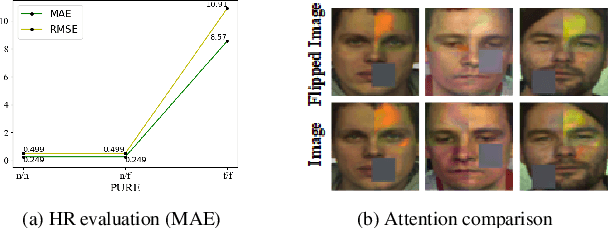
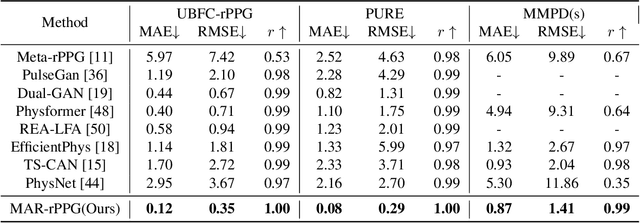
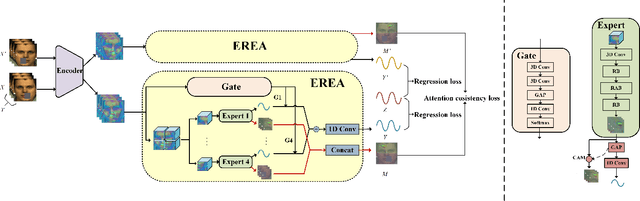
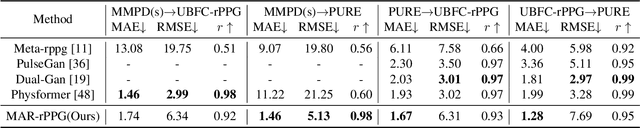
There has been growing interest in facial video-based remote photoplethysmography (rPPG) measurement recently, with a focus on assessing various vital signs such as heart rate and heart rate variability. Despite previous efforts on static datasets, their approaches have been hindered by inaccurate region of interest (ROI) localization and motion issues, and have shown limited generalization in real-world scenarios. To address these challenges, we propose a novel masked attention regularization (MAR-rPPG) framework that mitigates the impact of ROI localization and complex motion artifacts. Specifically, our approach first integrates a masked attention regularization mechanism into the rPPG field to capture the visual semantic consistency of facial clips, while it also employs a masking technique to prevent the model from overfitting on inaccurate ROIs and subsequently degrading its performance. Furthermore, we propose an enhanced rPPG expert aggregation (EREA) network as the backbone to obtain rPPG signals and attention maps simultaneously. Our EREA network is capable of discriminating divergent attentions from different facial areas and retaining the consistency of spatiotemporal attention maps. For motion robustness, a simple open source detector MediaPipe for data preprocessing is sufficient for our framework due to its superior capability of rPPG signal extraction and attention regularization. Exhaustive experiments on three benchmark datasets (UBFC-rPPG, PURE, and MMPD) substantiate the superiority of our proposed method, outperforming recent state-of-the-art works by a considerable margin.