 Add to Chrome
 Add to Firefox
 Add to Edge
JoyVoice: Long-Context Conditioning for Anthropomorphic Multi-Speaker Conversational Synthesis
Dec 22, 2025
Large speech generation models are evolving from single-speaker, short sentence synthesis to multi-speaker, long conversation geneartion. Current long-form speech generation models are predominately constrained to dyadic, turn-based interactions. To address this, we introduce JoyVoice, a novel anthropomorphic foundation model designed for flexible, boundary-free synthesis of up to eight speakers. Unlike conventional cascaded systems, JoyVoice employs a unified E2E-Transformer-DiT architecture that utilizes autoregressive hidden representations directly for diffusion inputs, enabling holistic end-to-end optimization. We further propose a MM-Tokenizer operating at a low bitrate of 12.5 Hz, which integrates multitask semantic and MMSE losses to effectively model both semantic and acoustic information. Additionally, the model incorporates robust text front-end processing via large-scale data perturbation. Experiments show that JoyVoice achieves state-of-the-art results in multilingual generation (Chinese, English, Japanese, Korean) and zero-shot voice cloning. JoyVoice achieves top-tier results on both the Seed-TTS-Eval Benchmark and multi-speaker long-form conversational voice cloning tasks, demonstrating superior audio quality and generalization. It achieves significant improvements in prosodic continuity for long-form speech, rhythm richness in multi-speaker conversations, paralinguistic naturalness, besides superior intelligibility. We encourage readers to listen to the demo at https://jea-speech.github.io/JoyVoice

Embedded Representation Learning Network for Animating Styled Video Portrait
Apr 29, 2024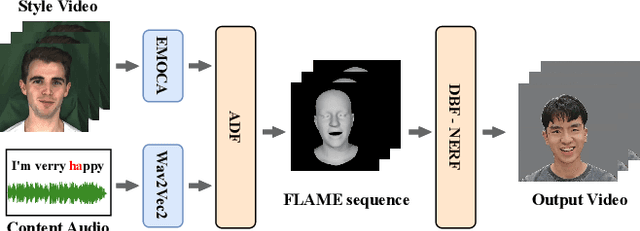
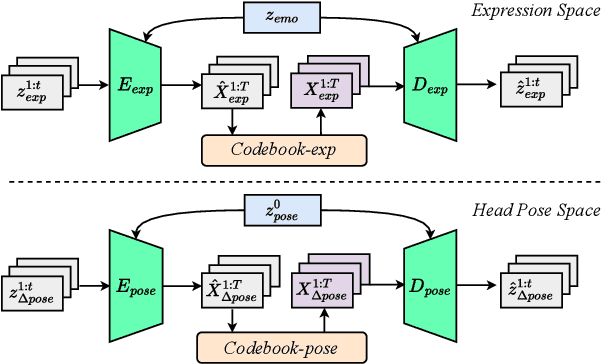
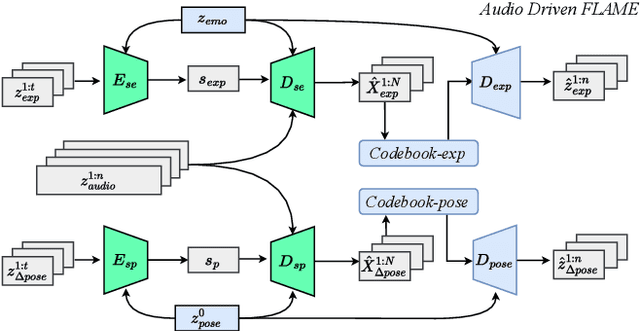
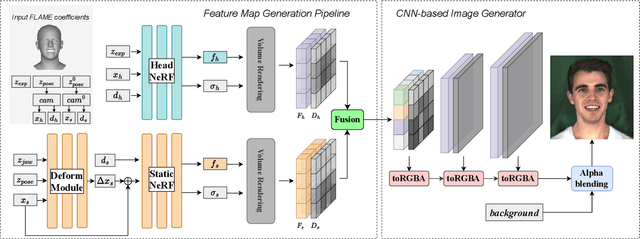
The talking head generation recently attracted considerable attention due to its widespread application prospects, especially for digital avatars and 3D animation design. Inspired by this practical demand, several works explored Neural Radiance Fields (NeRF) to synthesize the talking heads. However, these methods based on NeRF face two challenges: (1) Difficulty in generating style-controllable talking heads. (2) Displacement artifacts around the neck in rendered images. To overcome these two challenges, we propose a novel generative paradigm \textit{Embedded Representation Learning Network} (ERLNet) with two learning stages. First, the \textit{ audio-driven FLAME} (ADF) module is constructed to produce facial expression and head pose sequences synchronized with content audio and style video. Second, given the sequence deduced by the ADF, one novel \textit{dual-branch fusion NeRF} (DBF-NeRF) explores these contents to render the final images. Extensive empirical studies demonstrate that the collaboration of these two stages effectively facilitates our method to render a more realistic talking head than the existing algorithms.
CSTalk: Correlation Supervised Speech-driven 3D Emotional Facial Animation Generation
Apr 29, 2024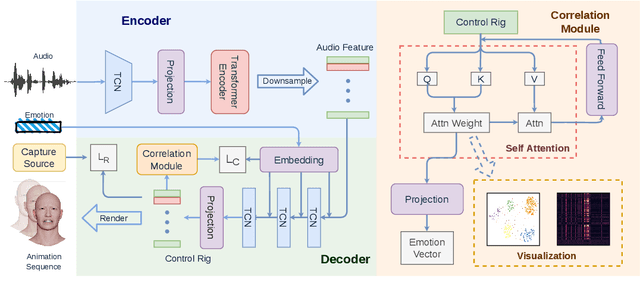
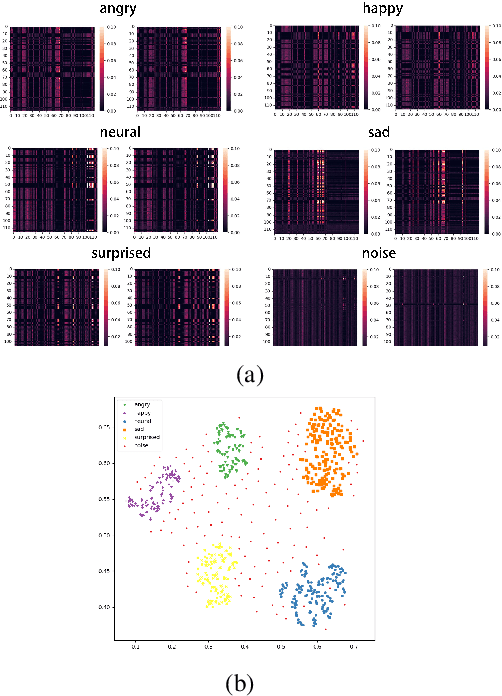
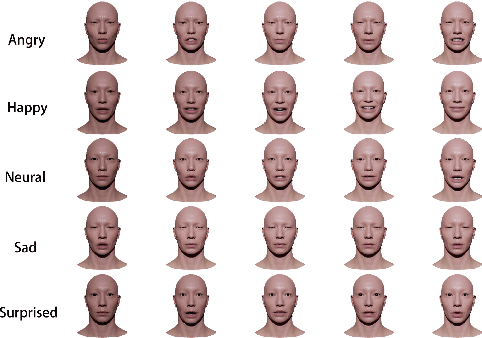
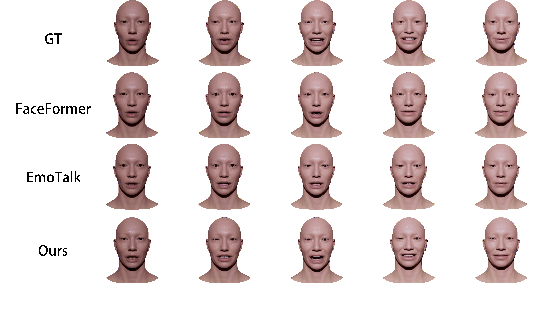
Speech-driven 3D facial animation technology has been developed for years, but its practical application still lacks expectations. The main challenges lie in data limitations, lip alignment, and the naturalness of facial expressions. Although lip alignment has seen many related studies, existing methods struggle to synthesize natural and realistic expressions, resulting in a mechanical and stiff appearance of facial animations. Even with some research extracting emotional features from speech, the randomness of facial movements limits the effective expression of emotions. To address this issue, this paper proposes a method called CSTalk (Correlation Supervised) that models the correlations among different regions of facial movements and supervises the training of the generative model to generate realistic expressions that conform to human facial motion patterns. To generate more intricate animations, we employ a rich set of control parameters based on the metahuman character model and capture a dataset for five different emotions. We train a generative network using an autoencoder structure and input an emotion embedding vector to achieve the generation of user-control expressions. Experimental results demonstrate that our method outperforms existing state-of-the-art methods.