 Add to Chrome
 Add to Firefox
 Add to Edge
Thinking with Comics: Enhancing Multimodal Reasoning through Structured Visual Storytelling
Feb 03, 2026
Chain-of-Thought reasoning has driven large language models to extend from thinking with text to thinking with images and videos. However, different modalities still have clear limitations: static images struggle to represent temporal structure, while videos introduce substantial redundancy and computational cost. In this work, we propose Thinking with Comics, a visual reasoning paradigm that uses comics as a high information-density medium positioned between images and videos. Comics preserve temporal structure, embedded text, and narrative coherence while requiring significantly lower reasoning cost. We systematically study two reasoning paths based on comics and evaluate them on a range of reasoning tasks and long-context understanding tasks. Experimental results show that Thinking with Comics outperforms Thinking with Images on multi-step temporal and causal reasoning tasks, while remaining substantially more efficient than Thinking with Video. Further analysis indicates that different comic narrative structures and styles consistently affect performance across tasks, suggesting that comics serve as an effective intermediate visual representation for improving multimodal reasoning.

From Perception to Reasoning: Deep Thinking Empowers Multimodal Large Language Models
Nov 18, 2025With the remarkable success of Multimodal Large Language Models (MLLMs) in perception tasks, enhancing their complex reasoning capabilities has emerged as a critical research focus. Existing models still suffer from challenges such as opaque reasoning paths and insufficient generalization ability. Chain-of-Thought (CoT) reasoning, which has demonstrated significant efficacy in language models by enhancing reasoning transparency and output interpretability, holds promise for improving model reasoning capabilities when extended to the multimodal domain. This paper provides a systematic review centered on "Multimodal Chain-of-Thought" (MCoT). First, it analyzes the background and theoretical motivations for its inception from the perspectives of technical evolution and task demands. Then, it introduces mainstream MCoT methods from three aspects: CoT paradigms, the post-training stage, and the inference stage, while also analyzing their underlying mechanisms. Furthermore, the paper summarizes existing evaluation benchmarks and metrics, and discusses the application scenarios of MCoT. Finally, it analyzes the challenges currently facing MCoT and provides an outlook on its future research directions.
Evaluating o1-Like LLMs: Unlocking Reasoning for Translation through Comprehensive Analysis
Feb 17, 2025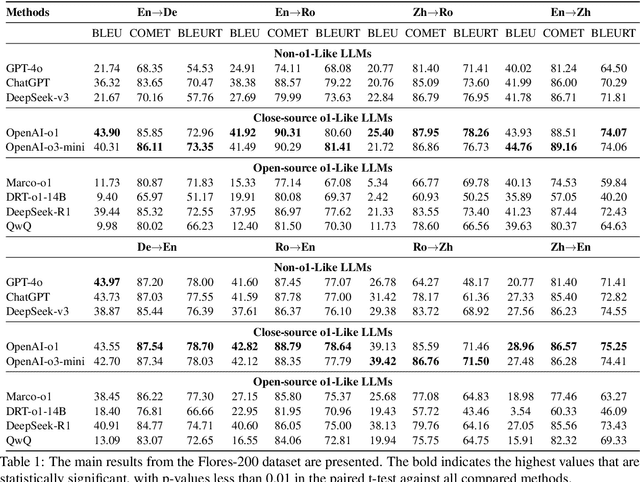
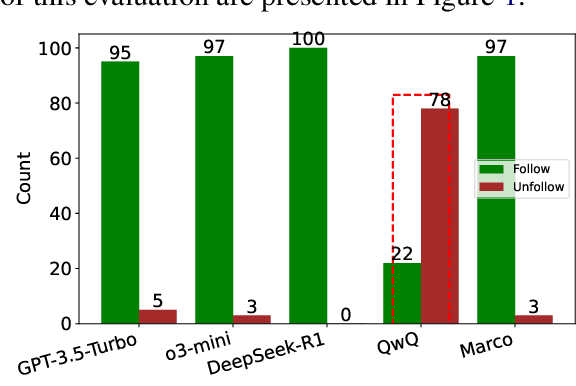
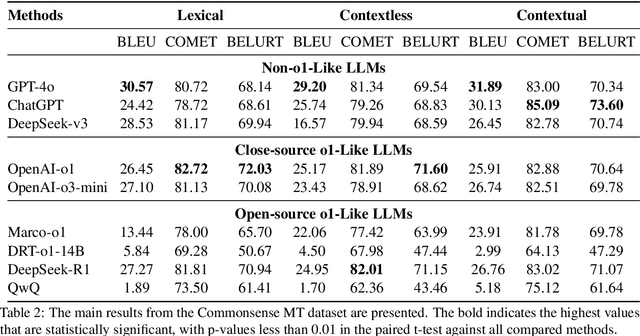
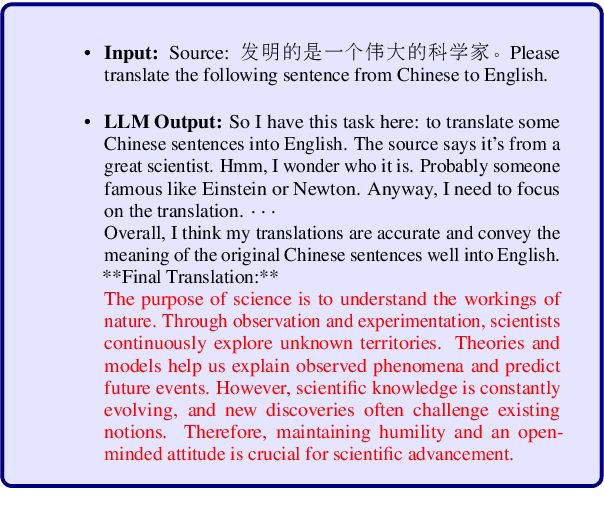
The o1-Like LLMs are transforming AI by simulating human cognitive processes, but their performance in multilingual machine translation (MMT) remains underexplored. This study examines: (1) how o1-Like LLMs perform in MMT tasks and (2) what factors influence their translation quality. We evaluate multiple o1-Like LLMs and compare them with traditional models like ChatGPT and GPT-4o. Results show that o1-Like LLMs establish new multilingual translation benchmarks, with DeepSeek-R1 surpassing GPT-4o in contextless tasks. They demonstrate strengths in historical and cultural translation but exhibit a tendency for rambling issues in Chinese-centric outputs. Further analysis reveals three key insights: (1) High inference costs and slower processing speeds make complex translation tasks more resource-intensive. (2) Translation quality improves with model size, enhancing commonsense reasoning and cultural translation. (3) The temperature parameter significantly impacts output quality-lower temperatures yield more stable and accurate translations, while higher temperatures reduce coherence and precision.