 Add to Chrome
 Add to Firefox
 Add to Edge
BrainStack: Neuro-MoE with Functionally Guided Expert Routing for EEG-Based Language Decoding
Jan 29, 2026
Decoding linguistic information from electroencephalography (EEG) remains challenging due to the brain's distributed and nonlinear organization. We present BrainStack, a functionally guided neuro-mixture-of-experts (Neuro-MoE) framework that models the brain's modular functional architecture through anatomically partitioned expert networks. Each functional region is represented by a specialized expert that learns localized neural dynamics, while a transformer-based global expert captures cross-regional dependencies. A learnable routing gate adaptively aggregates these heterogeneous experts, enabling context-dependent expert coordination and selective fusion. To promote coherent representation across the hierarchy, we introduce cross-regional distillation, where the global expert provides top-down regularization to the regional experts. We further release SilentSpeech-EEG (SS-EEG), a large-scale benchmark comprising over 120 hours of EEG recordings from 12 subjects performing 24 silent words, the largest dataset of its kind. Experiments demonstrate that BrainStack consistently outperforms state-of-the-art models, achieving superior accuracy and generalization across subjects. Our results establish BrainStack as a functionally modular, neuro-inspired MoE paradigm that unifies neuroscientific priors with adaptive expert routing, paving the way for scalable and interpretable brain-language decoding.

Contrastive Masked Autoencoders for Character-Level Open-Set Writer Identification
Jan 21, 2025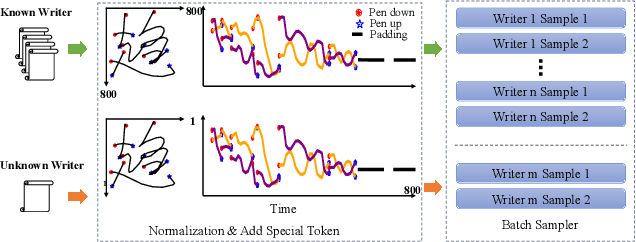
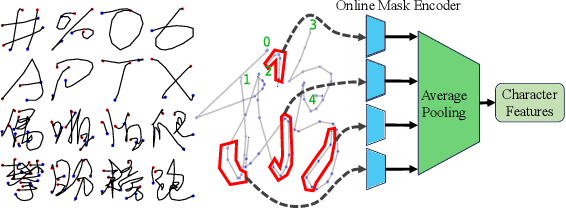
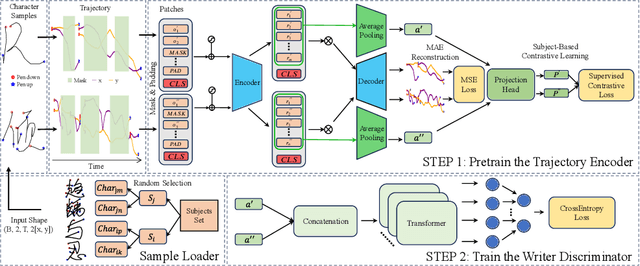
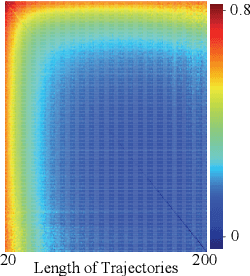
In the realm of digital forensics and document authentication, writer identification plays a crucial role in determining the authors of documents based on handwriting styles. The primary challenge in writer-id is the "open-set scenario", where the goal is accurately recognizing writers unseen during the model training. To overcome this challenge, representation learning is the key. This method can capture unique handwriting features, enabling it to recognize styles not previously encountered during training. Building on this concept, this paper introduces the Contrastive Masked Auto-Encoders (CMAE) for Character-level Open-Set Writer Identification. We merge Masked Auto-Encoders (MAE) with Contrastive Learning (CL) to simultaneously and respectively capture sequential information and distinguish diverse handwriting styles. Demonstrating its effectiveness, our model achieves state-of-the-art (SOTA) results on the CASIA online handwriting dataset, reaching an impressive precision rate of 89.7%. Our study advances universal writer-id with a sophisticated representation learning approach, contributing substantially to the ever-evolving landscape of digital handwriting analysis, and catering to the demands of an increasingly interconnected world.
Contrastive learning-based agent modeling for deep reinforcement learning
Dec 30, 2023

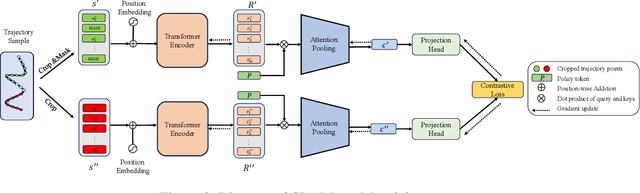
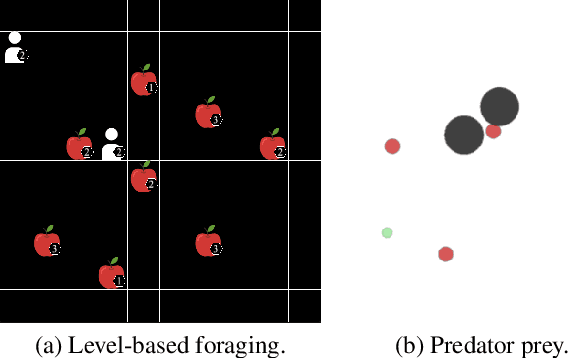
Multi-agent systems often require agents to collaborate with or compete against other agents with diverse goals, behaviors, or strategies. Agent modeling is essential when designing adaptive policies for intelligent machine agents in multiagent systems, as this is the means by which the ego agent understands other agents' behavior and extracts their meaningful policy representations. These representations can be used to enhance the ego agent's adaptive policy which is trained by reinforcement learning. However, existing agent modeling approaches typically assume the availability of local observations from other agents (modeled agents) during training or a long observation trajectory for policy adaption. To remove these constrictive assumptions and improve agent modeling performance, we devised a Contrastive Learning-based Agent Modeling (CLAM) method that relies only on the local observations from the ego agent during training and execution. With these observations, CLAM is capable of generating consistent high-quality policy representations in real-time right from the beginning of each episode. We evaluated the efficacy of our approach in both cooperative and competitive multi-agent environments. Our experiments demonstrate that our approach achieves state-of-the-art on both cooperative and competitive tasks, highlighting the potential of contrastive learning-based agent modeling for enhancing reinforcement learning.